Categories
Books

Unnatural

Unnatural by Michael Griffo. 352 pages, Kensington.

This is a Young Adult (“YA”) novel. Not a genre I usually traffic in, unless it crosses over into strong science fiction or horror.

So why did I read it? And why write this review of it? Well, you see, the last time I tried a true YA novel, I attempted to read Twilight. I made it until about page 90 or so, and just gave up. I couldn’t stand it. However, I’ve seen the movies of both Twilight and New Moon, so I know the story. And this book here, Unnatural? Basically… it’s Gay Twilight. Or, Twilight for gay teens, if you prefer.

On that premise, I had to at least give it a try.

When I was a teenager, there wasn’t Gay Anything as far as books went. I didn’t come across any positive portrayal of gay person at all until I was in college. I’m aware that times have changed quite a bit now, and I see and hear about kids coming out of the closet while they’re still in high school. Heck, it seems like a lot of teens today are never even in the closet to begin with. I was curious to see what a book like this might be like.

Like Twilight, this is a story of a mortal who falls in love with a vampire, a love that turns out to be so strong it breaks through the barrier that separates mortal humans from immortal vampires. Like Twilight, there’s a pretty deep and clever mythology around the particular vampires (and other supernatural creatures) that populate the novel. And like Twilight, there are good and evil factions warring against each other, with our love crossed teens at the center.

But unlike Twilight, this is pretty darn good read. Unnatural moves along at a brisk pace, the character’s motivations are pretty clear and understandable, and there is no bizarre superimposition of pious morality overlaying the whole thing. And also unlike Twilight, it’s a lot of fun, and pretty sexy to boot. Well, as sexy as the author can get away with and still keep the book firmly in the YA camp, that is.

As the novel begins, Michael Howard is a sixteen-year-old high school student living in Weeping Waters, Nebraska. Tall and blond with striking green eyes, Michael is an excellent student who dreams only of getting out of Weeping Waters and moving on to somewhere else, the sooner the better.

Michael lives in a small farm house with his mother and his grandparents. When Michael was three years old, his parents divorced. His mother moved in with her parents, and they’ve been there ever since. Michael has never met his father; all he knows is that his father is British and lives in London. His mother never speaks of him.

Michael is tormented and bullied at school, and treated with disdain by his own grandfather. Even though Michael has never come right out and said it, everyone pretty much knows he’s gay, and he suffers endlessly because of it. And his mother is no help, lost as she is in alcohol and pills.

Then one night, Micheal’s mother commits suicide. And within a few hours, his life changes. The father he’s never met arrives for his mother’s funeral, and announces he’s going to take him back to England and enroll him in a prestigious private school, Archangel Academy. Saddened as he is by his mother’s death, Michael is thrilled to finally leave Nebraska and start a new life.

Archangel Academy is everything Michael hopes it would be – and more. Because on his first day there, he meets Ronan Glynn-Rowley, a handsome, muscular, dark-haired boy the same age as Michael. And, it’s love at first sight for both of them.

Ronan, of course, is not what he seems. Although he really is only sixteen years old, he is a vampire, a special hybrid who only needs to drink blood once a month and can walk around during daylight without problems. In fact, other than being immortal and possessing supernatural strength and speed, Ronan is otherwise strikingly human, right down to his piercing blue eyes.

Archangel Academy, as it turns out, is quite the hotbed of supernatural activity, and Ronan is not the only vampire (or even the only kind of vampire) that walks these grounds. Even among the close group of Michael and Ronan’s friends, there are some who are not what they appear to be. As Ronan makes plans to bring Michael permanently into his life, so that they can life together forever, others try to do everything they can to pull them apart.

That’s enough of a summary to give the flavor. There are lots of supporting characters that help to build the world of the book. Two of my favorites are Ronan’s mother Edwige, and Ronan’s brother Ciaran. Ciaran is a human who desperately wants to become a vampire, and Edwige is both a Machiavellian bitch and a lovingly devoted mother at the same time.

This is clearly the first book in a series; in fact, the novel ends with the prologue and Chapter 1 of the next book. I suspect I’ll be reading the others as well. Because… well…

OK, so this isn’t Great Literature. I personally think it’s much better written than Twilight, and that the characters are a lot more fun. But this is not Anne Rice or Stephen King or Philip Pullman . Unnatural is rather derivative, pulling elements from Harry Potter, the Twilight series, and every other popular supernatural fiction of the last 10 years. The two lead characters are almost too perfect for each other. And everything does fall into place a little too neatly at the end.

But, you see… it’s like this. I felt this book in my heart. I was a gay teenager myself. And when I was in high school, there just weren’t any books like this around. I had no stories to read about romantic love between two handsome young men who were destined for each other. I love the fact that here’s a fun, enjoyable, entertaining Young Adult novel where not only are the two lead characters gay… but they are celebrated and heroic. They are admirable.

If the teenaged me had been able to read this book, I can tell you with absolute certainty that I would have read it several times. I would have fantasized about being Michael or Ronan. I would have imagined myself falling in love with a handsome man and living happily ever after. Maybe, just maybe, if I’d been able to read a book like Unnatural when I was in the age group it’s written for, I would have become comfortable with who and what I am a lot earlier in life.

And so, while I was reading and enjoying Unnatural, I was also hoping that somewhere, some shy gay kid is reading it as well. And it’s allowing him to fantasize about a future. And it’s showing him a way out and a way up. Because that’s why I love reading. It’s not always about the highest quality prose or the most fascinating plot or startling characters or exciting twist endings. Instead, what’s most important is enjoying a good story with people you like, one that maybe gives you some new insight you didn’t have before.

And at that level, Unnatural succeeds very well. Go get yourself a copy and walk along the fogbound paths of Archangel Academy.
Categories
Books

Swamplandia!

Swamplandia! by Karen Russell (2011). 336 pages, Knopf.

Not surprisingly, I read a lot of book reviews. I subscribe to the New York Times Book Review, as well as listen to their podcast once a week (go Sam Tanenhaus!). I read a lot of book and publishing blogs as well, such as TeleRead. And I pick up lots of recommendations from various Kindle forums and blog posts as well.

Swamplandia! has been showing up with glowing recommendations on almost every one of these places. In addition, since the novel is set in South Florida, and since the author Karen Russell is from Miami, it’s gotten a lot of local attention as well. Usually I don’t get around to actually reading recommendations like this until months after the book has come up… but something about the reviews for Swamplandia! made me decide to put it at the top of my list. And, since the Kindle edition was priced at the magic $9.99 point, I started into it right away.

This is a wonderful, engrossing book. All of those other glowing reviews are right on the money. Enjoyable, unusual plot in a unique and unusual setting. Characters that are entertaining as well as realistic. And Russell’s prose is fantastic – evocative and thrilling, tender and wistful, humorous and encouraging – and even deeply disturbing when called for.

Swamplandia! (yes, it’s always with an exclamation mark) is the story of an odd family, the Bigtree Alligator Wrestling Tribe. The Bigtrees are as white as I am, and moved down to Florida decades ago when they got sold, literally, 100 acres of swamp land. Rather than cursing the real estate agent who swindled them and then returning home, they stayed. And over the years, turned their one of the Ten Thousand Islands of the Everglades into a local tourist attraction, thanks to a ferry that made a mandatory stop on their island.

Somewhere back in the forties, Grandpa changed the family surname to “Bigtree”, and decided they were a tribe. And that became part of the family legend. Swamplandia! is like a lot of Florida roadside attractions, featuring alligator wrestling, a few other sad animal acts, and a lot of exaggeration. The Bigtrees run the park purely as a family business, with all the children doing their part.

The current generation consisted of Sam “Chief” Bigtree, wife Hilola, and their three children: oldest son Kiwi (17), daughter Osceola (16) and youngest daughter Ava (13). Both Ava and Kiwi have taken up the family calling of alligator wrestling, Ava with enthusiasm and Kiwi with reluctance. Osceola, a more moody child, contents herself with running the gift shop and giving tours.

The star attraction is their mother Hilola, whose act consists of diving from a platform into a pool filled with alligators, and then swimming between them to safety as the crowd cheers. In fact, Hilola Bigtree’s “Diving with the Gators” is really the only thing that distinguishes Swamplandia! from any of the other hundreds of cheesy tourist traps in Florida.

But as the novel opens, Hilola has just died of cancer, leaving the Chief and the three children without guidance – and the park without its star attraction. Young Ava hopes to make up for her mother’s absence, but it’s a tough row to hoe.

That’s the setup. The novel alternates between the first-person narration of Ava in the swamps, and the third-person narrative of Kiwi on the mainland. Kiwi strikes out to try to make some money for the now-broke family, and ends up as a janitor at an amusement park that simulates hell (the patrons are “Lost Souls”, for example). Chief Bigtree heads back to the mainland to call upon his “investors”, leaving Ava and Osceola alone on Swamplandia!

But Osceola has become entranced with an occult book, and becomes convinced not only that she can commune with the spirits – but that she has fallen in love with one. When she vanishes, leaving a note that she has decided to elope with one of her ghosts to travel to “The Underworld”, Ava is determined to go after her.

The only adult Ava can call upon is the odd Bird Man, a local gypsy-type who wears a coat of feathers, and makes his living scaring birds off of people’s property. And so, while her brother works in an amusement park version of hell, Ava sets off with the Bird Man in a tiny skiff to try to find the real thing.

Ava’s journey with the Bird Man is the heart of the novel, and is both enthralling and creepy at the same time. Because, as it turns out, the Bird Man’s motives for wanted to help find Osceola are not at all the same as Ava’s, and in a disturbing and uncomfortable scene, he turns out not to be who (or what) Ava thought he was. When Ava suddenly realizes she’s been duped, it’s a crushing moment that almost took my breath away. While reading the next scene, I was muttering “no… no… no…” under my breath. That’s some powerful prose right there, folks.

Kiwi’s journey through the World of Darkness parallels Ava’s journey through the swamp. While Ava learns about the underbelly of the Everglades, Kiwi discovers just how sheltered their upbringing was. And, when he discovers just what his father’s “investment” activities consist of, it changes his life almost as much as Ava’s journey changes hers.

The second half of this book, once everything is set up and rolling, is a nonstop read. I couldn’t put the Kindle down, and had to stay up until 2:30 in the morning to finish it.

The book ends cleanly and properly – although with not much in the way of denouement. We are led to believe that Ava and Osceola, at least, end up in high school on the mainland. It’s hinted that the three siblings are still in friendly contact in their adulthood. But, we don’t know what actually happened to any of the characters. Did Kiwi become a pilot? Did Ava ever return to alligator wrestling in any form? And I can’t begin to imagine what path Osceola would take later in life.

I know that Russell has written some short stories with these characters in the past; perhaps she’ll write some more with them in the future. I’d like to travel around Florida with these characters some more. Regardless, I eagerly await her next creation.

But you don’t have to wait. Go get yourself a copy of Swamplandia! and devour it.

Categories
Books

The Millenium Trilogy

The Girl With The Dragon Tattoo by Stieg Larsson (2008). 600 pages, Vintage Crime / Black Lizard.

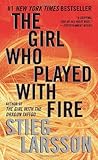
The Girl Who Played With Fire by Stieg Larsson (2009). 630 pages, Vintage.

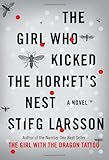
The Girl Who Kicked The Hornet’s Nest by Stieg Larsson (2010). 576 pages, Knopf.

OK, so I finally understand what all the fuss is about. I know who Lisbeth Salander is. I understand why Daniel Craig was cast as Mikael Blomkvist. I see why these three novels have been on the bestseller list for… well, forever now. I get why there’s an obsession as to what may or may not be sitting on Stieg Larsson’s hard drive after his death, and why his family is fighting over the rights to publish his final novel – which might not even exist. I understand why friends of mine have read all three books back-to-back in one obsessive weekend.

In short, these books actually are as gripping and involving as everyone has been telling me they are. I admit it.

Collectively, these three books are known as “The Millennium Trilogy” (even though I keep thinking of them as “The Girl Who” books). The name comes from the fictional magazine “Millennium” that the main character (as well as several other characters in the book) works for. “Millennium”, the magazine, is a hard-hitting, expose magazine that practices real, true journalism – the investigative kind. Nothing like “Millennium” exists in the United States that I know of, although every now and then Rolling Stone, Vanity Fair, The Atlantic, or The New Yorker might publish articles of the type described in the book.

So what are the plots? Well, all three books are taught mystery-thrillers, so I’m not going to spoil anybody’s fun by giving away too much. Briefly:

The Girl With the Dragon Tattoo is the first of the three books. Mikeal Blomkvist, a co-founder and reporter for Millennium magazine in Stockholm, Sweden, has just been convicted of libel. He wrote and published a scathing article taking down a corrupt businessman, but his sources didn’t come through, and he was not able to prove his case. (off to the side comment: I do wish there was an addendum to this book that explained a bit about the Swedish legal system, because what Mikeal is convicted of not only would not be a crime of any sort in the United States, it wouldn’t even make it as a civil lawsuit). Mikael is sentenced to 90 days in jail, and takes a leave of absence from his position at Millennium.

At the same time, we follow the life and exploits of 23-year-old Lisbeth Salander, a researcher and computer hacker of considerable skills. Unfortunately for her – and a secret to almost everyone she knows – Lisbeth is a ward of the state, having been declared mentally incompetent when she was 12 years old. The details of why are very murky, yet highly suspicious. As such, she has an assigned “guardian” who controls her money and citizenship status. Even more unfortunately for Salander, her current guardian is a sadistic rapist who uses his position of power to control her in the worst way. She plots revenge…

These two characters and storylines intersect when Mikeal accepts an offer from an eccentric millionaire to solve the case of his neice’s murder – a murder which occured 40 years ago, a murder where no body was ever found. Through a series of interesting-yet-unlikely twists (as with any thriller), Mikeal ends up hiring Lisbeth as his research partner in solving the murder. But of course, it’s not as simple as that, and together they uncover a deadly conspiracy that has links to both of them…

The Girl Who Played With Fire starts a year after the end of the previous book. Mikeal’s reputation and position at Millennium have been restored after the events of the previous book. Right now, he’s working with an up-and-coming new writer on an article that will expose the sex-slave trade in Sweden. He’s got ironclad sources, and has identified police officers and government officials who not only had their hands in the till – they were also making use of underage and abused prostitutes. But weeks before the article goes to press, someone murders both the article’s writer and the writer’s wife. And the main suspect is… Lisbeth Salander.

Because, as we follow in a simultaneous storyline, Lisbeth’s guardian has decided to seek revenge for the come-uppence he received from her during the first book. And in doing so, he’s called in favors from some very, very unscrupulous types. One thing leads to another, and as it turns out, those same unscrupulous types have their own very good reasons from wanting Lisbeth Salander either dead or locked away forever in a mental institution.

So, while Mikeal attempts to solve the murder of his friends – knowing full well Lisbeth could not have committed the crime – Lisbeth must hunt down the people who want her dead, even while she herself is being hunted by the police for murder. As the novel ends, Lisbeth is seriously wounded, and one mystery has morphed into another, much bigger one.

The Girl Who Kicked The Hornet’s Nest picks up immediately where the previous book left off, literally an hour or so later. Lisbeth is in the hospital, recovering from near-fatal wounds. The man who tried to kill her, who is also seriously wounded, lies just a few doors down in the same hospital. And some shadowy figures who were behind the scenes in the previous book move into the foreground here. Because they want both Lisbeth and her failed killer dead.

Meanwhile, Mikeal, having rescued Lisbeth at the end of the previous book, works tirelessly on her upcoming trial. He brings in his own sister – a lawyer who specializes in women’s rights – to represent his friend in court. But the conspiracy that Mikeal and Lisbeth are unravelling reaches deep into the walls of Sweden’s security police (their equivalent of the CIA), and there are people there who will stop at nothing to make sure the case never gets solved.

The first book can be read as a standalone thriller. But I warn you – the second and third have to be read together, as they are pretty much Volume 1 and Volume 2 of a single, continuous story. I can’t imagine how annoying it must have been for folks who read The Girl Who Played With Fire and then had to wait a year for the third book to come out. Luckily, if you haven’t read any of these books yet, you won’t have that problem. Just be sure to get the 2nd and 3rd one at the same time!

Kindle notes: All three books are formatted well, and don’t have any noticeable typos or layout errors. The second book, The Girl Who Played With Fire, is the only one of the three that does not have a linked table of contents, a strange omission since the other two have quite nice ones.

I was impressed with several characters and concepts in these books, aside from the complex conspiracies and thrilling mysteries. One example is the details of crimes and policing in another country. For example, the entire concept of “guardianship” that causes so much trouble for Lisbeth in all three books? As far as I know, we don’t have anything even remotely like that in our country. In fact, I’ve never even heard of such a thing, and I wonder how in the world it got started in Sweden.

Another is the sensible attitude towards extra-marital affairs, and sex in general. In all three books, Mikeal conducts an ongoing affair with the editor of his magazine. What’s unusual is that this goes on with the knowledge and understanding of the woman’s husband! Years ago, the couple reached an understanding, and every now and then she goes off and spends the night with Mikel. Her husbands tells her to have a good time, and he’ll see her tomorrow. They have a happy, long-lasting marriage, and the other two have a happy, long-lasting affair. It struck me as the most sensible approach I’ve ever encountered to this situation. Sometimes people really do fall in love with more than one person, and just accepting it as such makes it so much easier on everyone involved. Europeans are so much more sensible about sex matters than us puritanical Americans…

And lastly, I’m impressed with the devotion to the craft of investigative journalism as practiced at Millennium magazine. Of all the fictional things described in the book, this is the one I most wish was real. Every single reporter at Millennium really, truly believes in truthful, unbiased reporting of hard, cold facts. They will not cozy up to anyone in power, and consider it their sacred duty to expose any and all failings they encounter. They protect their sources even upon threat of death, and never give up, no matter what. If such a magazine actually existed in the real world – if such reporters and journalists actually existed in the real world – then the world itself would be a better place by far.

So if you’re looking for exciting, globe-spanning, tightly plotted, suspenseful, and thrilling mysteries with a large dose of spies and international conspiracies thrown in for good measure, then I urge you to run out and get all three of these books.

Because you won’t be able to stop at just one.

Categories
Books

The Passion of the Ripper

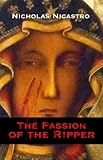
The Passion of the Ripper by Nicholas Nicastro (2010). 196 pages, CreateSpace/Kinder Shore Books.

I went through a period of my life when I was fascinated with the Jack the Ripper murders of the 1880s. In my early teens, I got hooked on Sherlock Holmes. I read all 4 novels and 52 short stories by Arthur Conan Doyle, then read them again, and then read a few of the various pastiche novels that were coming out in the mid-70’s. And because the Ripper murders occurred at about the same time Sherlock Holmes was practicing in London, I became interested in them as well.

To me, Jack the Ripper was the anti-Holmes. He was real, while Holmes was fictional. The Ripper was evil, while Holmes was good. The Ripper murders were never solved. Holmes, on the other hand, was never without a solution.

And I can’t deny that being a teenage boy who loved monsters and horror movies, the tale of a creepy killer prowling the fog-bound streets of London, slicing prostitutes to pieces and then sneaking away in the night, was like candy. I read my share of Ripper books – all non-fiction – during that time as well. A few of them are even still on my shelves, like The Complete Jack the Ripper by Donald Rumbelow – which includes lots of photos taken at the time, including a very disturbing full-body shot of Mary Kelly, the last and most completely dismembered Ripper victim.

Jack the Ripper seems not to have made that much of an impact in fiction, however. Maybe because the actual murders were so grisly… maybe because the case was never firmly or officially solved… I don’t know. There was, famously, Alfred Hitchcock‘s The Lodger, a creepy take on the Ripper case. And although kind of off course, I have a special fondness for Time After Time, the 1979 Nicholas Meyer film where Jack the Ripper steals H.G. Well’s Time Machine and travels forward to 1979… where, he discovers, he fits right in.

But here’s a new novel that delivers a great new take on Jack the Ripper, Nicholas Nicastro’s The Passion of the Ripper. Right from the very first page, I knew it was going to be good. Here’s the opening paragraph, which to me perfectly sets the tone and scene: London. 1888. The Whitechapel district…

The guts of London are laid out as if on a surgeon’s table. The narrow streets surge with pedestrians, tramps, carters and children flitting on mud-flecked lets – denizens of the great coal-gray smudgery piss-pot. Slip down through the smog, over hovels with garbage strewn across tar-papered roofs, down to the locals at their windows. Marionette arms test stiff laundry wings. The sound wafts up, the snap of umber linen on the wet, but no on rises above the cornices.

The first part of the book – approximately 3/4 of the total – covers the Ripper murders. And the murderer himself. Because this is no whodunnit. We know, quite early on, exactly who the Ripper is. The twist here, however, is that we get inside the Ripper’s head. We visit his past, his upbringing, his family, his training… what led him to become the heartless murderer that reaches out across history? For this is a take on the Ripper that speaks to the Hannibal Lector generation, those of us fascinated with profiling our serial killers. The Passion of the Ripper is a psychological take on Jack the Ripper, one that is unlike any I’ve encountered before.

And although I’m certainly no Ripperologist – merely someone who’s familiar with the murders and the setting – this novel reads and feels as if everything is rooted in fact. All the details are correct. The chronology is spot-on. The victims are rendered true to life. Even the Ripper here is based on an actual real-life suspect, a man whom the investigating officer became convinced years later was, in fact, the actual murderer.

The character of the Ripper here is so good, that I found myself getting a bit bored with the prattlings of Mary Kelley, and wishing we’d get back to the Ripper. Perhaps that’s why I felt the strongest part of the book is the last part – Part 2, the final quarter or so of the book.

In Part 2, we see what became of the Ripper in the years after the murders. And, in a great showcase of thriller writing, a satisfying ending is delivered. One that leaves the reader nodding and smiling, secure that justice was served in the end. An ending that, as it turns out, threads the needle between fact and fiction almost perfectly.

Maybe Jack the Ripper got his just reward after all? By the end of The Passion of the Ripper, you might think so.

This is a short but powerful novel, a perfect read for a few hours during this hot summer. I highly recommend it.

And if you have a Kindle, it’s a marvelous bargain at just $4.99. The Kindle version is well-formatted, with bold text done correctly throughout, and both a forward and afterward by the author. It lacks an active table of contents – but I suspect from the structure of the book itself that the printed version might not have one either.

Finally, I should point out that in all fairness, I’m acquainted with the author. However, as Nick well knows, if I don’t like something that one of my friends has created, I usually just keep my mouth shut about it. That is definitely not the case here. I’ll be recommending The Passion of the Ripper to anyone who’s looking for a great book to read – because that is exactly what this is.

And since Nick is a friend, I have to end this by saying that if you do end up reading and enjoying this book, you should definitely check out his other historical novels, which you can find at his website NicastroBooks  (http://www.nicastrobooks.com/novels.htm).

It’s a hot summer out there, folks. You can help save the planet and your sanity by reading as much as possible during it.

Categories
Books

2666: A Novel

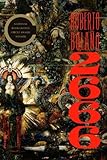
2666 by Roberto Bolaño (2004) (translated from the spanish by Natasha Wimmer, 2008). 898 pages, Farrar, Straus and Giroux.

The first thing I’ll say is… it took me a very long time to get through this book. Usually I read one or two books a week, depending on the length. A 900 pager like this one, usually a solid week, unless I have a lot of free time, which I never have these days. If it’s a very dense nonfiction or biography work, maybe two weeks. But it took me three months of on-and-off attention to get through 2666.

Normally, if I don’t get into a book, I’ll just put it aside and move on. Even if it’s an author I really enjoy. A good example is Quicksilver by Neal Stephenson. Stephenson is one of my all-time favorite authors. I thought I’d love Quicksilver, an historical novel revolving around the Royal Society of London in Isaac Newton’s time. Especially since it had a structural tie to Cryptonomicon, an excellent earlier work by Stephenson.

Yet… I just couldn’t get into it. I got to about page 500, and I just lost interest. Haven’t picked it up since, and doubt I ever will.

2666 was not like that. I’d read it for a day, put it aside for several weeks, and then get curious again and pick it back up. Slogging through the interminable Part Four, I almost gave up… but the prose was so strong, and I kept getting hints that it would all add up to something… so I kept going.

And now I have finally finished it. Looking back, I realize now that I read the first three parts of the book in about two weeks. Then Part Four took me two and half months. And the final Part Five I read over just the past week.

My main reason for reading 2666 is that it received awards out the ying yang (that’s a technical, literary term, I’m told). It topped the National Book Critics Circle in 2008. Time Magazine gave it Best Book of 2008. It’s been lauded by readers all over the world. And, just to add some icing to the cake, it was the final book by author Roberto Bolaño before his death. He apparently handed over the manuscript to his publisher while he lay dying in the hospital.

According to the introduction, Bolaño had intended the five parts of 2666 to be published as five separate novels, each a year apart. But after his death, his heirs decided to publish all five parts as one massive work, which they believed was more fitting to the manuscript.

So, I bought 2666 and dove in. The first thing I’ll say is that I sure wish there was a Kindle version of this! 900 pages in hardcover is very heavy. Weighs almost four pounds. Not an easy book to read in bed, that’s for sure. Just picking it up, I immediately understood why the author had intended it as five separate books.

Ok, all well and good. But what’s the story about? Well… it’s kind of hard to say. If judged by the amount of words and pages dedicated to plot, then it’s the story of a series of murders in the Mexican border town of Santa Teresa (a thinly-veiled fictional version of Ciudad Juárez, near the Arizona border). Hundreds of young women are brutally raped and murdered there, in a decade-long series of unsolved crimes. Every part of the book briefly touches upon this storyline, and three of the book’s five parts are set almost completely in Santa Teresa.

We follow a local University professor, as he moves in his own world, nearly oblivious to what is going on around him – included the danger than his teenage daughter puts herself in on a nightly basis (Part Two: The Part About Amalfitano). Why does the distracted instructor hang an out-of-print geometry book outside to sway on a clothesline, refusing to take it down for months?

We follow an African-American reporter, send to Santa Teresa to cover a boxing match, as he gets drawn into the circle of that city’s underworld, and to people who may (or may not) share responsibility for many of the murders (Part Three: The Part About Fate).

And, for nearly three hundred pages, we follow the discovery of every single body over nearly ten years. In an episodic, non-narrative form, one after the other, date by date. Some of the victims are identified. Many aren’t. Several people are arrested for some of the murders, including an odd German man who’s a naturalized American citizen – but living in exile in Mexico (Part Four: The Part About The Crimes).

But if judged by what is at the heart of the book, what (at least to me) the real story is, then it’s about a German novelist named Benno von Archimbaldi. In the opening pages, we meet four European academic literary critics, all of whom specialize in studying and critiquing the works of Archimbaldi, and each of them from a different country (Part One: The Part About The Critics).

And in the climatic last section, the book concludes with the life story of Archimbaldi, and we loop around to where we began (Part Five: The Part About Archimbaldi). The story of Archimbaldi and the people who study him is what got me hooked, and what kept me reading through the rest of the book.

It was Part Four that nearly lost me. This is the most difficult part of the book, mainly because there is no plot thread for this entire section. It really is just a narrated crime docket. A body is found, its condition is described, and various connections are followed up. We meet the many different police officers and detectives trying to solve the crimes. We meet many of the criminals. We follow one of the possible murderers into prison, and bear witness to an incredibly brutal torture-murder session as justice is served by prisoners on their own behind bars.

The only thing that kept me going was that I could see the table of contents promised that we’d finally get back to Archimbaldi after this horrific tour of Santa Teresa was over. I wish I could say that at the book’s end, it all ties together – but not really. Yes, it’s not surprising to find out there is a connection between Archimbaldi and the angry young German man who’s the prime suspect in the murders – but I’m going to warn you right now that this is not the kind of book that ties things up.

By the end of the book, you do not know who’s responsible for the murders. You don’t know if the mysterious German man with the connection to Archimbaldi had anything to do with the murders or not. You will not get a conclusion to Archimbaldi’s story. Nor will you ever see or hear from any of the critics again after Part One. Nor will you find out what happens to Fate or Amalfitano or any of the other characters. Part Five loops back to Part One, and I suppose you could just go right back to Part One and keep on reading the book forever if you wanted to. You still won’t get any answers.

As a novel, 2666 is pretty unsatisfying. It’s not a true novel, ignoring most storytelling conventions. Characters weave in and out, speaking and thinking in long, unbroken pseudo-paragraphs that go on for pages and pages. A lead character may stop in to rent a typewriter… and for the next ten pages, we jump into the point of the view of the storeowner, and hear his life story. He never appears again, and has no bearing on any part of the story. And we don’t even get to the end of the scene that brought us there in the first place!

There are a great number of dreams in 2666. Everyone is always waking up and recounting a dream that is vivid and surrealistic… and yet not a single one, to my mind anyway, had anything to do with what was going on either in that character’s life or anyone else’s in the book. Another running theme is insanity – particularly any variety of insanity that involves making some sort of sacrifice for the sake of art.

So. Why read 2666 at all? Because what this book adds up to, when all is said and done, is a testament to the craft of writing. It’s the prose that kept me turning the page. Despite the fact that this book is translated from the author’s original Spanish, the words are beautifully crafted, even (and maybe even especially) when used to describe brutal or violent deaths.

I would not have awarded it such high honors as those listed up at the beginning of this review. To my mind, the novel as an art form and as entertainment has certain expectations, certain loose rules, and 2666 is simply too unstructured and rambling to fit even those loose rules. It’s a collection of hundreds of incredibly well-written scenes, but just putting a bunch of scenes between two covers does not make something a novel. To me, that is the true art and craft of the novel: combining fantastic prose with well-conceived characters who act within a compelling story.

In the end, I can’t overtly recommend 2666. It’s a dense work. I suppose if you really truly enjoyed Ulysses or Gravity’s Rainbow, this will be right up your alley. For me, it was an interesting glimpse into another writer’s mind, and I’m glad I made the trip – even if it was a trip which I have no desire to repeat. Your mileage, however, may vary.

And by the way – I don’t have the slightest idea what the title means.

Categories
Books Technology

The Publishing War

Since I wrote my review of the Kindle DX in the previous post, quite a lot has happened in the little world of electronic books and publishing. Namely, one large publisher and one large retailer seem to have lost their collective minds and declared all-out war on each other. And in the process, they are dragging authors and readers down into the mud with them. There is quite a bit of anger on all sides, and so, as a (somewhat) neutral observers of the book world, I thought I’d chime in with my own summary and my own opinion.

Here’s how it went down. On Wednesday, January 27th, Apple announced their long-awaited new tablet computer: the iPad. The iPad is a 10-inch touch based computer, basically an iPod Touch scaled up to giant proportions. Part of the new feature set of this tablet, which should be available for purchase in two or three months from now, is an integrated book reading application and electronic book store, called iBook.

Unlike the Kindle, the nook, the Sony Reader and other true eReaders, the iPad is a standard LED-lit color LCD screen – the same type that your television and computer monitor use. For most of us who rely on an eReader, this technology doesn’t seem very well suited to reading… but we’ll just have to wait and see what the market decides. At $499, the iPad is a wonderful multimedia device – although an awfully expensive book reader.

Prior to announcing the iPad, Apple apparently negotiated some special deals with at least 5 of the “Big Six” publishers. Skipping over the accounting details, to the end user of an iPad, Apple’s deal means that new “hardcover” books will be $14.99 or $12.99 in electronic form from the iBook store. That sounds awfully expensive, considering that actual hardcovers cost just about exactly that same amount right now. And it sounds even more expensive compared to Amazon… which jumps through a lot of hoops, including selling a number of books at a loss, to keep prices at $9.99 per book and below.

A reporter from the Wall Street Journal, Walt Mossberg, asked Apple CEO Steve Jobs afterwards if this was going to be a problem. Jobs said no, because “the prices [for books] would be the same”. Initially, this was taken to mean that Apple would match Amazon’s $9.99 price. Within two days, however, it became clear that Jobs meant nothing of the sort. Instead, he had it on good authority that the publishers would in fact be forcing Amazon to raise their price to match Apple’s.

Let’s move forward to Friday, January 29th. Two days later. On that day (or perhaps the day before) the publisher Macmillan gave an ultimatum to Amazon: They had to immediately accept a new deal, under the exact same terms as their deal with Apple. And a key part of that deal meant that Macmillan, not Amazon, got to set the price of each and every book. You see, Macmillan felt that $9.99 was way too cheap for an electronic edition of a book, and wanted to make certain that Amazon could not sell at that price – not even if Amazon was willing to take a loss on the book. Amazon, being the largest retailer of books on the planet, did not take kindly to being told how to run their business, nor how they should set their prices. Macmillan said it was a “take it or leave it” deal.

So Amazon, as of that evening, pulled all Macmillan books from their web site. Both printed and electronic.

And the Internet went insane.

Authors published by Macmillan immediately put up articles and blog posts raking Amazon over the coals. Two prominent science fiction authors, John Scalzi (whose work I don’t care for) and Charles Stross (whose work I am a big fan of) were particularly vocal, claiming that Amazon is, more or less, pure evil, and certainly stupid. Almost every single author took the publisher’s side in this little war.

Readers, on the other hand, were furious at Macmillan and praised Amazon to the skies. They felt Macmillan was being extremely greedy, trying to force a retailer to bow to their will, and was engaging in a very obvious example of price collusion with their new partner Apple.

Anyone who’s ever read comments on any web site knows how quickly tempers can get out of hand. By Saturday, certain readers were vowing to permanently boycott certain authors. Some authors were vowing to never give Amazon any support ever. Some readers who vowing to never read any book published by Macmillan or any of its imprints. Very little in the way of reasonable arguments could be found in these comments, but you could find quite a lot in the way of four-letter words and over the top anger.

By Sunday, Amazon caved. They released a statement saying, in effect, that they were capitulating to Macmillan, and would have to raise the prices of any Macmillan imprint electronic book to whatever Macmillan wanted them to charge. And slowly, slowly, they began restoring Macmillan books to their online book store.

The war is not over, however, not by a long shot. During the next week, several other publishers immediately jumped and said they, too, wanted Amazon to agree to the same terms. The same terms they’d already agreed to with Apple, that is. The only exception was the largest of them all: Random House. Random House, in fact, stated that they wanted to let Amazon price however they wanted to, and planned to leave things the way they are. Notably, Random House is the one large publisher that did not sign on to supply e-books to the iPad. Also notably… the spokesperson for Random House used to work for Amazon.

As a fan of books, reading, and writing, I’ve read as much as I can stand to on this subject. The truth is… nobody comes out smelling rosy in this situation. Amazon definitely acted like a petulant child by cutting off all sales for Macmillan books; this act didn’t hurt Macmillan corporate a bit, while it hurt its authors and Amazon’s customers a great deal. And Macmillan was acting equally childish: they just got a new deal they liked, so they wanted to force their biggest retailer to accept the same terms.

The Supreme Court recently ruled that corporations have all the same rights in the constitution as actual people do. However, I think Amazon and Macmillan have demonstrated that corporations are, at best, children. And as such, they are not capable of making rational decisions and planning carefully for their future. They consider that sticking their tongues out at each, holding their breath until they turn blue, and taking all their toys and going home are all good business ideas. What a shame.

My personal view on all of this… well. I have always maintained that a purely electronic copy of anything is not worth as much as a physical copy. An album on a CD is worth more than an album downloaded from iTunes. A DVD of a movie is worth more than a copy of a movie purchased online. And a physical book is worth more than an electronic one.

Trying to price an e-book the same as a printed book is pure folly. It will never work, at least not in the long term. My gut tells me that an e-book should be about 25% less than whatever the current printed copy (either hardcover or paperback) price is. If you look on Amazon, most new hardcovers sell for between $15.00 and $12.00. So, frankly, $9.99 for an electronic version sounds exactly right. And, as a reader, that’s definitely my impulse buy limit. Any book that sounds halfway decent, as long as it’s under $10, I’ll probably give it a shot. Over $10? Well… I have to want to read it pretty bad.

I’m not saying I’ll never pay more than $9.99 for an e-book, but I will say that it will be rare. Right now, for instance, there are several books that I’d like to read on my Kindle (such as Kim Stanley Robinson’s new novel Galileo’s Dream), but they’re in Wish List Limbo at the moment, waiting for their price to drop below the $14 or $15 they’re at right now.

However, certain timely books, like political tell-alls, I can see ponying up $14.99 to read right away. Right now, instead of a higher price, many publishers are delaying the e-book version of these titles by several months, under the assumption that this will force people to run out and buy the hardcover. In fact, I’d like to read The Politician, Andrew Young’s account of John Edwards – but they publisher has delayed the e-book version until April. And that’s not the kind of book I’m willing to pay for a hardcover of. So, looks like I’ll be passing on it. You see? They just lost a sale by delaying the e-book. A sale they would have made if they’d just allowed the book to come out in electronic form, sold to Amazon for whatever they wanted to, and allowed Amazon to sell for whatever they want to.

in the long run, I don’t think this will work. As the years go buy, more and more people will read books in some electronic form versus a hardcopy form. I’ll predict that within 10 years, the split will be 50/50.And as more people read electronically, the price pressure will become even greater to lower the price as compared to the hardcopy version. When that happens, Macmillan and the other publishers who got suckered into Apple’s “agency pricing” model are going to wish they could go back to the old days.

Watch Random House laugh all the way to the bank in a few years.

Categories
Books Technology

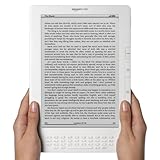
Kindle DX: 7 Months with the Amazon Giant

Kindle DX Wireless Reading Device. 9.7″ display, global wireless, $489.00.

Ever since I got my Kindle DX back in June 2009, I’ve been meaning to write up a review of it. But I never got around to it – mainly because every time I touch that little slab of glass and plastic, I immediately start reading something. An hour goes by, and I hear a voice nagging at the back of my head… didn’t I pick this thing up for some other reason? But whatever I’m reading is always more entertaining than listening to the voices in my head, so I ignore it and go back to my book.

In and of itself, that’s already a pretty good review, when you think about it.

Two days from now, Apple will be formally announcing their tablet or slate or giant iPod or whatever it’s going to be, and I wanted to be sure that I got my Kindle thoughts down clearly before I am forced to re-think the paradigm based on whatever it is that Apple comes up with. The media has been reporting all over that Apple has been in talks with publishers, and is going to make reading a big part of this new gizmo. These media reports claim, therefore, that this new iPad or iSlate or MacTablet will be a “Kindle killer”, and only a fool would thus buy a machine that “only” functions as an electronic reader.

Now, far be it from me to second guess Apple (says the man who is typing this post on a MacBook Air), but I don’t think so. The MSM (main stream media) doesn’t seem to think that there are “people who read” out there anymore. And while it is quite true that Constant Readers number far less than Movie Watchers or TV Freaks or Gamers, it’s still a large number. Speaking as one of those Constant Readers, a dedicated device for reading – and only for reading – is quite clearly the way to go. It’s entirely possible that I may buy whatever it is that Apple debuts on Wednesday… but I find it very unlikely that I’ll be reading a novel on it.

As I mentioned in my review last year of the Kindle 2, I ordered the Kindle DX the same day it was announced. I love the Kindle 2 (now just called the Kindle, since Amazon has long since stopped selling the old original model). Honestly, except for the screen being too small, I felt the Kindle 2 was just about as perfect a piece of hardware as I’ve ever used. But as I said, with a mere 6″ diagonal screen, I felt that the reading area was just too small. When reading a fast-paced novel, I found myself pressing the “Next Page” button so quickly that I was afraid it might break from such heavy use (it never did). The Kindle DX, marketed as an exact duplicate of the Kindle 2 except for a larger, 9.7″ diagonal screen, sounded like it would be the be-all end-all e-Reader.

I felt so strongly about that, in fact, that I sold my Kindle 2 the same week my Kindle DX arrived.

I wish I hadn’t done that.

Because as it turns out, the Kindle DX is not a sized-up duplicate of the Kindle 2. Amazon made three very obvious changes to the hardware, and I hate all three changes.

First off, and by far the worst… there are no buttons on the left side of the Kindle DX. None at all. On the Kindle, the “Next Page” button is on both the right and the left. The “Previous Page” button is also on the left side of the Kindle. Having the “Next Page” button on both sides means that you can hold the Kindle in either hand, or use either hand to turn the page. This helps to mimic the movement of using an actual printed book very closely. Sadly, and for absolutely no reason that I can see, the Kindle DX jettisons this nearly perfect design (so perfect, in fact, that it was copied almost exactly on the Barnes and Noble nook) and simply has an expanse of blank white plastic on its left side. I cannot fathom why Amazon did this, and I must repeat that this is the single most glaring design fault of the Kindle DX in comparison to its smaller cousin.

Second, the keyboard on the Kindle DX is different from that of the Kindle… again, for absolutely no reason that I can figure out. The Kindle has very nice, functional round keys that mimic a normal QWERTY keyboard. The Kindle DX instead uses rectangular keys that are much harder to use, since each key is wider than it is tall. This makes it almost impossible to “thumb type” on the Kindle DX keyboard, an operation that is quite easy on the Kindle. And still worse – and again for no reason – the top row of number keys is gone. To type a number, you have to hold down “Alt” and then press one of the top rows – ALT+Q for 1, ALT+W for 2, and so on. Maddening. Especially when there is plenty of room for another row of keys, even in the horrible rectangular style.

Third, the Kindle DX adds an accelerometer for “auto rotation” of the screen to landscape mode. For the first month, I hated this feature so much that I almost returned the device. Every time I would lean to one side, the book I was reading would rotate itself in the other direction. This would result in a comedic chase, as I kept trying to rotate the Kindle DX in the opposite direction to compensate. When I called Amazon to complain, the support person pointed out that I could turn off this feature using the “Font Size” key (how obvious!). Unfortunately, every time I turn off the Kindle or when it gets a software update, it resets itself back to “auto rotate”.

Since the Kindle DX came out, Amazon has updated the regular Kindle to include the rotation feature as well. But in the regular Kindle, it’s a maual option that must be selected by the user. It doesn’t try to “automatically” rotate itself based on whatever angle the device itself is at. This is a perfect illustration of a feature that is very handy in a mobile device (the iPhone has an excellent auto rotation feature, for example), but is useless and in fact very annoying when put into a dedicated reading device. Why in the world would I ever want the text I am currently reading to rotate itself in another direction just based on which way I happen to be leaning at the time?

Now, the larger screen? Oh, it’s quite nice. Especially when reading a book with illustrations or technical diagrams (I am re-reading Neil Shubin’s Your Inner Fish currently, and the diagrams are almost as clear as the printed version). I still wish the screen had better contrast – whiter whites, blacker blacks – but eInk displays don’t seem to be able to do that yet. The larger screen means that I can finally have a page in an eBook that has the same amount of text as a printed page.

But as the months have gone by, I’ve become increasingly disappointed in the Kindle DX. Because, as it turns out, the extra-large screen is really its only feature. Gone are the easy buttons from the Kindle. Gone is the nice keyboard. Silly auto-rotation added. And… well… the Kindle DX is heavy. Holding it with one hand gets tiring quickly, and when reading in bed, I always have to prop it on a pillow. (Keep in mind that when I say “heavy”, I mean as compared to the Kindle. The Kindle DX is still much lighter than most hardcover books). The Kindle weighs just a hair over 10 ounces. The Kindle DX weighs 1 pound, 3 ounces. Thus the Kindle DX feels about twice as heavy as the Kindle. A shame.

At $489, the Kindle DX costs almost twice as much as the $259 Kindle. When I originally ordered it, I felt that price was fair because of the much larger screen size. I still feel it’s a fair price – but I did not expect to have so much of what I liked about the Kindle taken away from me at the same time.

And… that nice big screen? Well, after 7 months… I’ve decided that it’s actually too big. I still feel that the Kindle’s 6″ diagonal screen is too small. But the Kindle DX’s 9.7″ screen goes too far in the other direction. Right in the middle, an 8″ diagonal screen, that would be truly perfect. But it seems like the world has settled on the 6″ and 9.7″ / 10″ size as standards, so I’m stuck. Having to choose between them… well… I guess I’d go with the smaller screen.

In summary, I prefer the Kindle to the Kindle DX. I wish I hadn’t sold my Kindle. If I had not, I would have probably returned the Kindle DX before the 30 day return window had expired. So, you may logically ask: Why don’t I sell the Kindle DX and buy a regular Kindle again? Well, see, the Kindle 2 came out almost exactly a year ago. So, I figure, Amazon should be coming out with what would be the “Kindle 3” sometime this year. I’ll just wait for that.

The Kindle DX was developed by Amazon primarily as a text book reader for college students. For that use, it would probably be great. The heavier weight of the Kindle DX is still pounds and pounds lighter than the lightest college text book I ever had, that’s for sure. And as I said, for books with illustrations, that big honking screen is wonderful.

But for reading books? Stick with the regular Kindle, which really is a bargain at $259. No matter what magic thing Apple comes out with on January 27th, the Kindle is still the best game around for reading books.

Categories
Books

The Sad Tale of the Brothers Grossbart

The Sad Tale of the Brothers Grossbart by Jesse Bullington (2009). 464 pages, Orbit Books.

I have the Amazon Daily blog to thank for bringing this book to my attention. A few weeks ago, author Jesse Bullington was the guest-editor for Amazon Daily. In several posts, he talked about how thoroughly he had researched the period of history his novel is set in – even though this is actually a dark fantasy novel, with witches, demons, sirens, hell-spawn children, and manticores. His eloquent series of posts prompted me to add his novel to my Watch List. And then the novel was named on Amazon’s Best Books of 2009: Editors’ Top 10 in Science Fiction & Fantasy. And a bunch of other “Best Of” lists. So, I figured I’d check it out.

I knew I was in for an intriguing read from the first page, with what has to go down as one of the best first paragraphs I’ve ever read:

To claim that the Brothers Grossbart were cruel and selfish brigands is to slander even the nastiest highwayman, and to say they were murderous swine is an insult to even the filthiest boar. They were Grossbarts through and true, and in many lands such a title still carries serious weight. While not as repugnant as their father nor as cunning as his, horrible though both men were, the Brothers proved worse. Blood can go bad in a single generation or it can be distilled down through the ages into something truly wicked, which was the case with those abominable twins, Hegel and Manfried.

That same style and sense of humor carries on throughout the entire novel. For example, when brother Manfried runs into a good-looking cad: “Like most men who are ugly on both sides of their skin, Manfried detested handsome people on general principle.”

The Sad Tale of the Brothers Grossbart is engrossing, disturbing, grim, humorous, disgusting, and intriguing all at the same time. Set in 1364, little more than a decade after the Black Death, the brothers wander through a very realistically painted medieval Europe. One in which supernatural things occur all the time. They run into knights, monks, yeomen, sea captains, beggars, rich men and poor men. The brothers themselves are terrible people who think they are not only right, but downright sainted as well.

The book begins when the brothers murder a man’s entire family. Wife, babies, small children. In gory descriptive detail. They steal horse and cart, and escape the village. You see, the brothers profession is grave robbing. A profession which has been passed down from father to son. And according to family legend, their grandfather robbed graves in Egypt, amassing a fortune. The brothers decide they’ll travel to “Gyptland” to dig up what their grandfather left behind, which will also serve the additional purpose of getting far away from the village where they’ve just committed mass murder.

That’s all in the first chapter. This ain’t exactly Harry Potter we’re talking about here.

The prose style of this novel is excellent. Bullington manages to weave in a great amount of realistic detail into this very fantastical novel, resulting in a book that really is unlike anything I’ve ever read. Oh, and it’s also funny as hell. In a sick way.

How does he pull this off? I’ll try to describe it. Early in the novel, the brothers encounter a demon that spreads the Plague. The demon is a disgusting creature that reminded me of the alien symbiote in The Hidden (a great little film that far too few people have seen, by the way. ). It grows its body out of the pus nodules extruded from its victims. Then, once the body is dead, it invades a new host by pushing its way down the victim’s throat until it is living inside of it. This is all accompanied by a great deal of blood, guts, torn limbs, decapitations, and descriptions of every horrific form of injury and decay that accompanies them.

Now, if all that wasn’t offensive enough (and I mean that in a good way), throw in loads of bizarre heresy as well. The brothers are followers of the Virgin Mary. But they call her son a “lousy coward”, and have long theological arguments about how they are the only true believers in the world, and everyone else is a heretic. Of course, along their journey they team up with an insane defrocked priest who agrees with all of their theological points, which frequently include murdering anyone who doesn’t agree with them.

And yet… intermixed with all the actual religious turmoil that was going on in the middle ages, it doesn’t seem that ridiculous. Bullington manages to thread the Grossbart’s heresy into King Peter’s invasion of Alexandria, for example, and it fits perfectly.

This is definitely not a book for everyone. There were a couple of places where I actually got sick to my stomach, and had to put the book down for a minute or two to quell my vomit reflex before I resumed reading. I’m not kidding about the extreme level of violence, mayhem, and just sheer, utter, disgusting gore. The Grossbarts are profane, foul creatures who look down on anyone who is not like them. Every supernatural entity they encounter is grossly and unremittingly evil. This is the categorical opposite of the Twilight approach to the supernatural. This is no book for children.

At one point in the book, the brothers kill a shape-shifter in the middle of its change. The bottom half of the corpse is animal, the top half still human. Being hungry, they butcher, cook, and eat the bottom half. But they won’t touch the top half, because that would be cannibalism. So they hack up the top half of the body and throw it away. Then they wonder if maybe they should have waited a few more seconds to kill it – so they could have eaten the whole thing.

Several other reviews I’ve read have called the novel “gritty”. I’m not sure that word applies, although I understand why so many used it. When reading a book in a genre that includes Lord of the Rings, Harry Potter, Twilight, and the like, how do you fit in the awful Brothers Grossbart?

There’s a sub-genre of literary fiction dubbed “magical realism” (exemplified by one of my personal Top Ten Novels of All Time, One Hundred Years of Solitude). The Sad Tale of the Brothers Grossbart might be called “historical magical realism”.

I also want to give a shout out to whoever was responsible for formatting the Kindle version of this book. This is one of the best e-books I’ve seen. Each chapter is cleanly delineated, even including the illustrated chapter headings and larger fonts at the beginning. The table of contents is full and expertly linked. And the publisher even threw in some extras at the end, including a long interview with author. I can’t help but contrast this admirable layout job to the very poor formatting of Under the Dome, which I reviewed last week.

My only real criticism is that the last five chapters seem a bit rushed. I got the feeling the author was getting tired of writing in so much detail, and just decided to get to the ending already. But this is a minor quibble about an altogether excellent novel.

I guess it says something about my sick personality that I enjoyed this book so much. If, like me, you’ve got a dark sense of humor, a strong stomach, and don’t offend easily, you definitely should read The Sad Tale of the Brothers Grossbart.

Because I can almost guarantee there will never make a movie version of something as depraved as this.

Categories
Books

Under the Dome

Under the Dome by Stephen King (2009).1088 pages, Scribner.

There is no author alive who can write a page-turner like Stephen King. None. I have read almost every single book he has ever written. And the vast majority of them have kept me up late at night – not because I can’t sleep (although, considering his usual subject matter, that is often the case), but because I just cannot stop reading. His books are that involving.

Under the Dome is no exception to this rule. This is another in King’s occasional Massive Book oeuvre; previous occupants include The Stand, IT, and Insomnia. That means the book is over a thousand pages long, has a very large cast of characters, and is going to be a grand take on the basic concept of good vs. evil.

(As an aside, I’d like to point out that if you’re a Constant Reader and you don’t have a Kindle yet, this would be a great opportunity to get one. The hardcover version of this book weights 3.6 pounds. A Kindle weighs 10 ounces. The hardcover version of this book sells on Amazon for $21.00. The Kindle version sells for $9.99. I rest my case. Now back to my review currently in progress…)

Unlike any of King’s previous Massive Books, however, this one has (almost) no actual supernatural elements. Technically, I guess it would be classified as science fiction, although it’s really a dramatic thriller. The science fiction element exist as the MacGuffin that drives the story. The story is basically: What would happen if a small town were completely and totally separated from the rest of the world? If nothing could get in, and nothing could get out?

The story begins on a nice day in mid-October, a few years from now. The town in question is Chester Mills, Maine, population about 2,000. At about 11am one morning, an impenetrable dome suddenly snaps into existence over the entire town, sealing it in. The dome is perfectly transparent. It reaches miles up in the air and miles down into the earth. It precisely follows the borders of the township, so it cannot be natural. Sound and all types of radio waves penetrate the dome easily, so radio and tv work fine. In fact, people can talk on opposite sides of the dome without any trouble. The dome is slightly permeable to air and water, but that’s about it.

When the dome appears, deaths occur immediately. Cars smash into the dome from either side; a small plane collides into the dome in seconds. The first helicopter to investigate crashes into the dome, killing everyone aboard immediately. And, within just a few hours, the dome over Chester Mills is the biggest news story in the world, and the focus of intense military scrutiny as the entire town is cordoned off and surrounded.

But that’s all mostly background. The real story is: What happens to the town inside the dome? Because, as it turns out, Chester Mills is a hotbed of tension. The town is run by the Second Alderman “Big Jim” Rennie, who is as cynical and evil as they come. Big Jim’s son, Junior Rennie, is every bit as mean as his father – and thanks to a very active brain tumor, is a raving psychotic as well.

As the hours and days go by, Big Jim turns from a simple Alderman into an all-out dictator, amassing his own police force within 24 hours of the dome’s existence. Will anyone oppose him? Of course! For starters, there’s former Army Lieutenant Dale Barbara (“Barbie” to his friends) who’s been working as a cook at the local diner. The local newspaper editor, Julia Shumway, has never been a fan of either Big Jim or his creepy son. And the former police chief’s wife isn’t too fond of have her husband’s old job being turned over to a complete retard. Oh, and let’s not forget another common King element, the teenage heros: “Scarecrow” Joe McClatchey and his gang of fellow skateboarding computer geeks.

Big Jim is big physically (there must be a dozen places in the book where the size of his gut and his eating habits are the focus of a scene), and his personality is bigger than life as well. Even though he’s an evangelical Christian, his favorite bible saying seems to be “The Lord helps those which help themselves”. Which, the last time I checked, is not in the bible (I think it originated in one of Ben Franklin’s Poor Richard’s Almanacs, actually). But that hasn’t stopped Big Jim from running the country’s largest meth lab, under cover of a Christian radio station. As evidenced by Big Jim, I’d have to say that Stephen King is not exactly a fan of evangelical Christians.

As the days progress under the dome, the townspeople take sides: Who’s in favor of the law-and-order regime set up by Big Jim, and who prefers to live free? Add into the mix the military forces amassed outside the dome, doing everything they can to break inside. Because the air is running out, and every time a fire burns or a car runs inside the dome, the oxygen count goes down a little further. Oh, and that giant meth lab isn’t helping the environment either…

Under the Dome, like all good King novels, is a capsule morality play that does it best to make observations on our modern world via an engaging story. Big Jim is obviously supposed to represent the approach to government taken by certain right-wing Christian fundamentalists. The ticking time bomb of life under the dome stands for our current debate over global climate change. And the anguished tensions of the townspeople stand in for our challenges in fighting the “war on terror”.

All of that is well and good, and you either like it or you don’t (I happen to like it, personally). King is well-known for didactic commentary in his fiction; see The Tommyknockers for his takedown on nuclear power, The Stand for his condemnation of government biological weapons, and even Firestarter for his low opinion of the CIA. It works particularly well in this case, since you can read the novel perfectly well without any outside allegory at all if you like. The story holds up perfectly fine on its own.

There’s definitely a Lord of the Flies vibe to the book, so much so that several characters even make explicit reference to that fact. The body count is high and rises quickly; I don’t think I’m spoiling much by warning that only a few of the people you meet in the beginning are still going to be alive at the end. Pretty much everything that could go wrong does go wrong, in other words.

My only real complaints are:

  • Some of the characters are not as fully realized as I would like, especially for a novel of this length. For example, we know almost nothing about Dale Barbara other than that he used to be in the Army, he served in Iraq, and he’s basically a good guy. King usually gives lots of depth and back story to his heroes, but not in this case.
  • The villain, Big Jim Rennie, is cartoonishly evil. He literally has not one single redeeming feature. It’s hard to believe that someone this glaringly odious would ever be admired by anyone, much less elected to public office. It’s fun to have a villain to hate, but Big Jim is a bit over the top.
  • The solution used by the heroes at the end of the book could have been used at anytime after the middle of the novel, by any one of a number of characters. The fact that they don’t think of it until the very last moment rings false; without giving away an important detail, I’ll just say that the minute a certain mysterious object is discovered, I thought of the solution that is ultimately used. Why did it take the characters in the book so long to think of it?
  • The Kindle version (which is the one I read) doesn’t have a table of contents, which makes it difficult to move back and forth between chapters and the map and character list at the front. Very annoying. In fact, I’d suggest printing out the town map from Amazon’s web site and keeping it beside you if you read the e-Book version, since there is no way to navigate back and forth to the map at the beginning of the book. I haven’t seen a major e-Book with such an obvious formatting flaw in a long time, and it’s especially unforgivable seeing as how the electronic version was delayed by almost two months.

But those are quibbles. This really is some good Stephen King here. Personally, I’d say this is his best novel since he changed publishers to Scribners (beginning with Bag of Bones back in 1998). If you liked The Stand or IT, you’ll like this one. This is King in full-on Save the World mode, and it’s a blast.

Like I said at the beginning, this is a real page-turner. So be prepared to put aside some long nights if you crack open Under the Dome. It’ll grab ahold of you tightly and won’t let go until the end.

Categories
Books

Little Brother

Little Brother by Cory Doctorow (2006). 384 pages, TOR Books.

I really enjoyed this book. If I were fifteen, I would love this book.

Little Brother is classified as a “Young Adult” or “Teen” novel. Amazon lists it as being for “Grades 10 and Up”. It’s even printed under publisher TOR’s “Teen” imprint. So why did I decide to read it?

One of my oldest friends (college buddy, former roommate, all around great guy), Jonathan Green, recently asked a bunch of us via Facebook to recommend appropriate science fiction for his 11-year-old son, Dash. I made the suggestions of A Wrinkle in Time and the Golden CompassHis Dark Materials series, among others. Several other people suggested Little Brother.

I’d heard of Little Brother, but hadn’t thought much of it, since it seemed so obviously aimed at teenagers. But since several of my fellow Galaxy Rangers (not the cartoon show – the Northwestern University Science Fiction club from the early 1980’s) had mentioned it, I figured I should check it out. And, it’s written by Cory Doctorow, whose short fiction I have always enjoyed – not to mention his excellent blog BoingBoing.net.

After a quick download to my Kindle DX, I started in on the book. And was transported back to high school…

Little Brother reminds me very much of the “juvenile” science fiction novels of the 1950s and 1960s. Robert Heinlein was the master of these, including Podkayne of Mars, Have Spacesuit Will Travel, Starship Troopers, and – my personal favorite – The Moon is a Harsh Mistress. However, unlike Heinlein’s quite obviously right-wing themes, Little Brother is just as obviously left-wing. I remember sometimes reading Heinlein’s books as a teen, and thinking, “Man. Don’t they ever care how about how the rest of the (world / aliens / humanity / planet) is going to survive?” Little Brother has all the excitement and techno-friendliness of Heinlein, without the creepy Ayn Rand vibe.

Little Brother takes place in the near future. Marcus Yallow is a 17-year-old high school student in San Francisco. He’s a gamer, a technology geek, and a decent student. He and his friends like to spend their spare time building computers, programming new and interesting games, and generally enjoying themselves in the 21st century. Hackers, but without the criminal part, you know?

In order to play a geocaching game, Marcus and three of his friends ditch school early one afternoon. But just as they are about to find an important clue in the game they are playing… terrorists strike the city of San Francisco. The Bay Bridge is blown up in a massive explosion, and thousands of people are killed. Almost instantly, the government panics, sending in massive squads of troops to restore order to the city. In the confusion and paranoia after the attack, Marcus and his friends are swept up in a security raid, and are taken prisoner by the Department of Homeland Security.

The next few chapters are gritty and gripping, as Marcus – along with literally hundreds of others picked up in the raid – is imprisoned and tortured for nearly a week, before the DHS becomes moderately convinced that he is not one of the terrorists. So they let him go, with the assurance that if he breaths a word of his capture to anyone, even to his parents, they will pick him up and ship him off to a foreign location for torture.

And although Marcus is frightened enough to keep his capture secret, he’s angry enough to decide to fight back. Using his computer skills, his army of geek friends, and his fervent belief in the power of the Declaration of Independence and the Constitution of the United States, he begins an underground war against the DHS. He and his gang become “Little Brothers” and “Little Sisters” in the fight against “Big Brother”, the DHS.

I won’t lie and say the characterization in this novel is on point and well done, because it isn’t. Marcus is a relatively two-dimensional character, as is everyone else. The bad guys are Bad and the good guys are Good. The DHS as portrayed in this book is almost (but not quite) laughably evil. I almost (but not quite) felt that their actions were so extreme, so one-sided, that even the frightened population of a post-attack San Francisco would never have gone along with it.

But then I remember 2001, and 2002, and the Patriot Act, and the war in Iraq, and the Military Commissions Acts, and Gitmo, and the secret torture prisons of the CIA… and I realize that this novel’s villains are not so far-fetched at all. And each time I’d read, and think “Oh, now, come on!” … well, after a few seconds, I would change my mind and think, “Yeah, that actually could happen”.

This is a first-person novel, and sometimes the story gets bogged down in techno-jargon as Marcus goes off on a tangent, describing the technology he’s using or the cryptography technique he is employing. But, as in any good Young Adult novel, the slight sidetrack for a lesson pays off well, so I found myself actually looking forward to Marcus’ little digressions.

There is real danger in this novel, and there are times when reading it that my heart raced and I gripped the Kindle in both hands, reading faster to see how it was going to play out. Marcus is a true hero – near the end of the novel he is ready and willing to sacrifice everything, even his life, to protect the freedoms that are provided to us in the United States.

As I said at the beginning, I really enjoyed this novel. But then again… I’m a 47-year-old liberal-leaning technology geek. Of course I would like it. The question is, how does Little Brother rate as far as my friend Jonathan’s original question: Would it be good for his 11-year-old son?

I can’t completely answer that. Little Brother does have some mild, non-graphic descriptions of sex (the characters are high school students, after all), although I am pleased to report that the characters involved clearly make use of condoms. So even that is educational. The overall subject matter is “deep”. And it’s really just barely science fiction… everything described in Little Brother already exists (or could exist) today, for example.

I can say that if I had children, I would very much endorse them reading this book. It’s the specific age that I’m just not sure about. I read my first Stephen King novel (Carrie) when I was 12, and I absolutely loved it. My mother was smart enough to bring it home one night and said “You’ll love this, and I guess you’re old enough”. If I were 12 today, I would hope my mother might hand me a copy of Little Brother and say exactly the same thing.

It’s not exactly a secret that I was beyond horrified at the extremes the Bush administration went to in curbing our civil liberties during the first half of this decade. For a while during the 2002 to 2004 period, I seriously lived in fear that The Government was going to literally be in control of every facet of our lives – all in the name of “protecting” us from “terrorism”. I’ve said it over and over: Osama bin Laden and Al Qaeda must have jumped for joy when our paranoid and frightened political leaders rolled over and gave up our hard-fought freedoms in just a few months.

During that time, I kept wondering, “Why isn’t anybody fighting back? Why aren’t young people taking to the streets in mobs?” But no one ever did. In Little Brother, the young people do fight back. And they do take to the streets. And in the end… well, I won’t give it away. Read the book. Or give it to a Young Adult and have them describe it to you later.