Categories
Books

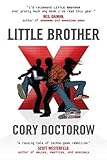
Little Brother

Little Brother by Cory Doctorow (2006). 384 pages, TOR Books.

I really enjoyed this book. If I were fifteen, I would love this book.

Little Brother is classified as a “Young Adult” or “Teen” novel. Amazon lists it as being for “Grades 10 and Up”. It’s even printed under publisher TOR’s “Teen” imprint. So why did I decide to read it?

One of my oldest friends (college buddy, former roommate, all around great guy), Jonathan Green, recently asked a bunch of us via Facebook to recommend appropriate science fiction for his 11-year-old son, Dash. I made the suggestions of A Wrinkle in Time and the Golden CompassHis Dark Materials series, among others. Several other people suggested Little Brother.

I’d heard of Little Brother, but hadn’t thought much of it, since it seemed so obviously aimed at teenagers. But since several of my fellow Galaxy Rangers (not the cartoon show – the Northwestern University Science Fiction club from the early 1980’s) had mentioned it, I figured I should check it out. And, it’s written by Cory Doctorow, whose short fiction I have always enjoyed – not to mention his excellent blog BoingBoing.net.

After a quick download to my Kindle DX, I started in on the book. And was transported back to high school…

Little Brother reminds me very much of the “juvenile” science fiction novels of the 1950s and 1960s. Robert Heinlein was the master of these, including Podkayne of Mars, Have Spacesuit Will Travel, Starship Troopers, and – my personal favorite – The Moon is a Harsh Mistress. However, unlike Heinlein’s quite obviously right-wing themes, Little Brother is just as obviously left-wing. I remember sometimes reading Heinlein’s books as a teen, and thinking, “Man. Don’t they ever care how about how the rest of the (world / aliens / humanity / planet) is going to survive?” Little Brother has all the excitement and techno-friendliness of Heinlein, without the creepy Ayn Rand vibe.

Little Brother takes place in the near future. Marcus Yallow is a 17-year-old high school student in San Francisco. He’s a gamer, a technology geek, and a decent student. He and his friends like to spend their spare time building computers, programming new and interesting games, and generally enjoying themselves in the 21st century. Hackers, but without the criminal part, you know?

In order to play a geocaching game, Marcus and three of his friends ditch school early one afternoon. But just as they are about to find an important clue in the game they are playing… terrorists strike the city of San Francisco. The Bay Bridge is blown up in a massive explosion, and thousands of people are killed. Almost instantly, the government panics, sending in massive squads of troops to restore order to the city. In the confusion and paranoia after the attack, Marcus and his friends are swept up in a security raid, and are taken prisoner by the Department of Homeland Security.

The next few chapters are gritty and gripping, as Marcus – along with literally hundreds of others picked up in the raid – is imprisoned and tortured for nearly a week, before the DHS becomes moderately convinced that he is not one of the terrorists. So they let him go, with the assurance that if he breaths a word of his capture to anyone, even to his parents, they will pick him up and ship him off to a foreign location for torture.

And although Marcus is frightened enough to keep his capture secret, he’s angry enough to decide to fight back. Using his computer skills, his army of geek friends, and his fervent belief in the power of the Declaration of Independence and the Constitution of the United States, he begins an underground war against the DHS. He and his gang become “Little Brothers” and “Little Sisters” in the fight against “Big Brother”, the DHS.

I won’t lie and say the characterization in this novel is on point and well done, because it isn’t. Marcus is a relatively two-dimensional character, as is everyone else. The bad guys are Bad and the good guys are Good. The DHS as portrayed in this book is almost (but not quite) laughably evil. I almost (but not quite) felt that their actions were so extreme, so one-sided, that even the frightened population of a post-attack San Francisco would never have gone along with it.

But then I remember 2001, and 2002, and the Patriot Act, and the war in Iraq, and the Military Commissions Acts, and Gitmo, and the secret torture prisons of the CIA… and I realize that this novel’s villains are not so far-fetched at all. And each time I’d read, and think “Oh, now, come on!” … well, after a few seconds, I would change my mind and think, “Yeah, that actually could happen”.

This is a first-person novel, and sometimes the story gets bogged down in techno-jargon as Marcus goes off on a tangent, describing the technology he’s using or the cryptography technique he is employing. But, as in any good Young Adult novel, the slight sidetrack for a lesson pays off well, so I found myself actually looking forward to Marcus’ little digressions.

There is real danger in this novel, and there are times when reading it that my heart raced and I gripped the Kindle in both hands, reading faster to see how it was going to play out. Marcus is a true hero – near the end of the novel he is ready and willing to sacrifice everything, even his life, to protect the freedoms that are provided to us in the United States.

As I said at the beginning, I really enjoyed this novel. But then again… I’m a 47-year-old liberal-leaning technology geek. Of course I would like it. The question is, how does Little Brother rate as far as my friend Jonathan’s original question: Would it be good for his 11-year-old son?

I can’t completely answer that. Little Brother does have some mild, non-graphic descriptions of sex (the characters are high school students, after all), although I am pleased to report that the characters involved clearly make use of condoms. So even that is educational. The overall subject matter is “deep”. And it’s really just barely science fiction… everything described in Little Brother already exists (or could exist) today, for example.

I can say that if I had children, I would very much endorse them reading this book. It’s the specific age that I’m just not sure about. I read my first Stephen King novel (Carrie) when I was 12, and I absolutely loved it. My mother was smart enough to bring it home one night and said “You’ll love this, and I guess you’re old enough”. If I were 12 today, I would hope my mother might hand me a copy of Little Brother and say exactly the same thing.

It’s not exactly a secret that I was beyond horrified at the extremes the Bush administration went to in curbing our civil liberties during the first half of this decade. For a while during the 2002 to 2004 period, I seriously lived in fear that The Government was going to literally be in control of every facet of our lives – all in the name of “protecting” us from “terrorism”. I’ve said it over and over: Osama bin Laden and Al Qaeda must have jumped for joy when our paranoid and frightened political leaders rolled over and gave up our hard-fought freedoms in just a few months.

During that time, I kept wondering, “Why isn’t anybody fighting back? Why aren’t young people taking to the streets in mobs?” But no one ever did. In Little Brother, the young people do fight back. And they do take to the streets. And in the end… well, I won’t give it away. Read the book. Or give it to a Young Adult and have them describe it to you later.
Categories
Books

Heart of Darkness

Heart of Darkness by Joseph Conrad (1899). 117 pages, Easton Press.

I have never read anything by Joseph Conrad before picking up this book a week ago. I’ve had it on my shelf for a few months, as part of the Easton Press “100 Greatest Books Ever Written” collection that I subscribe to (one book a month, you know). Anyway, about a week ago I was scanning my shelves for a DVD to watch, and paused over Apocalypse Now. I decided on something else that night, but I was reminded that I had never read the novel that was the source material for Apocalypse NowHeart of Darkness.

So, later that night, I pulled the book down and started reading it. Having seen Apocalypse Now probably six or seven times (the first time when it originally came out in 1979, in a theater in Elizabethtown, Kentucky), I’m pretty familiar with the movie. I assumed, having heard that Heart of Darkness was the source for the film, that it would share some loose plot elements, but otherwise bear little resemblance.

My conclusion after finishing the book is quite the opposite. Apocalypse Now is Heart of Darkness – just updated for the 1970’s and with a change of local from Africa to Viet Nam. The character names are the same. Much of the actual dialogue is the same. The situations and moral tone is the same. The ending is (almost) the same. I discovered that I knew the entire plot of the book, from beginning to end, because of my familiarity with Apocalypse Now.

Heart of Darkness follows the journey of a professional Merchant Marine, Marlow, as he navigates up the Congo river in the late 1800’s. Marlow has been hired to repair and pilot a steamboat up the river and retrieve Mr. Kurtz – an “agent of the company” who was supposed to collect ivory from the natives and ship it back for sale. However, oddly enough, Mr. Kurtz refuses to return from his post, and strange tales come down the river about what has been going on in Mr. Kurtz’s village. Eventually, Marlow finds Kurtz, and what he discovers in that village deep in the jungle, horrifies him and changes his life forever.

A short novel (really a novella), the book is divided into three untitled chapters. Chapter One describes how Marlow got the job through the connections of an Aunt, his journey from Belgium to the Congo, and his travel inland to the outpost on the river where his steamboat command is supposed to launch from. Chapter Two covers Marlow’s repairs of the wrecked steamboat he finds at the outpost, his discovery of what is known so far about Mr. Kurtz, and the launch of the steamboat upriver – until the boat falls under attack.

The final Chapter Three covers Marlow’s meeting with Kurtz and his disciples, the resolution of both of their stories, and Marlow’s eventual return to civilization – and his decision on what to do with the legacy that Mr. Kurtz has bequeathed to him.

It’s a good story, and it’s not hard to see how and why it inspired Apocalypse Now. But what is downright astonishing is the prose itself. Like I said, I’ve never read anything written by Conrad before, and there are passages in this book that literally took my breath way, they are so well written. This is a very rich book, rich in detail, rich in language. I read each chapter twice before proceeding to the next, because there is so much to take in that I felt I was missing something. I didn’t want to move further along in the story until I had absorbed everything completely. And after finishing the book (it is a short read) I went back again and skimmed through the whole, re-reading select passages now that I knew the whole story.

The prose tone reminds me somewhat of Herman Melville‘s in Moby Dick (the only Melville work I’ve read), but streamlined and more modern. I felt that Melville, writing in 1850, was deliberately attempting to make his novel sound like it was written A Long Time Ago – exemplified by his use of “Thee” and “Thy”, which by 1850 had been out of use for quite a while. Conrad, on the other hand, writing just as the 19th century was turning into the 20th, sounds completely current to these modern ears. What I’m trying to say is that Conrad sounds like a modern writer. His rich and dense prose needs no analysis or annotation for the modern reader to understand it clearly.

I guess what I’m trying to say is that while the tone reminds me of Melville, that actual writing style is a lot more like Ernest Hemingway or F. Scott Fitzgerald.

This may be influenced by the fact that Conrad, originally from Poland, learned English as his second language – he didn’t speak a word of English until he was 21 years old. Perhaps, learning English as an adult in the late 19th century, aboard various ships populated by crews of young men from all over the English-speaking world, he learned a newer, more modern form of English. Or perhaps he’s just a fantastic writer and no other explanation is required or expected.

Whatever. Although this was the first time I’ve read a book by Conrad, it will definitely not be the last. I’m already starting Lord Jim.

So, if you’ve seen Apocalypse Now and have always been curious… or if you just like a solid, well-written novel that will haunt you for days afterwards… well, then, read Heart of Darkness. To paraphrase the Russian youth from Chapter Three, it will enlarge your mind.

Categories
Books

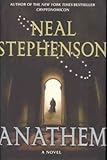
Anathem

Anathem (2008) by Neal Stephenson. William Morrow, 960 pages.

Anathem is a Big Novel. By that I mean both in physical length – at 960 pages, this is a good long read – and in subject matter. Anathem is a type of book I haven’t read in quite a while. Reading Anathem was like reading Dune for the first time, or Lord of the Rings, or The Foundation Trilogy.

It’s an epic, yes – but there are lots of epics out there. Anathem is one of those rare books that builds an entire world all its own, from the ground up, complete with its own detailed history, unique language, culture, and attitude. Anathem surrounds you and immerses you, so much so that I am still thinking in terms from the book, days after finishing it.

I knew Anathem was going to be very detailed right from the beginning. Before the novel even starts, there’s a 5 page “Note to the Reader” that introduces the language spoken on the planet Arbe, and gives a historical timeline of the previous 7,000 years of the planet’s history. The author advises the reader that while all relevant parts of the planet’s history will be covered in their own due time during the plot of the novel, the reader may find it “convenient” to refer back to the timeline “on occasion”. For me, that turned out to be about once every 10 pages or so.

In addition, the novel has its own language, much like may other fantasy and science fiction epics have done. The book has a glossary in the back, and in the first several chapters, dictionary definitions of terms unique to Arbe are sprinkled throughout the text. Some of the words are almost English, with just a slight difference in spelling or pronunciation. Some examples: On Earth we have “convents” of the religiious; on Arbe they have “concents” of mathematic and scientific scholars. On Earth “secular” means non-religious; on Arbe “saecular” means non-scientific – the world outside of the concent walls.

Anathem is a world-spanning novel set on the very Earth-like planet of Arbe. On Arbe, scientific and learned people live in walled, secluded communities, in the same way that some religious orders live on Earth. These communities are called “concents”, and the individual orders within them are called “maths”. Individual members of these walled academies are called “avout”. Structurally, it’s sort of similar to an old British university of colleges, like Oxford. Culturally, however, it’s much more like a religion on Earth. The concents follow strict rules of study, dress, and conduct, and interact with the outside world only on rare and highly regulated occasions.

On Arbe, civilizations rise and fall, but the maths have stayed constant. Oh, the concents have been sacked a few times during their 4,000 year existence, but they always reform after each pillage, stronger than they ever were. Within the walls of the concents, history is maintained. All scientific theories, research, and knowledge that has ever been developed by anyone, anywhere in the world are recorded, studied, and researched behind their walls. The avout are the keepers of all of Arbe’s collective knowledge.

Anathem opens in the year 3689 A.R. (“After Reconstruction”), in the Concent of Saunt Edhar. The novel is a first-person narrative, written by a 19-year-old “fraa” (a male avout) named Erasmus, or Ras, as he is called by his friends. The story begins as Ras describes the ceremonies the day before the gates of his concent are to be opened for the first time in ten years to the outside world, a 10-day festival called “Apert”. As we follow Ras throughout his day, we learn how the world of Arbe is very similar to – and yet very different from – our own Earth. Is Arbe a lost colony of Earth? Is this a parallel universe of some sort? Or is Anathem just an alternate history, an “Earth that might have been” kind of story? I won’t tell.

Mysteries unfold. Fraa Orolo, Ras’s mentor and a renowned member of the concent, is expelled for violating one of the basic rules of the order: using technology from outside the concent walls (a portable computer and video recorder, as it turns out). Political struggles between the members of the avout and the outside, saecular world. Mysterious revelations that some members of the avout have been tinkering with advanced genetic engineering, something that has been forbidden for over 3,500 years.

And then a massive spaceship settles into orbit around Arbe, a ship constructed with designs that seem familiar, but using technology that is not. And yet the ship is engraved with geometric symbols that are strangely familiar to the members of the avout, who have maintained their planet’s history throughout the rise and fall of many civilizations. Who are the extraterrestrial visitors? What do they want? And why do they seem to only want to communicate with members of the avout, ignoring the political entities of the saecular world?

We discover all of this through Ras, as he writes his first-person description of all that happens. I’m not going to give away any more of the plot, but I will tease and say that by the end, Arbe will never the same – and you will fully understand how the worlds of Earth and Arbe are intimately connected.

Anathem is a terrific read, engrossing and exciting – and enlightening as well. Although it is an epic science fiction novel, it’s also a keen study of the cloistered world of academia. On Arbe, academics are literally shut away from the rest of the world, and much of their conversations are in the form of “dialogs”, classic structures of education between a fid (student) and a mentor. These are clearly modeled after our own Greek dialogs of Plato, Socrates, etc., and they have formal rules of engagement. There are sections of the book where the characters may engage in this formal sort of dialog for 10 or 20 pages at a stretch, and yet I never found it boring.

Anathem is a different sort of novel for Neal Stephenson. His previous works have been two classics of the cyberpunk genre (Snow Crash and The Diamond Age), and a set of linked historical novels (Cryptonomicon, Quicksilver, The Confusion, and The System of the World). This new work is his first try at a “whole world” epic, and it is a fantastic, marvelous success.

Although Anathem ends cleanly and completely (no loose ends, no “still to come” nonsense), most of the major characters are still alive at the end, and the book cover less than a single year. Could Stephenson be planning a sequel, or at least some sort of related novel? His previous four novels were all linked together in a common history, so I certainly wouldn’t rule it out.

If you like epics – if you like massive works of realistic science fiction with great characters – if you like to immerse yourself into a world other than your own – then go and buy Anathem, and settle down for a long read. Anathem is an investment that pays off with joyful dividends. You will be in for a great and rare pleasure.