Categories
Books

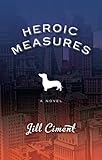
Heroic Measures

Heroic Measures by Jill Ciment (2009). 208 pages, Pantheon.

This is an absolutely wonderful little book. And I mean that as a true and sincere compliment.

Sometimes with books, I get the feeling that an author is trying way too hard to tackle A Big Subject. Other times it feels like the book has been padded by an extra hundred (or sometimes even two or three hundred) pages to make it seem more “weighty”. Heroic Measures is little in both ways: It is a short novel (just 208 pages), and its subject matter could not be more prosaic: This is the story of an elderly couple and their elderly dog. Over one weekend. And the plot? They’re selling their condo.

Yes, that really is the main plot. Ruth and Alex, married for 45 years, are trying to sell their 5th-floor walkup apartment in New York City. Although they bought the place for $5,000 40 years ago, they have a real estate agent who says she can get them one million dollars for their place. And with that kind of money, they can afford to buy an apartment in a building with an elevator.

The novel starts on a Friday. Their agent is planning an open house on Saturday morning, and Alex and Ruth have to get their place ready for potential buyers. But, two terrible things happen: their elderly dachshund, Dorothy, suddenly can’t walk. As the couple frantically try to find a 24-hour emergency vet to treat their beloved dog, news of a possible terrorist attack ripples through the city. A tractor-trailer hauling gasoline has stopped in one of the city’s tunnels, and reports are coming in that there may be a bomb on the truck…

What follows is 48 hours of hectic turmoil in Alex and Ruth’s life. Will Dorothy survive back surgery? Will they be able to sell their condo while the city is in full-fledged panic mode? And what about the offer on their new place, whose owners demand an answer and a down payment by Sunday afternoon?

One of the charming – and poignant – aspects of this book is that periodically, there will be a short chapter from Dorothy’s perspective. Yes, from the point of view of the sickly dog. And these chapters are among the most tense moments in the novel. You’re pulling for Dottie, you want her to survive and get out of the hospital so badly. From her point of view, she’s been abandoned and she’s in pain. She comes up with her own theories as to what is going on, and she is determined to get back to “her people”.

Reading that back, I see I haven’t done this justice – I’m making it sound like it’s a silly story about a heroic dog, when that is not the case at all. Ciment writes Dottie’s point of view the way you’d imagine a dog would actually think, not in some sort of storybook or Disney fashion. It’s extremely gripping, so much so that when the action switches back to Alex and Ruth’s point of view, I wanted to cheat and skip ahead to find out what was going to happen to Dorothy!

I can’t tell you anything about the author, Jill Ciment, other than to tell you she is one hell of a great writer. She has taken a mundane plot and created a terrific, wonderful novel out of it. The characters are real people. The situations are heartfelt and true. And the plot is every bit as gripping as a bestseller from John Grisham or Dan Brown. It sounds crazy, but trust me – it’s true. She has a way with words and storytelling that I have not encountered in quite a while. Take this passage, where Ruth is looking wistfully out of her favorite window:

The rise of the sun is like the opening of a novel she’s read so many times that she can take pleasure in the details and nuances without having to race to the end to find out what happens.

Or this passage. Here, Alex, an acclaimed artist, is working on what he imagines may very well be his last great work: an illuminated manuscript taken from his and Ruth’s FBI files, created when they were peace protesters back in the 1950’s:

It will take in not only the manuscript page he is finishing, but all six hundred and ninety-nine pages still waiting to be illuminated, and his studio filled with a lifetime of work in the terrified city on the panicked island by the nervous continent.

If you love New York City, or any big city, you’ll love this book. If you love dogs, you’ll love this book. If you’ve ever had a tense weekend filled with possible life-changing challenges, you’ll love this book.

Frankly, if you simply like to read, you’ll love this book. Heroic Measures is a truly heroic slice of life, and you should not miss it. This is a book you will read with pleasure, and one you’ll think about with satisfaction long after you’ve finished it.
Categories
Books

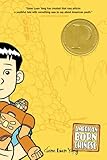
American Born Chinese

American Born Chinese by Gene Luen Yang (2006). 240 pages, Square Fish Press.

I love stories where there are one or more plots that seem to be completely unrelated. Then they come together, one by one, in a way that I never saw coming. Sometimes it’ll be two stories that run at the same time. Sometimes you follow different characters doing completely different things. I always enjoy seeing how the author twines plot lines together.

But every once in a long while, I come across a book where I don’t even realize I’m reading an integrated story. And then an amazing feeling creeps over me, as it becomes clear that the stories – which I thought were completely unrelated – are in fact all part of one single story.

The graphic novel, as an art form, is quite new. The vast majority of graphic novels are actually collected reprints of comic books (Watchmen, V for Vendetta, Sandman, etc). A great trend over the past decade, however, has been the emergence of the true graphic novel – a work created from the beginning as a single book, one single story, told by the author in words and pictures in such a way that it could never be done with words alone.

Gene Yang’s American Born Chinese is a wonderful book. It has won all manner of awards, and it deserves every one of them. This is a book that reveals so much to the reader, so cleverly drawn and written, so perfectly plotted, that it literally took my breath away as I neared the end. And it is the perfect, the absolutely perfect, example of how seemingly completely and utterly different stories merge together in a way that is totally unexpected and seamlessly plotted.

As I began to read American Born Chinese, I just assumed it was a collection of short pieces, just grouped together under the theme of being written by the same author, a man who is an “American-born Chinese”. It wasn’t until about page 200 that it became clear that I was reading a true novel, and that the three alternating, seemingly completely unrelated stories were all part of a whole.

The three individual plot lines take the form of alternating chapters. The book begins in the “ancient past”, and relates the myth of the Monkey King – a monkey who is determined to shed his animal nature and become elevated to a God. The Monkey King is an actual Chinese folk hero; I cannot say how much of the Monkey King story here is “the real story” and how much is Yang’s invention, but it reads like a real folk story.

The second story is that of Jin Wang, a lonely Asian-American kid from San Francisco whose parents move to the midwest. Suddenly Jin is one of only two Asian kids in the entire school, and his natural shyness becomes all encompassing. He’d do anything to fit in with his white classmates, especially to win the heart of the girl he has a crush on.

And the third story – written with an accompanying laugh track and applause – is the sitcom plight of Danny, an All-American white teenager who is mortified every summer when his Chinese cousin Chin-Kee comes to visit. Chin-Kee is a painfully obvious ethnic stereotype, complete with buck teeth, a pigtail, and yellow skin. Even his name is an ethnic slur – which I didn’t figure out until after I finished the book, by the way. Spell it slowly to yourself, stopping after the fifth letter…

Each chapter of the book alternates, one after the other, between these three stories. Chapter 1 begins the tale of the Monkey King. Chapter 2 begins the story of Jin Wang. Chapter 3 begins the story of Danny and Chin-Kee. Chapter 4 picks up with the Monkey King again… and so on throughout the book. Each story line is very good, although I found myself particularly drawn to the saga of Jin Wang. His painful attempts to make friends in his new school reminded me a lot of my own life during middle school – minus the racial problems, of course.

As the book nears the end, each of the three stories seems to be reaching their own, separate conclusions. But then – no, sorry, I can’t and won’t spoil it. It was just too well done.

What I liked so much about this book is that it’s a small, human story. Here is a fantastic, wonderful, modern graphic novel that doesn’t have any super heros. No aliens. No vampires. Just good, honest storytelling, combined with a bit of Chinese folk wisdom. The “big reveal” at the end of the book is not really “big” at all. It’s just about one person, one character. No one dies, no one saves the world, no one makes news, none of that. It’s just the story of a few people, and how they live their lives, and a great lesson.

Obviously, I’m not Asian. Gene Yang could have made up the entire folklore part of this book from whole cloth, and I would never know. All of the Chinese symbols that are integrated into the typography and layout of the book could be gibberish. I doubt it, however. Those elements just feel… right.

In Chapter 2, when we first meet Jin Wang, he’s a small boy in San Francisco. His mother likes to visit an ancient herbalist in Chinatown for her allergies, and Jin sits out in the waiting room while she takes her treatment. Jin is playing with a Transformers toy, and he tells the herbalist behind the counter that when he grows up, he wants to become a Transformer.

He stares at his toy, embarrassed, and tells the old lady “But Mama says that’s silly. Little boys don’t grow up to be transformers”.

The old herbalist looks at him with a baleful eye. “Oh, I wouldn’t be so sure about that,” she says. “I’m going to let you in on a secret, little friend.” The next panel is an extreme close up of the old woman’s face, as she tells Jin: “It’s easy to become anything you wish… so long as you’re willing to forfeit your soul”.

And that is the heart of what the book is all about. Better to be who you really are, than to forfeit your soul in an attempt to become something else.

Go get a copy of American Born Chinese. Buy it at your bookstore. Order it from Amazon. Or check out a copy from your local library. Even if you “don’t like comic books”, or have never read a graphic novel, or if you think this book looks like a collection of cartoons, please – take a chance on this book. You won’t be sorry. It’s charming, enlightening, and breathtaking.

My hat is off to Gene Luan Yang, and I hope he writes-and-draws many more books to come.

Categories
Books Technology

Kindle 2: The Review

Kindle: Amazon’s 6″ Wireless Reading Device, $359.00

I’m living on a greatly tightened budget. I’ve cancelled satellite service, land phone service, pool cleaning, book and magazine subscriptions, and I’m buying all our food at Costco and Wal-Mart. So why, why did I just spend $359 a month ago for a new Amazon Kindle 2 – to replace the perfectly good, still working Kindle that I bought only a little under a year ago?

Because I love to read, I love books, and the Kindle 2 (now referred to as just the 6″ Kindle by Amazon) is the best book reader I’ve every encountered. That’s why.

LIke many others, I had some complaints about the original Kindle. Amazon listened to me and countless others, and they fixed (almost) everything that was wrong with the original Kindle. And, let me be clear, the original Kindle was a very good device (and still is, for that matter). The Kindle 2 literally fixes every single complaint I had with the original – with the exception of the screen size, which is the same as the first Kindle and is still too small.

Thin Is In – And Oh So Shapely!
The first thing I noticed when I removed the Kindle from its (very nice and very Apple-inspired) packaging was the thickness of this device. As in the lack of it. You may have seen some ads for the Kindle 2 that show it on edge next to pencil – and the pencil is noticeably thicker. Those pictures aren’t lying. The device is thinner than an iPhone 3G, thinner than any remote control I’ve got, thinner than any other electronic gadget of any kind that I currently own. It’s about the thickness of 30 sheets of paper.

And the thickness (er, thinness) of the device is constant. It doesn’t curve out anywhere or bulge up at any spot. The edges taper in somewhat, much like the edge of a MacBook Air do. All four corners are rounded identically, following the same gentle taper toward the edge. The overall effect feels very good in your hands. It just feels… right. The specs say it weighs 10 ounces. I haven’t verified that independently, but it feels about like holding a sheaf of paper.

The back of the Kindle 2 is smooth aluminum. There are tiny grills in the lower back for speakers, used for the audio book and music playback features (which I completely do not care about and never use). Even the holes in the speaker grills are carefully milled and feel good under your fingertips. And the smooth brushed metal doesn’t get slick as you hold it for a long about of time, as plastic usually does (think how a phone feels after you’ve been holding it for a long conversation).

Interface Reface
The Kindle 2 sports a revamped version of the Kindle interface to go along with the new physical design. The main outward aspect of this is getting rid of the “sparkle bar” and wheel that was the navigation system for the original Kindle. It’s been replaced with an easy-to-use four-way joystick type toggle. You just use the little joystick to point to the item you want, then push it in to select. Amazon refers to this as a “five-way control” because it’s up, down, right, left, and select. Anyone who has used a remote control for a Tivo, satellite, or cable box in the last 10 years will instantly know how to use the control. It also makes it possible to scroll right and left of text in order to bring up menu options.

Magazines and newspapers, two things that I absolutely love on the Kindle, are much, much easier to navigate with the Kindle 2. In fact, it’s so obvious now that I can’t believe Amazon didn’t do it like this to begin with. You get a straightforward table of contents, with sections from the magazine in question. Next to each section is the number of articles in each section. You can select the section’s name to go straight to the first article, or click on the number to see a detailed sub-table of contents for that section, with longer descriptions of each article.

Reading Newsweek and the New York Times on the Kindle is now much better than reading the print editions. Now I really wish every magazine was available on the Kindle! I’m still pushing hard for The Economist and Rolling Stone. Come on, publishers!

Nice little tweaks and additions are scattered throughout. For example, the little status bar at the bottom of every page now shows you what percentage of the way through a book you are. This helps a great deal to duplicate the feeling of “I’m half way through this book” that you get from a physical book.

Size Does Matter
Amazon fixed all but two thing I didn’t like about the original Kindle. I felt, and still feel, that the Kindle needs some sort of built-in reading light, or at least a custom-made “snap on” light that is low profile and fits neatly onto the device. And, I opined that what the Kindle really needed was a larger screen – I felt that it needed about a 9″ to 10″ diagonal screen, one that would let you read a book page at approximately the same size as the print edition. And magazine articles would also “feel” about the right length.

But when the Kindle 2 came out, I though, oh well. I’ll continue to just use a clip-on reading light, clamping it in ugly fashion to the top of the Kindle. And, it looks like they just couldn’t manage to get a larger screen, so I’ll just buy this one and —

Crap. The Kindle DX is Announced.
Well, damn. Only six weeks after I got my Kindle 2, Amazon announces the Kindle that I really want: The Kindle DX. Yup. A larger sceen, almost 10″ diagonally. The screen it should’ve been from the start. With auto rotation. And native reading of PDF files. Literally everything except a light.

I’ve watched all the videos for the Kindle DX I can find. I’ve seen the pictures. I’m salivating for its arrival. I pre-ordered one the day they were announced, even though they won’t be shipping this reading wonder until “summer” (which could mean anywhere from late June to late September, really).

I’ve read the criticisms lobbed Amazon’s way over the price point – the Kindle DX will be a whopping $489, and the Kindle 2 will remain at its current $359. For me, a Constant Reader, this price is worth it. I find it interesting to read the snarky comments on Engadget and Gizmodo trashing the device, with person after person saying they’ll never buy one until it has a color screen or blah blah blah. (An aside: Of what use would a color ebook reader be? Every book I’ve read consists of exactly two colors: white paper and black ink. And no, I’m not counting graphic novels / comic books. Those will always need to be in glossy print).

The Kindle Market
I get the Kindle. I really do. And I think anyone who reads a lot – people who list their hobby as “reading”, people who regularly buy lots of books – they will want a Kindle. As for anyone else? I can’t see why they’d ever want a device that is a dedicated book reader at all.

I’m reminded of a friend of mine, who was listening in on a conversation me and some other guys were having about an iPod. He volunteered that he didn’t have an iPod, and couldn’t understand why he’d want one. We all looked at him funny, and I said “Well, what do you listen to music on now”? He said, “I don’t even listen to music. I don’t like music, and I don’t own any CDs or records or anything”. And my answer was: “Then there is absolutely no reason at all for you to own an iPod”.

So, if your’e one of the many tech geeks out there who looks at the Kindle and says “Why? I already have an iPhone, I can read web pages on that”, or “Blech! It’s not in color. I can’t read graphic novels on it”, or “It has to display video and play music and accept a mouse and…” then I have to say: You’re not in the target market. You don’t need a Kindle, nor should you want one. And please go away and stop bothering me, OK?

But for those of us who Read. Read every night. Read all the time. Read magazines that consist of nothing but printed words, magazines where the only picture is the one on the cover or the occasional graph on the inside. Read the New York Times Book Review. Read works in translation. Read the classics, new and old. Read read read read… We need a Kindle. You need a Kindle. You want a Kindle.

You want to be able to buy a new book at 2 in the morning, have it instantly delivered to you in about a minute, and start reading immediately. You want to be able to highlight sections and save them for reference later. You to be able to get on a plane and bring a hundred books with you, on a device that weighs less than a pound.

So, if the above description fits you, and you don’t already have a Kindle, then go to Amazon now and order one. If you can afford it and if you can wait until “summer”, then I’d suggest waiting for the Kindle DX. But on the other hand… well, this economy ain’t gonna stimulate itself, y’know.

Categories
Books

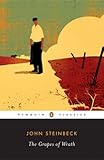
The Grapes of Wrath

The Grapes of Wrath by John Steinbeck (1939). 559 pages, Easton Press.

When I was a child, whenever we would go on a long road trip, my mother would look at our packed-to-the-gills station wagon and sarcastically say, “Well, here come the Joads”. And Dad would laugh loudly, and off we’d go.

Somewhere around the time I was 7 or 8 years old I asked Mom what “The Joads” were. She said that “The Joads” were people who drove around looking for work, and they packed all of their belongings as well as their entire family on the back of their car wherever they went. She said it was a common phrase when she was growing up, and that her mother and father used to say it all the time.

However, she did not mention that it came from a book (or movie). So, for many years I thought “The Joads” were some ethnic group, like “The Jews” or “The Italians”. Ours being a military family, I knew it was not polite to poke into someone’s ethnic background (racism is an absolute no-no in the military world), so I didn’t ask any further questions.

As time went by, I started using the phrase as well. When we would pack up our station wagon (or later, our VW bus), I would say, “OK, here come the Joads!” and people would laugh. I began to build up a picture in my head of what a “Joad” must be. I pictured them as looking somewhat like gypsies, but perhaps wearing turbans or headscarves. I imagined a swarm of Joads streaming across the desert in their loaded-down station wagons, looking for work in every oasis they came across.

It was not until my senior year of high school that I finally learned what “The Joads” really were. My english teacher, Mr. Blair, had us read a book every two weeks. He had a list of about 500 books we could choose from, with a brief synopsis of the plot under each title. And there it was, staring at me on the purple mimeographed page: “The Grapes of Wrath: The depression-era story of the Joad family, forced to leave their Oklahoma farm and become migrant workers”.

I distinctly recall blushing as I read the synopsis. So they were not an ethnic group after all…

When my mom got home from work that day, I casually asked her if “The Joads” were from The Grapes of Wrath. She gave me a funny look. “Well, where else would they be from?” she said. “The book, and the movie with Henry Fonda“. And so I finally understood that my image of the massive caravan of swarthy Joads motoring across the world’s deserts was not only amazingly wrong, but that the entire “Joad” business was based on a popular book and movie.

It was on of those times (of which there have been many and will no doubt be many more) in my life where I suddenly realized there was a great deal of information that I did not posses.

I never got around to reading the book that year, and as time went on, I forgot about it. Occasionally the topic would come up whenever I’d participate in helping someone move, but that was about it.

Until a few weeks ago, when I got laid off from my job of the last five years. In a melancholy mood a few days after I’d gotten the ax, I read an article that suggested that if you think you’re hurting in this recession, try reading The Grapes of Wrath to put things in their proper perspective.

Just a few months earlier, I had received a wonderful leather-bound copy of The Grapes of Wrath as part of my Easton Press book subscription. I got it out of my library and started reading it. And let me tell you… it certainly does put things in perspective.

The book is told mainly from the point of view of 27-year-old Tom Joad, who has just been released from prison, having served four years for manslaughter. As Tom makes his way across Oklahoma circa 1938 to return to his family on their sharecropped farm, he runs into Casy, an ex-preacher that he remembers from his childhood. Casy joins Tom, since he remembers the Joad family and would like to say hello as well. But when they arrive at the Joad home, it’s abandoned. One corner of the house is smashed in, and the entire grounds of the farm have been tractor-graded away to merge with the surrounding farms into one giant field.

Tom finds out that “The Bank” has taken possession of all the farms in the area, kicked out their tenants, and merged them into one mega-farm tilled by a single man on a tractor. It seems that while he was away in prison, the combination of a months-long dust storm and the long arm of the Depression have destroyed the hundred-year-old job of sharecropped tenant farming.

Tom finds the rest of his family – Ma, Pa (who is also named Tom Joad), Grandpa, Grandma, his Uncle John, his siblings Noah, Rose of Sharon (or “Rosasharn”, as she is called by most), Al, Ruthie, and Winfield – all crammed into Uncle John’s tiny one-room cabin. And Uncle John himself is being evicted that week as well. With nowhere to live, no job prospects of any kind, and many hungry mouths to feed, the family pools all their money, sells most of their possessions, and loads every family member and every remaining possession onto a single broken-down farm truck. And begins the long journey to California, where, according to a series of handbills being passed around Oklahoma, there is plenty of year-round work at high wages on the many fruit farms in that region.

Of course, the family learns the harsh truth as their journey engages and their money dwindles. One by one, family members and friends die, are arrested and jailed, or simply run off for the hope of something better. The family stays in a series of “Hoovervilles“, government camps, and abandoned boxcars as they work picking fruit or cotton for a few dollars a day. During the course of the novel, everything that is bad and brutal about people being forced to work for starvation wages (and less) is made painfully clear.

The book is shockingly frank for something written in 1939. It’s filled with casual profanity, mocking dismissals of religion, open discussion of sex and pregnancy, and brutal in its depiction of violence, murder and death. One character dies by having his head smashed in by a strikebreaker. Another has a stillborn baby, whose blue, mummy-like corpse is tossed into a flooding river. And at the end of the novel, a starving man is saved from death by being fed the only food anyone in the group has – milk from the breast of a new mother.

The Grapes of Wrath is a “can’t put it down” kind of book. The prose is vivid and rythmic, the dialogue compelling. Every single character in this book is fully realized, as clear as if they were actually standing right in front of you. It’s heartbreaking, it’s realistic, it’s…. well, amazing, actually. I have no trouble at all seeing why this was a runaway bestseller as soon as it was published, and why it was turned into a movie only one year after the book came out. This ranks right up there with the absolute classics of the 20th century.

I wasn’t prepared for how engaging this book would be. I read a hundred pages in one sitting, without getting up – it’s that engrossing. You just have to read a little more, to see what happens next. And oh, for God’s sake, can’t something good happen to these poor folks? Man oh man.

And yes, as I said above, it does put things in perspective. I’m sitting here writing this in my big house, living off my generous severance pay while I work on starting up my own business. Oh, yeah, poor, poor me.

I’ll still probably say “Here come the Joads!” whenever I overload a car for a long trip. But… after reading The Grapes of Wrath, I will never make fun of any hard-working person driving around in a vehicle trying to make an honest buck. Or make foolish statements about how out of work people “deserve” what they get. Or pretend that the lose of a job when you’ve got a family to feed is just “unfortunate”.

Yeah, times are relatively tough. But I think we could all use a little bit of the spirit of Ma Joad. Hitch up your skirts, wash your hands, and git to doin’ what needs doin’.

Categories
Books

Heart of Darkness

Heart of Darkness by Joseph Conrad (1899). 117 pages, Easton Press.

I have never read anything by Joseph Conrad before picking up this book a week ago. I’ve had it on my shelf for a few months, as part of the Easton Press “100 Greatest Books Ever Written” collection that I subscribe to (one book a month, you know). Anyway, about a week ago I was scanning my shelves for a DVD to watch, and paused over Apocalypse Now. I decided on something else that night, but I was reminded that I had never read the novel that was the source material for Apocalypse NowHeart of Darkness.

So, later that night, I pulled the book down and started reading it. Having seen Apocalypse Now probably six or seven times (the first time when it originally came out in 1979, in a theater in Elizabethtown, Kentucky), I’m pretty familiar with the movie. I assumed, having heard that Heart of Darkness was the source for the film, that it would share some loose plot elements, but otherwise bear little resemblance.

My conclusion after finishing the book is quite the opposite. Apocalypse Now is Heart of Darkness – just updated for the 1970’s and with a change of local from Africa to Viet Nam. The character names are the same. Much of the actual dialogue is the same. The situations and moral tone is the same. The ending is (almost) the same. I discovered that I knew the entire plot of the book, from beginning to end, because of my familiarity with Apocalypse Now.

Heart of Darkness follows the journey of a professional Merchant Marine, Marlow, as he navigates up the Congo river in the late 1800’s. Marlow has been hired to repair and pilot a steamboat up the river and retrieve Mr. Kurtz – an “agent of the company” who was supposed to collect ivory from the natives and ship it back for sale. However, oddly enough, Mr. Kurtz refuses to return from his post, and strange tales come down the river about what has been going on in Mr. Kurtz’s village. Eventually, Marlow finds Kurtz, and what he discovers in that village deep in the jungle, horrifies him and changes his life forever.

A short novel (really a novella), the book is divided into three untitled chapters. Chapter One describes how Marlow got the job through the connections of an Aunt, his journey from Belgium to the Congo, and his travel inland to the outpost on the river where his steamboat command is supposed to launch from. Chapter Two covers Marlow’s repairs of the wrecked steamboat he finds at the outpost, his discovery of what is known so far about Mr. Kurtz, and the launch of the steamboat upriver – until the boat falls under attack.

The final Chapter Three covers Marlow’s meeting with Kurtz and his disciples, the resolution of both of their stories, and Marlow’s eventual return to civilization – and his decision on what to do with the legacy that Mr. Kurtz has bequeathed to him.

It’s a good story, and it’s not hard to see how and why it inspired Apocalypse Now. But what is downright astonishing is the prose itself. Like I said, I’ve never read anything written by Conrad before, and there are passages in this book that literally took my breath way, they are so well written. This is a very rich book, rich in detail, rich in language. I read each chapter twice before proceeding to the next, because there is so much to take in that I felt I was missing something. I didn’t want to move further along in the story until I had absorbed everything completely. And after finishing the book (it is a short read) I went back again and skimmed through the whole, re-reading select passages now that I knew the whole story.

The prose tone reminds me somewhat of Herman Melville‘s in Moby Dick (the only Melville work I’ve read), but streamlined and more modern. I felt that Melville, writing in 1850, was deliberately attempting to make his novel sound like it was written A Long Time Ago – exemplified by his use of “Thee” and “Thy”, which by 1850 had been out of use for quite a while. Conrad, on the other hand, writing just as the 19th century was turning into the 20th, sounds completely current to these modern ears. What I’m trying to say is that Conrad sounds like a modern writer. His rich and dense prose needs no analysis or annotation for the modern reader to understand it clearly.

I guess what I’m trying to say is that while the tone reminds me of Melville, that actual writing style is a lot more like Ernest Hemingway or F. Scott Fitzgerald.

This may be influenced by the fact that Conrad, originally from Poland, learned English as his second language – he didn’t speak a word of English until he was 21 years old. Perhaps, learning English as an adult in the late 19th century, aboard various ships populated by crews of young men from all over the English-speaking world, he learned a newer, more modern form of English. Or perhaps he’s just a fantastic writer and no other explanation is required or expected.

Whatever. Although this was the first time I’ve read a book by Conrad, it will definitely not be the last. I’m already starting Lord Jim.

So, if you’ve seen Apocalypse Now and have always been curious… or if you just like a solid, well-written novel that will haunt you for days afterwards… well, then, read Heart of Darkness. To paraphrase the Russian youth from Chapter Three, it will enlarge your mind.

Categories
Books

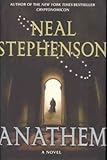
Anathem

Anathem (2008) by Neal Stephenson. William Morrow, 960 pages.

Anathem is a Big Novel. By that I mean both in physical length – at 960 pages, this is a good long read – and in subject matter. Anathem is a type of book I haven’t read in quite a while. Reading Anathem was like reading Dune for the first time, or Lord of the Rings, or The Foundation Trilogy.

It’s an epic, yes – but there are lots of epics out there. Anathem is one of those rare books that builds an entire world all its own, from the ground up, complete with its own detailed history, unique language, culture, and attitude. Anathem surrounds you and immerses you, so much so that I am still thinking in terms from the book, days after finishing it.

I knew Anathem was going to be very detailed right from the beginning. Before the novel even starts, there’s a 5 page “Note to the Reader” that introduces the language spoken on the planet Arbe, and gives a historical timeline of the previous 7,000 years of the planet’s history. The author advises the reader that while all relevant parts of the planet’s history will be covered in their own due time during the plot of the novel, the reader may find it “convenient” to refer back to the timeline “on occasion”. For me, that turned out to be about once every 10 pages or so.

In addition, the novel has its own language, much like may other fantasy and science fiction epics have done. The book has a glossary in the back, and in the first several chapters, dictionary definitions of terms unique to Arbe are sprinkled throughout the text. Some of the words are almost English, with just a slight difference in spelling or pronunciation. Some examples: On Earth we have “convents” of the religiious; on Arbe they have “concents” of mathematic and scientific scholars. On Earth “secular” means non-religious; on Arbe “saecular” means non-scientific – the world outside of the concent walls.

Anathem is a world-spanning novel set on the very Earth-like planet of Arbe. On Arbe, scientific and learned people live in walled, secluded communities, in the same way that some religious orders live on Earth. These communities are called “concents”, and the individual orders within them are called “maths”. Individual members of these walled academies are called “avout”. Structurally, it’s sort of similar to an old British university of colleges, like Oxford. Culturally, however, it’s much more like a religion on Earth. The concents follow strict rules of study, dress, and conduct, and interact with the outside world only on rare and highly regulated occasions.

On Arbe, civilizations rise and fall, but the maths have stayed constant. Oh, the concents have been sacked a few times during their 4,000 year existence, but they always reform after each pillage, stronger than they ever were. Within the walls of the concents, history is maintained. All scientific theories, research, and knowledge that has ever been developed by anyone, anywhere in the world are recorded, studied, and researched behind their walls. The avout are the keepers of all of Arbe’s collective knowledge.

Anathem opens in the year 3689 A.R. (“After Reconstruction”), in the Concent of Saunt Edhar. The novel is a first-person narrative, written by a 19-year-old “fraa” (a male avout) named Erasmus, or Ras, as he is called by his friends. The story begins as Ras describes the ceremonies the day before the gates of his concent are to be opened for the first time in ten years to the outside world, a 10-day festival called “Apert”. As we follow Ras throughout his day, we learn how the world of Arbe is very similar to – and yet very different from – our own Earth. Is Arbe a lost colony of Earth? Is this a parallel universe of some sort? Or is Anathem just an alternate history, an “Earth that might have been” kind of story? I won’t tell.

Mysteries unfold. Fraa Orolo, Ras’s mentor and a renowned member of the concent, is expelled for violating one of the basic rules of the order: using technology from outside the concent walls (a portable computer and video recorder, as it turns out). Political struggles between the members of the avout and the outside, saecular world. Mysterious revelations that some members of the avout have been tinkering with advanced genetic engineering, something that has been forbidden for over 3,500 years.

And then a massive spaceship settles into orbit around Arbe, a ship constructed with designs that seem familiar, but using technology that is not. And yet the ship is engraved with geometric symbols that are strangely familiar to the members of the avout, who have maintained their planet’s history throughout the rise and fall of many civilizations. Who are the extraterrestrial visitors? What do they want? And why do they seem to only want to communicate with members of the avout, ignoring the political entities of the saecular world?

We discover all of this through Ras, as he writes his first-person description of all that happens. I’m not going to give away any more of the plot, but I will tease and say that by the end, Arbe will never the same – and you will fully understand how the worlds of Earth and Arbe are intimately connected.

Anathem is a terrific read, engrossing and exciting – and enlightening as well. Although it is an epic science fiction novel, it’s also a keen study of the cloistered world of academia. On Arbe, academics are literally shut away from the rest of the world, and much of their conversations are in the form of “dialogs”, classic structures of education between a fid (student) and a mentor. These are clearly modeled after our own Greek dialogs of Plato, Socrates, etc., and they have formal rules of engagement. There are sections of the book where the characters may engage in this formal sort of dialog for 10 or 20 pages at a stretch, and yet I never found it boring.

Anathem is a different sort of novel for Neal Stephenson. His previous works have been two classics of the cyberpunk genre (Snow Crash and The Diamond Age), and a set of linked historical novels (Cryptonomicon, Quicksilver, The Confusion, and The System of the World). This new work is his first try at a “whole world” epic, and it is a fantastic, marvelous success.

Although Anathem ends cleanly and completely (no loose ends, no “still to come” nonsense), most of the major characters are still alive at the end, and the book cover less than a single year. Could Stephenson be planning a sequel, or at least some sort of related novel? His previous four novels were all linked together in a common history, so I certainly wouldn’t rule it out.

If you like epics – if you like massive works of realistic science fiction with great characters – if you like to immerse yourself into a world other than your own – then go and buy Anathem, and settle down for a long read. Anathem is an investment that pays off with joyful dividends. You will be in for a great and rare pleasure.

Categories
Books

Diary of a Wimpy Kid

Diary of a Wimpy Kid (2007) by Jeff Kinney. Amulet Books, 218 pages.

Diary of a Wimpy Kid: Rodrick Rules (2008) by Jeff Kinney. Amulet Books, 218 pages.

I like to laugh. I think most people do. Have you ever seen Mary Poppins? There’s a number in that movie called “I Love To Laugh“, with Ed Wynn as Uncle Albert. In the sequence, everyone’s laughing so hard that they float up to the ceiling of the room and have a tea party there. As a child, I thought that was the best scene in the entire movie, and I used to listen to that song on the soundtrack record over and over.

I love to laugh.

And oh man, was I laughing hard over these two books. I read the first volume, Diary of a Wimpy Kid, late at night in bed. Several times I woke Frank up because I was shaking so hard with laughter. I finally had to get out of bed and go sit in another room, so I could finish the book without disturbing him. Or waking up any of the animals with my loud peals of laughter. The second volume, Rodrick Rules, is equally funny.

Diary of a Wimpy Kid purports to be the diary of 7th-grader Greg Heffley. The series originated as a web comic (which it still is, and which you can find here) which went day by day through Greg’s life. The printed versions are rearranged, edited, and updated versions of the web comics, printed in logical sequence and somewhat streamlined. (And with an eye towards avoiding any possible copyright problems: For example, in the web version, Greg reads “Encyclopedia Brown“, a childhood book series familiar to everyone. But in the printed version, it’s been changed to “Sammy Sleuth” so as to not overtly invite lawsuits.)

Author Kinney is primarily a cartoonist. He started the series because he needed a venue to show off his cartoon art, and he didn’t have a portfolio. By necessity, he had to write some material to go with his cartoons, so he came up with the idea of an illustrated journal of a fictional 7th-grader (which I have to assume is at least somewhat based on the author’s real life).

Every page in the books has at least one cartoon, and the whole book is printed as if it’s in a boys’ neat printed lettering. Greg, his best friend Rowley, his evil older brother Rodrick, his painfully annoying younger brother Manny, Mom, Dad, and all the teachers and other kids at school make up the characters.

I understand these books are very popular with the tween set. I’m not sure what it says about me that I found them so funny I practically choked while reading them. Either my sense of humor is extremely juvenile, or I maintain a reassuring dialogue with my inner child. Or, maybe this is just plain funny stuff to anyone of any age.

Here’s a little preview:

First of all, let me get something straight: This is a JOURNAL, not a diary. I know what it says on the cover, but when Mom went out to buy this thing I SPECIFICALLY told her to get one that didn’t say “diary” on it.

Great. All I need is for some jerk to catch me carrying this book around and get the wrong idea.

The other thing I want to clear up right away is that this was MOM’s idea, not mine.

But if she thinks I’m going to write down my “feelings” in here or whatever, she’s crazy. So just don’t expect me to be all “Dear Diary” this and “Dear Diary” that.

The only reason I agreed to do this at all is because I figure later on when I’m rich and famous, I’ll have better things to do than answer people’s stupid questions all day long. So this book is gonna come in handy.

That’s from the first page and a half. Laugh along as Greg runs for class treasurer, since he believes that will allow him to control all the money in the school. Thus he can get the girls on his side and punish the jocks. Or when he and his friend Rowley go trick or treating, even though they’re obviously too old to pull it off. Or when Greg is forced to take part in his school play, “The Wizard of Oz”, as one of the apple trees – only to discover his teacher has written a new song just for them, “We Three Trees”. Or taking drumming lessons from his insolent teenage brother. Or spending the weekend with his clueless Grandfather. And so many, many more.

The cartoon illustrations are hysterical, and if there isn’t a desk calendar of them yet, there should be.

At around $10 a volume, this is some of the most economical laughter you’re going to find in these recessionary times. Kinney has said there will be five volumes total, so I have three more to look forward to.

And remember: Beware of the Cheese Touch.

Categories
Books

The Age of American Unreason

The Age of American Unreason by Susan Jacoby (2008). Pantheon Books, 356 pages.

Remember the term “Highbrow“? You don’t hear that much anymore. Nor its companion, “Lowbrow“. And never, ever do you hear “Middlebrow“, which was all the rage during the 40’s and 50’s. Nowadays, people use words like “elitist” and “trailer trash” to connote one end or the other of the culture spectrum… when they bother to discuss it at all.

But Way Back When, folks like Virginia Woolf used to write reams about how Middlebrow culture was going to destroy society, by keeping people away from the good Highbrow stuff. Unfortunately for Virginia and all of her friends who used to write long-winded articles for The New Yorker, that’s not at all what happened. Instead, Middlebrow culture vanished almost entirely, and Lowbrow increased its share accordingly.

In a nutshell, that is what The Age of American Unreason is about: How Middlebrow culture has nearly ceased to exist. Reading this book is what prompted my post on elitism a few weeks back.

The book’s first chapter grabbed me right away: “Just Us Folks”. In this introduction to the book, Jacoby outlines how our national discourse has fallen dramatically over the past 70 years. She points this out by excerpting a few of Franklin Roosevelt’s fireside chats, in which FDR spoke eloquently and candidly about the issues facing the country. He did not speak using eighth grade words, or patronize to his audience. He described complex problems and the complex solutions that would be required, and assumed that the citizens of the country cared enough to listen carefully. And would carefully discuss and vet the solutions he proposed. And that is pretty much what happened.

But nowadays, politicians try to fall over themselves in showing how “folksy” they are. Instead of speeches to “My fellow citizens”, they makes speeches to “my friends” or “regular folks”. The complexities of our problems are buried and simplified; our leaders demand nothing of us and expect even less. They assume that their listeners are ignorant, and in doing so, create a self-fulfilling prophecy of ever-downward expectations. So rather than engender a lively discussion of our banking and credit system, and the myriad little things we should do to shore it up, and the pros and cons of each and their possible long term effects… well, they just say that the whole industry needs a “bailout” and that these things just happen.

Jacoby descirbes how reading for both pleasure and education continues to drop every year. She illustrates this by pointing out how the entire country used to breathlessly await the arrival of the latest serialized chapter of the latest Dickens book – but now, if people here of an interesting book, they wait for the movie or video game version. She believes that this change actually affects our cultural ability to remember things:

Memory, which depends on the capacity to absorb ideas and information through exposition and to connect new information to an established edifice of knowledge, is one of the first victims of video culture. Without memory, judgements are made on the unsound bias of the most recent bit of half-digested information.

Jacoby also believes that the rise and embracing of fundamentalist religions has greatly contributed to the decrease in the reasoning capabilities of many Americans. Since any fundamentalist approach to faith (she argues) requires that its adherents never question any of the tenants of said faith, they cannot learn how to read a text critically. And when she uses the term “critically”, she uses it in the classic scholarly sense of the word: carefully analyzing a text to see what it means.

This chapter reminded me of a childhood Sunday school class. When I was in the 4th grade or so, we were reading and discussing the story of Jonah and the whale (beginning around Jonah 1:17 and continuing to about Jonah 2:10). We read the story critically – what was the message of the story? What was the lesson? What is God telling us in this story? When someone in the class (not me!) asked how Jonah could survive inside a whale’s stomach for three days, what with stomach acids and all, our teacher chuckled and said the story was not a literal factual story, but was instead a parable – like the parables Jesus used on the mount – and we were supposed to discover what the story was telling us about God by carefully reading the story. We were taught how to “read between the lines”, which is the first time I remember hearing that phrase.

That kind of Sunday school teaching, I am sad to say, seems to occur less and less nowadays. Jacoby believes that this fundamentalist approach (mostly in Christian faiths in the U.S., but also in Muslim and Jewish faiths in other parts of the world) greatly contributes to the lack of formal reasoning in adults of our era. And yet, almost no one ever addresses this issue when we talk about education (or religion, for that matter):

One of the most powerful taboos in American life concerns speaking ill of anyone’s faith – an injunction rooted in confusion over the difference between freedom of religion and granting religion immunity from the critical scrutiny applied to other social institutions. Both the Constitution and the pragmatic realities of living in a pluralistic society enjoin us to respect our fellow citizens’ right to believe whatever they want – as long as that belief, in Thomas Jefferson’s phrase, “neither picks my pocket nor breaks my leg”. But many Americans have misinterpreted this sensible laissez-faire principle to mean that respect must be accorded the beliefs themselves. This mindless tolerance, which places observable scientific facts, subject to proof, on the same level as unprovable supernatural fantasy, has play a major role in the resurgence of both anti-intellectualism and anti-rationalism.

The book moves on to cover the rise of pseudoscience: how various scientific-sounding ideas became pop culture sensations. One prime offender is the completely non-scientific idea of “social darwinism“. This is the notion that human interactions are similar to, or even caused by, biological evolution – i.e., that “survival of the fittest” is either a goal to strive for in society, or else is a cause of behavior that cannot be changed.

The chapter on this subject is fascinating, and shows how most Americans don’t understand what the term “science” really even means. Darwinism is strictly a genetic, scientific, biological process: It has nothing to do with psychology, culture, nationalism, religion, or any other aspect of human behavior at all. And yet more and more we see the terms “evolution” and “Darwinism” used in discussions that have nothing to do with biological speciation over time.

Another chapter talks about the “Red Scare” of the 50s, and how this was another attempt to make scary any sort of “high falutin’ book learning”. After all, if you’ve read The Communist Manifesto, so the argument went… then you must have instantly believed it and become a “fellow traveler“. For years, people were afraid to even read the book – for fear they’d be accused of actually being a communist. This, in turn, led to more questioning of “suspect” reading habits and learning in general. It starts with an accusation of treason if you read one certain book – and expands into a suspicion of people who read any books.

And if you think this is esoteric and doesn’t really happen in real life? Well, as I write this, on the eve of the 2008 election, for example, one candidate is claiming the other is a “socialist” and a “Marxist” – and it is pathetically obvious that the accuser has never read Marx and has no idea what a “Marxist” even is. To them, these are just scary words to throw at an opponent. And I’m sure if you suggested to Sarah Palin that she should at least read Marx and study his writings a bit before she uses such terms… well, I’m pretty sure she’d dismiss such a suggestion out of hand.

My favorite chapter, however, and the one that I think is the true heart of the book, is the chapter on Middlebrow Culture. Here Jacoby writes about all the little things that we used to do to educate our families: The Book-of-the-Month Club. Encyclopaedia Britannica in the home, carefully purchased one volume at a time. Attending lectures on important subjects. Visiting the art museum to see the popular pieces. Seeing the ballet, the symphony, or the opera when they came on tour to your town. And so many others in this vein.

Ironically, Highbrow culture used to frown and dismiss all of this Middlebrow stuff as dumbing down important topics for a mass audience. Jacoby’s main argument here was that the end result of these attacks were the virtual elimination of Middlebrow culture entirely, and the rising up of Lowbrow culture to become the common “Pop Culture” we have today.

In short, Susan Jacoby has written an eye-opening book about the rise of anti-intellectualism and the decline in reasoning. If you, like me, are worried that our current embrace of ignorance combined with arrogance is a deadly combination… then I urge you to read The Age of American Unreason. The book is written in a witty academic style that, true to its premise, never dumbs down its approach, but doesn’t skip opportunities for humor at the same time.

I think Virginia Woolf would probably approve. I know Franklin Delano Roosevelt would.

Now stop reading this and get out there and vote.

Categories
Books

Two Books I Didn’t Finish

Friends, family, and the very small number of readers of this blog who do not fall into either of those two categories know that I am a Constant Reader. But I don’t like everything I read – as witness by some reviews I’ve written, such as my trashing of John Grisham‘s The Appeal. And, every now and then, I start a book that I’m sure will be at least a decent read, but I just can’t finish it.

For novels, it’s usually because I find it boring or not well written. For non-fiction, it’s often because the subject matter turns out to be not really what I was expecting, or – far more likely – the author, while being a fine expert on the subject at hand, is simply a terrible writer.

One example of the latter was Bill Clinton‘s autobiography, My Life. The subject matter was certainly interesting. But when it comes to writing, Bill Clinton is no Jimmy Carter or Richard Nixon, both of whom write quite well. Clinton’s work was almost unreadable. I got about half way through and simply couldn’t slog through any more of it. It was like reading a poorly translated textbook.

This always annoys me because books aren’t cheap, and even if I end up not liking the book in question, I do expect to read it from beginning to end.

Sometimes, however, I just can’t. Here, then, are two books that I tried to read within the last month, but did not finish.

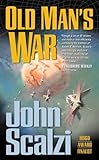
Old Man’s War by John Scalzi (2004). Tor Books, 320 pages.

I really like well-written science fiction, and I had read a couple of reviews of Scalzi’s work that lead me to believe I would like his writing. Scalzi is also mentioned frequently over on Wil Wheaton’s blog, and I’ve discovered over the years that Mr. Wheaton’s tastes usually match mine pretty well. So when Wil called out Scalzi’s latest for praise, I decided I’d check him out.

Old Man’s War is the first in a series of four books, all set in the same fictional universe, and all sharing the same basic character set (the book Wil Wheaton was talking about is the last, or most recent, of the four). The novel is set about 250 years in the future.

In this future, humanity has expanded out into the galaxy, thanks to a wormhole-generating faster than light drive. However, it turns out that our neighborhood of the galaxy is very crowded already, and when we start to colonize likely planets, we find ourselves at war with other potential colonists, and sometimes with the local residents of the worlds we’re trying to colonize.

So, the Colonial Defense Force recruits Earth’s senior citizens. Upon turning 75, they volunteer to become soldiers. They’re given a new, young body and have to serve 10 years as a soldier. If they survive, at the end of the 10 years they’re given yet another new body, and a free claim of land on some colonial planet.

The problem is that this book reads like the sad, last few books of Robert Heinlein, when he was getting senile and very paranoid (i.e., Number of the Beast, a novel that I did finish and wish I hadn’t). It’s just wish fulfillment, with very little thought and no attempt at building a coherent world environment.

For example, it’s supposed to be 250 years in the future – and yet people on Earth still live to the same age in the same condition as they do today. They have the same types of computers, even referring to them as “PDA’s”, just as we do today. They live in little towns in America, holding the same types of jobs as they do today, driving cars around, living in single-family homes, just Mom, Pop, and apple pie.

In order to make the story work, Scalzi has to come up with a ton of totally implausible plot elements, such as there is no communication between the colonies and Earth. Ever. And never has been. Nor any technological exchange of information. So, basically, Earth is stuck in some sort of static state, where we haven’t changed in 250 years, while “out there”, they’re using new technologies and meeting aliens. And yet they recruit colonists and soldiers from Earth. The people of Earth are certainly a very incurious, strangely satisfied lot in this future, I must say.

I was about at the halfway point in the book when the new recruits, now transferred into shiny new indestructible 20-year-old super-athletic bodies with libidos to match , have to go to… boot camp. With a drill sergeant. Who yells at them and hates all of them. Yeah, right. 250 years in the future, when they can transfer minds into new bodies, have faster than light travel, space elevators, computers inserted into your head… and they’re going to still be running a boot camp straight out of 1968.

I got the feeling that the author saw Full Metal Jacket, said, “Wouldn’t this be cool.. in SPACE!!” and started writing.

I stopped reading and deleted it off my Kindle. Looking through the reviews on Amazon.com, I see that people absolutely love this book. And for the life of me, I can’t figure out why. It just is… not very good. And sadly, makes me very unlikely to ready anything else written by John Scalzi.

Me of LIttle Faith by Lewis Black (2008). Riverhead Hardcover, 256 pages.

Lewis Black is Funny with a capital F. I’ve got three of his comedy albums, I’ve watched every special he’s done, and I love his “‘Back in Black” sections on The Daily Show. And, I had enjoyed his first book, Nothing’s Sacred, which was a combination autobiography and observational humor book.

Me of LIttle Faith purports to be Black’s humorous contribution to the current round of atheist / anti-religious tracts like God Is Not Great, The God Delusion, and The End of Faith. I’ve read all three of those books, and while they’re fine for what they are, they certainly could use a good satirical skewering. I figured Lewis Black would be just the right guy to perform such a skewering.

Unfortunately, his heart just doesn’t seem to be in it. I got the feeling that perhaps he felt he should write another book, but didn’t have a topic. It reads like an assignment: “Hey, Lewis! Write a book that’s a send-up of some of those atheist books”.

Lewis isn’t an atheist but isn’t religious either (kind of like myself). He does, however, seem to be very superstitious. On one page he’s making fun of some aspect of the catholic church or the jewish faith, and on the next page he’s carrying on about his very good pyschic friend who absolutely can tell the future – and he’s serious about the psychic friend.

My stopping point was only about 40 pages from the end, when I simply didn’t care any more. This book commits the cardinal sin of a humor book: It’s not funny. And Black doesn’t have the scholarly or theological chops to write a serious book on religion, so it just comes off as a meandering, unfocused collection of thoughts and experiences. Kind of like an episode of Seinfeld without any laughs.

Let me repeat: It’s just not funny. If you want funny, check out David Sedaris‘ latest book, When You Are Engulfed in Flames. Now that’s a funny book. As opposed to Me of Little Faith, which… isn’t. I think I’ve made my point here.

So there you have it! Two books I didn’t like and didn’t finish. I guess I can’t call these reviews, since for all I know both of these books might somehow have turned out fantastic in the very end.

But I’ll never know. And I suggest you never bother to find out.

Categories
Books

World War Z

World War Z: An Oral HIstory of the Zombie War by Max Brooks (2006). Three Rivers Press, 352 pages.

I just love zombies. As a fictional type, they’re hard to beat. So much can be done with them. You can have your outright horror, like Night of the Living Dead. You can up it a notch, add gore and social commentary: Dawn of the Dead. You can use them in a comedy, like Return of the Living Dead. And you can even use them as the focal point of a surprisingly good novel, like this one.

World War Z is a pastiche, a novel written in the form of another type of book: the oral history. This type of book is best known in the works of Studs Terkel. Terkel’s most famous book (and my introduction to his works) is The Good War: An Oral HIstory of World War II. Quite obviously, the novel we’re talking about here is a direct takeoff of that book.

When I first heard of this book, I figured it would be a one-note joke, not really worth reading. But several people I know read it and really liked it. And then I heard from a Studs Terkel fan that this one one of the best fictional emulations of the “oral history” style he’d ever read, regardless of genre. So I figured, what the heck.

World War Z starts out with an introduction from our nameless narrator, written in a dead-on mimic of the Terkel style. In the introduction, written approximately 25 years from now, we learn that this is a collection of remembrances of the Zombie War that broke out “twenty years ago”. Or, in other words, a year or so from “now”. The war, in which most of the population of the earth was converted into zombies by means of an unspecified plague, nearly destroyed humanity. These collected remembrances are about how the world fought back and recovered from the Zombie apocalypse.

As a novel, my only plot complaint is that we never learn what exactly causes “zombieism”. We hear over and over from various surviviors that it’s some sort of virus. Once a person is infected (by being bitten by a zombie), that’s it. Within a few days, you die. A few minutes after death, you “reanimate” as a brainless, dead zombie. Although many people refer to the “virus” that causes the zombie plague, that’s as far as it goes.

In this story, zombies are really, truly walking corpses. They don’t eat, they don’t breathe. They can only be killed by destroying their brains. They crave living flesh – presumably to infect it, since these zombies don’t seem to gain anything by eating people. They also don’t seem to want to eat brains any more than any other part of the body. In this respect, they are much more like the George Romero zombies from Night of the Living Dead, et al, than the brain-craving zombies from Return of the Living Dead, et al.

Wow. I just used the phrases “in this respect” and “et al” in a post about zombies.

What’s surprising about this book is how realistic and moving it is, especially in light of the ridiculous premise. Brooks takes great pains to make this sound like it really, truly is a collection of interviews of survivors from this war. He interviews the doctor in China who witnessed the first outbreak. A soldier who was there in Yonkers, when the military tried in vain to hold back a zombiefied New York. An Australian austronaut, who survived for three years on board the International Space Station as the zombie war played out. The man who was vice president during the war. And so on.

Many of the people in the book are thinly disguised characterizations of real people. There’s a movie director names “Elliot” who is obviously supposed to be Steven Speilberg. The president during the war is clearly Colin Powell, although he is never referred to by name. An unnamed potty comedian on the radio must be Howard Stern. And so on. It’s fun to try to figure out who each figure in the book is supposed to be in real life.

This isn’t they type of novel that grabs you and doesn’t let go; the plot meanders quite a bit. However, that’s to be expected since the book presents itself as a collection of audio interviews, not as a continuos third-person or first-person narrative like a normal novel. It sure does make for a fun read, however, and it’s easy to pick up and put down. I read World War Z over a period of a week, picking it up every now and then to read additional interviews. This would be a great book for a long plane trip, or for situations when you might get interrupted a lot.

World War Z has already been optioned as a movie, and it’ll be interesting to see how Hollywood turns a fictional collection of made-up interviews into a coherent film. I look forward to hundreds of thousands of zombies in Manhattan, zombies strolling across the ocean floor, zombies in the sewers, zombies trapped inside abandoned cars, and zombies unthawing from the snow in the spring. Let’s hope they don’t CGI it to death.

And by the way… if you’re worried that the Zombie Apocalypse might actually occur, well, Brooks has an earlier book called The Zombie Survival Guide that you might want to take a look at.

Peace out, and guard those brains.