Categories
Books

The Post-American World

The Post-American World by Fareed Zakaria (2008). W.W.Norton, 288 pages.

A few days ago I was having lunch with my friend and colleague Frank Anderson (despite the name similarity, he is no relation to “my” Frank, who is Frank Henderson). Since both Frank A. and I love to talk, we were both going on at high speed about the presidential election, politics, the economy, oil prices, you name it. In between bites of Thai food (Thai Spice in Fort Lauderdale – great food, great atmosphere, great service) we both carried on at quite some length about the need for our country to switch to some other fuel source rather than oil.

Having recently finished reading Fareed Zakaria’s new book, The Post-American World, I felt flush with knowledge about the current world economy, and I pontificated at length about how I thought we should go about “getting rid of oil”. Frank A. and I both agree on the basics: Rather than spending money on ridiculous, pointless wars just so we can have leverage over some oil supplies, why not spend the same money and encourage a full-on switch to ethanol or biodiesel? It’s a discussion we have had several times, and we’re both enthusiastic about the topic.

The state of the world we live in – and our place in that world – is on a lot of people’s mind these days. And that is the subject matter of The Post-American World. Despite the first impression that one might get from the title, this is not a book about the decline and/or fall of America or even the American way of life. Instead, what this book is about is the rise of the rest. It is, in fact, actually a very optimistic book, laying out a very logical path for how the rest of the 21st century might come to pass.

I’ve respected Fareed Zakaria for a few years now. He first came to my notice as a columnist in Newsweek . Later, I started to see him on a couple of the Sunday morning talk shows here and there. And more recently he starting making occasional guest appearances on The Daily Show with Jon Stewart. Zakaria is an enthusiastic, highly intelligent student of the world stage, and I’ve always found his opinions to be pretty well thought out and on the mark.

Zakaria belongs to the Realist school of geo-political thought, a camp in which I count myself as well. Unlike Conservatism, Neo-Conservatism, Liberalism, Socialism or any other current ideology, Realism tries its very best to discover and deal with the world as it really, truly is. No idealism, no ideology, just plain, straightforward analysis. Exactly why are people doing what they are doing? What are the real driving forces behind various actions? What’s the most logical outcome, based on what we know has actually happened before? Realism strives to avoid wishful thinking, and concentrate solely on how things actually work in the real world.

The Post-American World is divided up into seven chapters, each dealing with a particular main theme. Two of the chapters, “The Challenger” and “The Ally” deal with China and India respectively. The first chapter, “The Rise of the Rest”, lays out the overarching philosophy of the book.

The cold war is over. We won. Or, more specifically, the economic system of capitalism won and the economic system of communism lost. For decades, we in the West had been preaching that free markets, stock exchanges, a strong currency, and an open economy were the best way to bring prosperity to any country or region. The rest of the world finally agreed. And once they agreed, they began to work at a feverish pace to make up for past mistakes and to catch up with the West.

For the last 30 years, and especially in the last 20 since the fall of the Soviet Union, Communism as an economic system has pretty much ceased to exist. Every country in the world is now trying as hard as it can to acquire all of the same economic benefits that the United States and other Western states has had for over a century. And, with the ability to study our very well documented history, they are able to do a very good job of it.

In Chapter 4, “The Challenger”, Zakaria outlines how China has done this. 30 years ago, China had 800 million people living in poverty. Today, it has 400 million – and the population is the same size. That’s 400 million people who have moved into the middle class in just 30 years. China has the 2nd largest economy in the world. It has a population of 1.3 billion people, almost 4 and a half times that of the United States. And China remains “communist” only in the sense that the ruling party still uses that name. Their economy is almost completely market driven, with private property, a strong currency, stock markets and exchanges, the works.

Thanks to their robust economy, China now supplies the World, as anyone who has shopped at Wal-Mart in the last decade can clearly see:

Wal-Mart imports about $18 billion worth of goods from China each year. The vast majority of its foreign suppliers are there. Wal-Mart’s global supply chain is really a China supply chain.

What I found most educational in this chapter was how the Chinese people feel about all this. They are an intensely patriotic people, very proud of their country and their accomplishments. Unlike the rest of the world, they just don’t see much of a problem in having an authoritarian form of government. Their attitude seems to be: I have a great job, a nice house, money to spend, and my children are living in the fastest growing economy in world history. Who cares if we don’t have freedom of speech, or elections?

In fact, the vast majority of Chinese see their form of government as a strength, not a weakness. They want an interstate system? No problem. Since there is no opposition, the government simply decrees “let’s have one”, and in five years… viola! For the most part, the Chinese think we’re the ones with the wrong political system – even though they agree with us completely on the economic system.

Chapter 5, “The Ally”, talks about India. Zakaria himself is originally Indian (he is naturalized U.S. citizen now), so he has a very good perspective on this. In much the same way that China has thrown off the shackles of communism, India is throwing off socialism. China now supplies the world with goods; India is positioning itself to supply the world with services. Why, you wonder, is India so well suited for this?

But more important is the fact that Indians understand America. It is a noisy, open society with a chaotic democratic system, like theirs. Its capitalism looks distinctly like America’s free-for-all. Many urban Indians are familiar with America, speak its language, and actually know someone who lives there, perhaps a relative.

For the rest of the book, Zakaria talks about how America can best take advantage of this new world reality. Sure, we’re still the strongest in military terms, and very likely we always will be. No other nation on earth is interested in spending the kind of money it would take to match us in that area, not even Russia. The rest of the world has learned from our mistakes, and is slowly trying not to repeat them. A strong economy beats a strong military any day of the week.

Towards the end of the book, Zakaria discusses the “smile curve”, so-called because it’s a simple U-shaped curve, like the smile on the “Have a Nice Day” happy face symbol. Picture a curve that starts on the left, curves down into a smile, and curves back up to the right:

At the top left of he curve one starts with the idea and high-level industrial design – how the product will look and work. Lower down on the curve comes the detailed engineering plan. At the bottom of the U is the actual manufacturing, assembly, and shipping. Then rising up on the right of the curve are distribution, marketing, retail sales, service contracts, and sales of parts and accessories. In almost all manufacturing, China takes care of the bottom of the curve and America the top – the two ends of the U – which is where the money is.

In other words, if we concentrate on what we do very well – education (the entire world values our universities as the best in existence), design, engineering , open immigration – and let the rest of the world do what it does best… then America can continue to ride high. America excels at the areas on both ends of the curve, which, after all, is where all the profit is to be made. So, we should stop whining about losing manufacturing to the rest of the world: There is simply not much profit in manufacturing. Get over it and move on. Let the rest of the world take care of that part.

I highly recommend The Post-American World. In fact, I’d say that anyone who works for a living should read it cover to cover. Zakaria has a great prose style; the book is a pleasure to read in addition to being highly educational. Especially at the moment, when we’re all caught up in the silly sport of a Presidential election, and people are complaining about using phrases like “putting lipstick on a pig”, it’s highly refreshing to read and appreciate a calm, cool, well-written tour of the actual world we live in, and our place in it.

Categories
Books

The EC Archives: Tales from the Crypt

The EC Archives: Tales from the Crypt, Volume 1 (2007). Gemstone Publishing, 212 pages.
The EC Archives: Tales from the Crypt, Volume 2 (2007). Gemstone Publishing, 212 pages.

By all rights, I should have been at Comic-Con 2008 during the last week of July. I bought a full pass more than six months in advance. I had a couple of old buddies from Los Angeles that I was going to team up with and “do the floor”. I had a place to stay. I had arranged a heavily discounted airplane ticket. I had my sessions planned out, what lines I was going to stand in for autographs, what panels I was going to attend. I had everything but a costume.

Fate intervened.

Two days before I was to leave, I came down with The Mother Of All Colds, expanding into a strep-throat-like illness that made me sound like Harvey Fierstein, and so congested that I could only breath through my mouth. I couldn’t work, much less fly. And so, very reluctantly, I stayed here in humid Fort Lauderdale, instead of breezy San Diego. Sadness and gnashing of teeth ensued.

For the record, my last San Diego Comic-Con was in 2000, the last year I lived in Los Angeles.

One of my Los Angeles friends whom I was hoping would go to San Diego with me this year is Jonathan Green (as I have said before on this site, Jonathans Rule). However, Jon, being a responsible father, decided not to go this year. He did not want to set a bad example for his eight-year-old son, especially at a time in the boy’s life when Jon is trying to teach him thriftiness and the value of a hard-earned dollar.

Jon was, however, hoping to live vicariously through me. This was especially true since we are both huge EC Comics fans, and we had been exchanging emails over the past few weeks outlining some of our dream acquisitions.

When I emailed Jon that I would not be able to attend this year thanks to an Evil Virus Attack, he opined that the best revenge would be to stay in bed and read comics.

Which I did.

And that finally brings us to the subject of this review. If, a few paragraphs earlier when I wrote “huge EC Comics fans”, you went, “What the hell is EC?”, I’ll give you a very brief summary. “EC” stands for “Entertaining Comics”. Without going into all the detail (go here if you want that), when I say “EC”, I’m referring to the comic books published by EC from about 1948 to 1956. This period, referred to as the “New Trend” by the EC editors at the time, introduced the greatest revolution in illustrated fiction yet seen. EC comics included The Haunt of Fear , The Vault of Horror , Weird Science , Weird Fantasy , Shock SuspenStories , and – the only title to survive the 1950’s – Mad .

During the brief period they were published, EC Comics completely changed the whole concept of comic books. EC hired highly talented artists who brought a cinema-like touch to the 4-color pages. The stories were aimed at teenagers and young adults, not at children. Most, if not all, of the stories taught a lesson. Most were considered “racy” or “shocking” at the time. And almost all are considered classics today.

But the New Trend line of EC comics did not survive after the summer of 1955, when the U.S. Congress – spurred on by a pop psychology book called Seduction of the Innocent, which claimed comic books turned children in murderers and rapists – held hearings about standards and practices in the comic book industry. EC comics, with their lurid covers and cutting-edge stories, did not hold up well during a time when the country was looking to clamp down on any freedom of expression. And so, they were effectively banned. Mad was the only survivor, as it converted to black-and-white and resized itself into a magazine.

The New Trend EC comics are very rare nowadays, especially since as time went by, so many of them got adapted into lucrative television shows and hit films.

Naturally, there have been several reprints and collections over the years. I looked at many of these collections with longing, but most of them were reprinted in black-and-white, not in the full color of the originals. And many of the reprints excised some of the humorous elements like the prose stories and the Editor’s Page. But in the last few years, they’ve finally gotten the deluxe treatment, and that’s what I’m talking about today.

The EC Archives is a series of thick, glossy hardcover collections of the New Trend EC Comics. I read through both existing volumes of Tales From The Crypt during the week of Comic-Con, and was reminded of what glorious storytelling is contained within these pages. These reprints are made directly from the original art (with a few exceptions where the original artwork has been lost forever in time), and have been recolored using modern techniques by one of the original EC colorists. The artwork jumps off the page.

In these volumes of Tales From The Crypt – one of the very first of the revolutionary EC line – we can see how the basics of the 20th century horror story actually work. The spurned lovers, the revenge stories, the guy/girl who had it coming to them, they’re all here. You got your zombies, your ghosts, vampires, werewolves, aliens, robots, immortals, you name it, they’re here. And of course, there is The Crypt-Keeper to present them all to you – along with his fellow “Ghou-Lunatics”, The Old Witch and The Vault-Keeper.

As a modern reader, it’s baffling to see how anyone could have taken these stories so seriously that they would seek to ban them – just the presence of the hilarious “hosts” for each story should have been enough to clue in even the most humorless person skimming any issue. These are the best forms of what I call Delicious Horror – the type of ridiculous phony gore that is delectable to watch (or read) because it’s so obviously not real.

Tales From The Crypt, like all EC Comics, specializes in the “Good Lord!” moment: the point in the story when some character realizes what is going on, or going to happen, or has been happening, etc. and then says “Good Lord!” followed by some sort of revelation. Here are some examples:

“Good Lord! Look! A dead man!”

“Locked! Good Lord! How will I get out of here?”

“Good Lord! It’s A… heart! A human heart!”

“Good Lord! I… I must be insane. Wanting to… No! Don’t let me do it!”

“Good Lord! How Horrible! He’s been… scalped!”

“Good Lord! Her pulse has actually stopped!”

“Good Lord! It’s locked! Chained… and locked from the inside!”

“Good Lord! My beard! It’s stopped growing!”

“Good Lord! He’s out of his mind! He’s fighting with that doll!”

And my favorite, from the cover of Tales From The Crypt #25 (found in Volume 2 of this collection):

“Good Lord! This isn’t wax! This is a human hand!”

These hardcover reprints are gorgeous to the eye, thrilling and entertaining to read. “Entertaining Comics” in the best of all senses of both words. I await the remaining volumes in this series, along with the other EC comic titles being reprinted in the same format. But beware, once you start reading them, you won’t be able to put them down.

Good Lord!

Categories
Books Technology

Eating My Words: A Kindle Review

Kindle: Amazon’s New Wireless Reading Device, $359.00

Almost 6 months ago I wrote a post here called “5 Reasons I Don’t Have a Kindle“. I got a surprisingly large number of comments on this post, mainly due to it getting a bit of popularity on Digg.com. However, as I pointed out over and over again in response to the comments, that article was not a review of the Kindle. It was, instead, a post about why I hadn’t bought one. I had five specific complaints, and at the time, I stated that until and unless a new model came out that addressed at least some of my complaints, I wouldn’t be buying one.

Well, I lied.

Or rather: what a difference a few months makes. Stuck in Las Vegas a month ago, I had a week to kill and had not brought enough books with me to fill the time. I was going to search out a bookstore (not exactly common in Las Vegas), when I noticed an article on Engadget stating that, for the first time since its introduction, Amazon actually had Kindles in stock for immediate shipment. No more waiting list. Right then and there, having a Kindle to wirelessly purchase some books and magazines seemed like the absolutely perfect thing to me. And, I figured, if I hated it, I could just return it.

So I ordered it from my laptop in the hotel room for next day shipping. And the next day it arrived, right at the Mandalay Bay Convention Center Business Office. And that night I stayed up until 2am, using the Kindle. I think I bought six things on that first evening: a newspaper, three magazines, and two books. I didn’t hate it. And I didn’t return it.

Now that I’ve had a Kindle for a little over a month, I figure it’s time to sum up my thoughts. The Kindle is a lot better than I thought it would be. In fact, if you tried to take it away from me now, you’d have to pry it out of my hands.

What no one else was able to clearly communicate to me – and what Amazon itself does not adequately communicate, in my opinion – is that the Kindle is really a platform for reading. The device itself has a number of problems, no question about that. Some of those problems are maddening if you focus on them. But the overall software, the environment, the platform that is The Kindle – that’s what matters. That is what makes the experience of using a Kindle so damn good. If you’re a “Reader” – if you regularly read books and magazines – you will love a Kindle.

Wireless Purchase, Instant Delivery. This is the heart of the Kindle platform, right here. The Kindle gives readers instant gratification. Interested in a particular book? Go to Menu, select Kindle Store, find your book, and you’ve got it in under a minute. From anywhere. At anytime. Basically, if you’re in an area that a cell phone will work, you’ve got immediate, constant, instant wireless access to the Kindle store. No charge, no wireless subscription, nothing. It’s free and built into the device.

When I read about the Kindle, this seemed like a gimmick. Who cares, I thought. I could not have been more wrong. I was waiting in the airport, and wanted to read a newspaper. But, you know, you bring a newspaper on a plane, you’ve got to open it, unfold it, shove your elbows in your seat-mate’s face, parse through the sections… it’s a mess. With the Kindle, I bought that day’s New York Times. And had it on screen in about 30 seconds. I also bought Newsweek, The Atlantic, Forbes, and Asimov’s Science Fiction Magazine. All downloaded nearly instantly, right while I was sitting there.

And reading through the New York Times, I read a review of a book… and bought the book immediately, right then and there, while I was still reading the review. So, when I finished the review, I was ready to start reading the book.

Clear, Easy To Read Screen. Although I had seen e-Ink technology demonstrated, and had played with a Sony Reader in a store, the Kindle is the first time I’ve used it day in, day out. It’s amazing. There is no real “off” state. Whatever the screen is at the moment, that’s what it is. It draws no power to keep text on the screen – it uses power only when the screen refreshes with the next page of text. And the screen is the closest I’ve ever seen to the printed page. I mean, it looks almost like a laser-printed piece of paper. There are no “jaggies”, no reflections – it does not look like a computer screen at all. In fact, the first time I showed it to someone else, they stared at it for a second, and then said, “Holy shit… is that the actual screen?” It turned out that they thought it was a printed cover of some kind that I was using to protect the actual screen.

The Screen Should Be Bigger. Although you can adjust the font size to be as large or as small as you want, to my taste there simply isn’t enough physical space to put as much text on the “page” as I expect. Even at the smallest text size, it’s still not the same amount of text as you would get on the printed version of the same book. This is the Number One thing I want Amazon to change in a future version of the Kindle. There are other book readers out there that are already using the latest 8″ and 9″ e-Ink screens, like the iRex Iliad. These readers are able to do a page-for-page match to the printed version. Amazon should follow suit as fast as possible. I would pay… well…. a good chunk of change for a Kindle with a 9″ screen, that’s for sure.

Magazines and Newspapers. As of this writing, there are 19 newspapers and 16 magazines available on the Kindle. Magazines are available either via subscription, or by purchasing just the current issue. I cannot emphasize enough how very, very cool this is. You can read Newsweek, Time, Fortune, Forbes, The Atlantic, and several others instantly, right away. Without the advertisements. Without the subscription cards falling out. And when you’re done, you just delete it – no paper to through away.

Not Enough Magazines. In fact, the only problem I have with the Magazines feature is that there are not enough. I want The Economist, Entertainment Weekly, Wired, Rolling Stone. I want specialty academic journals. I want every magazine that has text articles to have a Kindle version. Since I got my Kindle, they’ve added a couple of additional newspapers, and tons of new books come out every week – but so far, not a single magazine has been added to the list. To me, this is one of the greatest features of the Kindle. For example, on my Kindle I’ve subscribed to both Slate and Salon. And every day, a new issue is waiting for me. I would subscribe to dozens more if they were available. I would cancel my print subscriptions and switch to Kindle versions for almost every magazine I read.

Blogs Don’t Work Very Well. In addition to Newspapers and Magazines, the Kindle also offers subscriptions to a wide variety of current blogs – 341 as of this writing. However, for the most part, this isn’t worth it. I tried a number of blogs, such as Ars Technica, Pharngula, Boing Boing, and Daily Kos. The main problem is that they aren’t complete. Ars Technica doesn’t contain the Articles section of the web site, which is where (in my opinion) the best stuff can be found. Daily Kos doesn’t include all the Diaries, which, once again, are the best stuff. You can’t see any of the comments sections in any blog. And Pharyngula actually crashed my Kindle for the one and only time, requiring me to open up the back and press the Reset button. After an initial spate of subscribing to a dozen blogs – it’s so nice to read things on that great e-Ink screen – I ended up canceling all of them. I was missing too much. In their current form, the Kindle version of Blogs just does not match up to the web version of the same blog.

Highlighting. Ever want to remember a particular quote from a book? I sure do (especially when I’m writing reviews). The Highlight feature allows you to move the scroll cursor to the first line, select Highlight, move to the last line, click, and the selected “Highlight” text is then placed in quote format in a Kindle book called “My Clippings”. With a full reference to whatever it’s from. This was another feature that I thought was “so what” when I read about it – but the first time I used it, I immediately understood its value.

Dictionary Lookup. Every run across a word in a book that you don’t know? Or one that you think you sort of know the meaning of, but you’re not completely sure? The Kindle has a built-in dictionary. Scroll the cursor to any line on the screen, and select “Lookup”. A popup window opens with the words in the sentence you’ve selected, with a mini-definition for each word in the sentence. Select the actual word you’re interested in, and you get the full definition. And then a single click of the scroll cursor, and the definition vanishes, and you haven’t left your book at all. I absolutely love this feature. It is simple and elegant. This is one thing that does not need to be improved on at all – it is just enough, and it works perfectly.

Other Sources of Books. I didn’t realize that there are lots of sources for free books for the Kindle. Most books that are in the public domain (that means the vast majority of literary classics and books from more than 75 years ago) are available for free from a wide variety of sources. My favorite is feedbooks.com, which has a single document that you can download directly to your Kindle. This document, in turn, contains a catalog of all their books that are already formatted for the Kindle. Just select the book you want – The Great Gatsby or Gone With The Wind, for example – and that book is instantly downloaded to your Kindle, just as if you’d purchased it directly from the Amazon Kindle store. Only it was completely free.

This is an area that I hope gets expanded on a lot. It would be great if, for example, companies started providing their product manuals in Kindle format (they can use the openly available Mobipocket format, which works transparently on the Kindle). Or all kinds of documents. It is so much easier to read things on the Kindle than it is on even the best computer monitor. Amazon should evangelize this capability and encourage anyone and everyone to make all their documents available in Kindle format. I can tell you right now that one of my “side projects” at work is going to be converting some of our product documentation into Kindle format. Maybe I can start a quiet little movement in this regard…

You’ll Need Light. One drawback to the screen is that it has no light source of any kind. Since the e-Ink display is not backlit , and since it does not draw power at all while you’re reading a screen of text, it is no brighter than a sheet of paper is. Which means you need a light to read by. For future versions, I sure wish they would design some sort of socket to attach a little reading light to. I use an Itty Bitty Book Light, and clip it on to the leather case that the Kindle fits into. This works mostly OK, but it does feel rather jury-rigged. And it adds a messy cable to the whole situation.
This drawback became very apparent when I was flying back from Houston a few weeks ago, and the reading light for my seat was out (thanks, Southwest). The only thing I had with me was my Kindle. And with no light, you can’t see the screen any more than you can see a book without light. So I had to sit in the dark, unable to read anything. Admittedly, physically printed books and magazines have exactly the same problem – but I expect an electronic device that costs almost $400 to be able to provide me enough light to read by as part of the bargain!

Turned Off During Takeoff and Landing. Here’s another drawback. On the same trip (but going out, when I had a light) I was annoyed by the fact that the flight attendants demanded I turn off the Kindle until we reached 10,000 feet – and again a full 20 minutes before we landed. Since the only thing I had with me was the Kindle, I had nothing else to read. If you’re in the middle of a good book or magazine, it’s very annoying to sit there for up to half an hour waiting for the OK to turn it back on. I can understand (sort of) the need to turn off devices that have some sort of communication capability… but you can easily turn off the wireless function on the Kindle with a simple switch, without affecting any other feature. Although it’s worth noting that because the wireless on/off button is on the back, you have to remove the Kindle from its leather cover in order to do that. The switch really should be on the top of the device, not on the back.

Why do the airlines require you to turn off these kinds of devices? I realize this is not Amazon’s problem, but maybe they can help lobby the airline industry. I love the way they say “FAA regulations state…” when they state no such thing. Each airline could choose whether or not to allow these sorts of devices – there are no regulations at all. But they choose to take a One Size Fits All approach, because they don’t want laptops flying through the air while a plane is landing. However, a 10-ounce Kindle that draws no more power than a watch is simply not in that category.

Previous and Next Buttons Are Awful. This takes a day or two to get used to. This is the one area where I really don’t know what the designers were thinking. The “Next Page” button runs down almost the entire right side of the device – and it’s angled in addition to that! So there is literally no way you can hold it on the right side without hitting the “Next Page” button by mistake. Your only option is to either hold it by the screen itself, or to finesse your fingers around the blank spots in the keyboard area. On the left side, the “Previous Page” button is almost but not quite as bad… at least it doesn’t run the entire length of the device.

To me, this is the single biggest design flaw of the device. When I turn the page of a book or magazine, I reach up and turn the top corner. So why didn’t they just put the Next and Previous buttons up at the top of the device, and leave the rest of it as a margin to hold on to – just like a real book? Instead, the entire margin area is eaten up by a giant Next button. This feature needs to be fixed right away. Even before going to a larger screen, Amazon needs to do a “1.1” quick fix redesign to change these buttons. It would be a trivial change, and yet would make a huge difference in ease of use. My guess is they expect people to rely on using the leather cover as the way to hold the device. Which leads me to my next point…

Leather Cover Is Poor. The leather cover – which thanks to the poor positioning of the Next and Previous buttons is an absolute requirement for reading – simply doesn’t attach very well. In fact, it doesn’t “attach” at all – it just sort of hangs on by use of a tab in the back that fits into a depression on the back of the Kindle. I found that by folding up a piece of paper and wedging it into the “clip” part of the leather cover, I could get the Kindle to stay attached to the cover most of the time. Unless you make a sudden movement, or try to read at an angle. This is another area where it seems strange that it doesn’t work better. How about a simple piece of velcro, or a sliding notch? I remember I had an old Palm Tungsten device that had a leather cover that slid into a slot along its left side. An approach like that would work perfectly for the Kindle.

Zoom For Illustrations Would Be Nice. For books with illustrations, it sure would be nice to have some sort of Zoom or Enlarge option. I was reading Your Inner Fish by Neil Shubin, which has quite a number of illustrations, including some detailed biology specimen sketches. Unfortunately, they were just too small to be able to make out the writing. I am aware that text is the primary function of the Kindle, but it would be relatively simple to add some sort of enlargement function to handle this special case.

It Plays Music But I Don’t Care. The Kindle is also able to play music – or so it appears. I’ve never tried it, and doubt I ever will. This seems pointless to me, and putting volume knobs and a headphone jack onto a book reading device strikes me as a waste of space and circuitry. It’s never going to be an iPod, which is what all my music comes from these days anyway. I say pull out the audio stuff and free up the space and power for more reading.

DRM is Tolerable. One of my primary objections to getting a Kindle was its use of DRM (Digital Rights Management) “anti-piracy” protection on all books. I put that in quotes because I consider DRM in all forms to be an insult to every paying consumer. I’ve paid for the book (or song or movie), so why are you treating me like I tried to steal it? However, I’m somewhat mollified by accepting the fact that anything on the Kindle is not really purchased – instead, you’re basically renting the book or magazine. If you want a permanent copy, go buy the physical book. I still think the DRM approach is wrong-headed, insulting, and detrimental to the long-term survival of these kinds of devices, but I’m willing to live with it for convenience’s sake at the moment.

In Conclusion…

Amazon… I’m hooked. You got me. I love it and I can’t live without it. But if you’d just put out a 2.0 version with a bigger screen, better Previous and Next buttons, and a decent cover attachment, I’d pay double what I paid for this one.

If you read for enjoyment with any regularity, you want the Kindle. Despite some of the criticisms I talk about here, this is a fantastic, wonderful machine. In fact, the only reason I’ve gone into such details about its mistakes is that the rest of the device is so damn good, the places where it falls down are that much more apparent. And let me reiterate again – focus on the entire experience, not just on the device itself. I hate to add to the hype… but the Kindle really does put a whole new spin on what “reading a book” can be.

Go get yourself a Kindle. They just dropped the price to $359, and they are in stock now. Happy Kindling!

Categories
Audio Visual Books

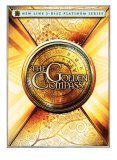
The Golden Compass

The Golden Compass (2007). 113 minutes, New Line Pictures. Directed by Chris Weitz.

A dismal, unsatisfying and confusing adaptation of a great book. Avoid this one like the plague, especially if you have read the book. Or even if you are planning on reading the book.

I should have known. When I originally heard that New Line was planning on adapting all three volumes of Phillip Pullman’s His Dark Materials Trilogy, starting with The Golden Compass, I thought, “Wow, that’s awfully gutsy for a major studio”.

You see, the trilogy covers the epic journey of a young girl on a parallel version of Earth, joined by various friends and opposed by numerous enemies. The action takes place on her own world, and then, after the first volume, on our world and then many other worlds. It culminates ina battle of the forces of good against… well, God and the Catholic Church, basically.

Yes, in His Dark Materials, God is an evil overlord who uses religion (specifically, the Catholic Church on our world, and its corresponding entity on other worlds) to control and enslave mankind. And the little girl Lyra, accompanied at the end by rebel Angels and others, finally succeed in destroying God and freeing the universe from… His Dark Materials.

Well, if that doesn’t have “Studio Blockbuster” written all over it, I don’t know what does!

The book(s) are about a lot more than that, and I’m summarizing it a bit loosely to make the point, but it is very far and away from Harry Potter or Lord of the Rings. The Golden Compass, the book that starts it off, is downright subversive in its appeal. It’s only after you’re into it for a 100 pages or so that you go, “Hey… wait a minute… what the hell…” as you start to realize that this fantasy story with talking animals, armored polar bears, and flying witches is really about A Lot More Than That.

Just as C.S. Lewis used his Narnia tales to teach a thinly-veiled allegory for Christianity, Pullman uses the three books including The Golden Compass to issue a thinly-veiled allegory for atheism (or really agnosticism, I suppose, since in Pullman’s works God is actually real, he’s just evil). It’s hugely popular in the non-U.S. parts of the western world, mainly in the U.K. and Australia, and reasonably popular among “weird kids” in the U.S.

Now, I personally loved The Golden Compass (the book!), as well as the other two novels that continue and complete the story, The Subtle Knife and The Amber Spyglass. But I’ll be the first to admit that it’s not suitable for everyone, and it definitely would offend and upset a large percentage of American parents. I mean, the people who protested Harry Potter actually have a solid argument about this series!

I guess New Line thought that if Harry Potter and Narnia were such big hits, they’d pull up another popular Young Adult Fantasy Series and give it a go. That’s what I thought when I heard they were going to adapt the books into big-budget films. I wondered what they would change…

The next thing I heard about the movie was some months later, when Nicole Kidman was cast in the part of the lead villain, Mrs. Coulter. I thought the casting was perfect. In the books, Mrs. Coulter is a beautiful, stylish, and deeply evil woman who actually tortures children. On purpose. And when they die (yes, children actually die in this series), she shrugs her shoulders and moves on. I thought Kidman would eat that part up.

But then Kidman said she would never act in any film that was not respectful of the Catholic Church and all that it stood for, and that “of course” all those elements had been “removed” from the film. I went back and re-read The Golden Compass. It seemed to me that if you just removed “those elements”, the story would not make any sense at all. And as it turns out… I was right.

The Golden Compass (the movie) is an antiseptic, by-the-numbers adaptation. Sure enough, all references to religion in any way, shape, or form have been removed. All tonal references to growing up sexually, or to the concept of a soul (“dust”, as it’s called in the novels) has been removed as well. Unfortunately, they weren’t replaced by anything.

So throughout this movie, we have no idea why anyone is doing anything. Why is Lyra given the golden compass? What is its purpose? Why does it matter that it tells the truth? Why does “The Magisterium” want to separate humans bodily from their animal other halves (daemons)? What are the flying witches? What are the armored bears? What is dust? None of these concepts or actions are explained in the film. Not even in a vague, comic-book-explanation kind of way. They are just… presented. Like someone made a PowerPoint summary of the plot of the novel in bullet points, and then they just filmed it.

Even the special effects look half-hearted and sterile. In this day and age, with CGI art being what it is, it’s not much of a challenge to make a talking polar bear or a flying witch. But to make such things look real and lived-in, especially when you’re supposed to be looking at actions on an entirely different world, takes real care and art. And apparently no one cared.

The whole movie looks like a video game, or, as Frank said while we were watching it, “one of those awful new Star Wars movies”. It never looks like anyone actually lives in it – it just looks… well, clean, crisp, and fake.

And by not explaining why or what anything is, the story just makes no sense. Here is my prime example: A linchpin of The Golden Compass is that on Lyra’s world, human minds (and souls) are split in half, physically. Half is inside your head, the other half resides inside an talking animal companion that is always at your side. This companion is referred to as your “daemon”. Every person has one. The types of animals are different, although usually the type of animal is representative of the overall type of person you are. Up until puberty, your daemon changes from one type of animal to another, as your personality forms. But once puberty hits, you daemon fixes forever on one type of animal. People know who you are, in a sense, by your daemon.

On Lyra’s world, the “internal dialog” that we have inside our heads is held instead with your daemon, all the time. All daemons, of course, talk. And there is a taboo, very strong, that you never, ever touch another person’s daemon. And, if anything happens to your daemon, it happens to you (and vice versa). If your daemon is killed, you die – and vice versa. And if your daemon is physically separated from you somehow, you would both die. After all – how could you live with half of your mind, or half of your soul?

All of that is very, very important to understanding even the basic plot of The Golden Compass. And almost none of that is explained in the movie. One key point about any scenes in the book is that there is always a certain amount of physical distance between people, so that daemons don’t touch when walking down a street, for example. Imagine a crowd scene where everyone is at least three or four feet apart from everyone else, so that their daemon has room to stand as well as not touching anyone else’s daemon. It would look quite cool if done right…

…but all of that is completely ignored in the movie. Daemons are there, of course, but most of the time they’re just thrown in as random CGI critters milling around people. Crowd scenes were obviously shot as normal crowd scenes, and then CGI animals were stuffed in around the edges. Sometimes you see people with their daemons, sometimes you don”t. No one pays any attention to them, and no one makes space for them.

And because none of this is explained or illustrated properly, the horror of what the church is doing to the children in the film – physically removing and killing their daemons while somehow leaving them alive with half of their minds – is also not explained. And so the horror is not felt. All we see is one child saying, “Where’s my rat?” and looking pale. In the book, this same scene is absolutely horrifying – because you realize that what the villains are doing is lobotomizing children so that they will become zombie slaves without free will. In the movie, however, it comes across as if they’ve just hidden a boy’s rat somewhere. Barely “evil” at all.

The whole movie is like that. Concepts from the book are kept intact, but all reasoning and explanation for them is dropped – probably because the filmmakers were afraid they’d offend somebody. As a longtime fan of the book, I was angry, annoyed, and very disappointed.

Frank, however, had never even heard of the book. HIs summation was that the movie was boring, sterile, and made no sense at all. We’d pause it every five minutes when he’d go “What the hell?” I’d try to explain it using the book version as a reference.. which was a losing battle.

Honestly, this film is terrible. Sure, there are some pretty visuals here and there, but that is absolutely all there is. It is so glaringly obvious that no one – not the writers, not the actors, not the producers – cared about the source material of this movie at all. I would be willing to bet that only a very few people involved even bothered to read the book.

Thankfully, this film tanked at the domestic box office. I fervently hope that they never make the rest of the series into movies. What in the name of all that is good would these people do to the climatic battle to overthrow God out of heaven in The Amber Spyglass, I’d love to know.

Don’t watch this movie. Don’t buy this movie. But if you love well-written, challenging fantasy, read The Golden Compass. And see the perfect version in your head, not on the screen.

Categories
Books

The Appeal

The Appeal by John Grisham (2008). Doubleday, 355 pages.

It’s been a while since I have read a John Grisham novel. Looking at my bookshelves, the last one I see up there is The King of Torts (2003), and honestly I don’t remember a thing about that one at all. However, I’ve enjoyed a fair number of his books – A Time to Kill, The Firm, The Pelican Brief – pretty much all of them up until The Summons, which I found repetitive of his earlier stuff yet less entertaining. And apparently he’s written a number of non-legal fiction books since the turn of this century, which don’t interest me in the least. Frankly, Grisham is just not a good enough writer to be interesting outside of his milieu.

Even in the very specialized genre of legal thrillers, Girsham has always, to my mind, not stacked up to Scott Turow, who although far less prolific, is a much better author. Unfortunately for Turow, only Presumed Innocent really made its mark on the bestseller lists, and he has nowhere near the name recognition that Grisham has.

However, I was intrigued by the book blurb for The Appeal, and thought that maybe a few years away from legal thrillers might have tightened Grisham’s work up a bit. So I bought it the same day I bought Stephen King’s latest and called it a bestseller twofer.

The new Stephen King turned out to be a blast, and I’ll be writing about it here soon. The Appeal, on the other hand, has got to be one of the most turgid, stereotypical novels I have read in a long time.

The plot of The Appeal is quite good: A giant chemical company, guilty of illegally dumping toxic waste in a small Southern town, loses a lawsuit brought by a woman whose husband and son were both killed by drinking water in the same town. The woman’s lawyers have nearly gone bankrupt fighting the giant chemical company, and in a great victory, the jury sides with them against the giant company and awards damages of 41 million dollars. The head of the chemical company, who would rather lose billions that pay a dime to white trash, engages a secret consulting firm to change the makeup of the state supreme court – thus ensuring that the chemical company will win… The Appeal.

What a great story! How could that possibly not be fun?

Here’s how. Everything in this book is so predictable, it might as well have been an episode of Perry Mason. The good guys are so good that you want to slap them: A married couple, both lawyers, with two adorable children. They’re so determined to help the poor woman that they sold their home and ran themselves $400,000 into debt just to finance the lawsuit. The wife is actually from the same horrible little Southern town that the lawsuit victim is from. They run a colorful little law firm where everyone works for no pay because they’re all so… well, good.

The villain, on the other hand, is so evil he makes Darth Vader look like Santa Claus. He’s so evil that he literally does not care if thousands of people died from his waste, as long as he doesn’t have to pay them one thin dime. He willingly spends 8 million dollars on a horrible sculpture to keep his new trophy wife happy and to get a mention in the morning paper. To him, spending 3 million to change the state Supreme Court of Louisiana is not unethical or wrong in any way, and he gives no thought to it at all – it’s just business.

About every third page or so, I would actually mutter, “hooo boy”, under my breath. What, is the villain going to boil a puppy in the next chapter? Are the husband and wife lawyers going to take in some orphans? John Grisham may be many things, but believe me, subtle ain’t one of them.

And worst of all, the book ends… exactly the way it looks like it would end in the first chapter. There are no twists, no changes of heart. One character – the hapless sap whom the evil consulting firm targeted to be on the Supreme Court – does have a sort of, kind of, life changing moment near the end of the book.. which results in absolutely nothing changing at all.

Predictable at the beginning. Predictable all the way through. And predictable (and boring) at the end. This was really a letdown. I mean, The Firm was genuinely fun, had some conflicted characters, and had a great twist ending. Most of the other Grisham books from the 90’s were similartly engaging. But not this one.

Unless you like your reading safe, predictable, and very pulpy, avoid The Appeal like the plague. I’m sure they’ll make a movie out of it, which is bound to be better than this book. In fact, I’m looking forward to it… because it will surely be one of the few occasions when I’ll be able to say “Oh, the book was much worse!”

Categories
Books

Benjamin Franklin: An American Life

Benjamin Franklin: An American Life by Walter Isaacson (2003). Simon & Schuster, 590 pages.

I’ve always been fascinated by Ben Franklin. I first read a children’s biography of him when I was about 8 or 9 years old; I remember that it was illustrated every three or four pages with a black-and-white sketch. I can still clearly see the drawing in my head of the 18-year-old Franklin arriving in Philadelphia, eating a loaf of bread as he walked down the street. Although topics such as bastard children and political rivalries were, of course, glossed over in this 60-page Scholastic version, nevertheless it made a big impression on me. For years afterwards, I would recognize sayings from Poor Richard’s Almanac, and I actually signed a letter once as “Silence Dogood” (I didn’t realize that it was supposed to be a woman’s name).

I never learned much more about Franklin, however, until I read Walter Isaacson’s biography of Franklin a few weeks ago. I had read his recent biography of Albert Einstein, Einstein: His Life and Universe, and enjoyed it quite a bit. So I figured his previous book on Benjamin Franklin would probably be good as well.

My only real complaint about this bio is that it seems too short in some places and too long in others. For example, Franklin’s young life is glossed over pretty quickly, leaving me wanting to know a lot more. On the other hand, there are over a hundred pages covering Franklin’s stay in France during the battle for America’s independence, which felt like it could have been covered a lot quicker.

The book follows the same format as Einstein, with each chapter bearing a title and a range of years. For example, the title of Chapter Four is “Printer: Philadelphia, 1726-1732”. Chapter Twelve is “Independence: Philadelphia, 1775-1777”, and so on. This structure helps the reader navigate the periods of Franklin’s life, while also providing a discreet framework for this book. If only real life followed such a neat pattern! It also helps the reader anticipate what’s coming next, and the table of contents by itself serves as the briefest outline of Franklin’s life.

Isaacson restricts himself to material that is widely available on Franklin, relying heavily on Franklin’s personal correspondence, writings, and letter written to him and about him at the time. This is not one of those biographies where the writer is trying to push some secret agenda or attempts to prove some bizarre theory. This is just a good, old fashioned, extremely well-written story of the life of Benjamin Franklin.

And in reading it, I identify even more strongly than ever with “B. Franklin, Printer” (as he always signed his name). Franklin was a great believer in self-improvement, education during and throughout life, and in experiencing new and different things. He delighted in traveling, meeting new people and hearing new ideas.

Franklin viewed religion as something useful and practical for making people behave better, even though he personally never belonged to any religion. In fact, although he often spoke of the importance for young people to attend church and “trust in providence”, he himself was almost agnostic, at least as far as Christianity was concerned. Towards the end of his life, he said about Jesus Christ: “I have doubts as to his divinity, though it is a question I do not dogmatize upon, having never studied it, and think it needless to busy myself with it now, when I expect soon an opportunity of knowing the truth with less trouble.”

Perhaps my favorite takeaway from this book is the astonishing evidence of Franklin’s everyday practicality. Franklin was the original pragmatic realist. Rather than focusing on the lofty or abstract virtues that can be heard from a pulpit, Franklin constructed his own set of personal, practical virtues that he endeavored to perfect in his own character, which he referred to as The Moral Perfection Project.

He set up for himself a program of self-improvement, whereby he would concentrate on one of his Virtues for one day, practice it to perfection, and then move on to the next virtue on his list the next day. When he reached the end of the list, he would start back at the beginning. Franklin felt that by doing this, over time he would get better and better at recognizing his own faults and correcting them before they were expressed. I found this imminently practical method very refreshing, even though it’s been over 250 years since he compiled his first list of them.

Here are some of Franklin’s 13 Virtues that he thought were desirable. For each he added a short definition, to help him practice each:

  • Temperance: Eat not to dullness, drink not to elevation.
  • Silence: Speak not but what may benefit others or yourself; avoid trifling conversation.
  • Order: Let all your things have their places; let each part of your business have its time.
  • Resolution: Resolve to perform what you ought; perform without fail what you resolve.
  • Frugality: Make no expense but to do good to others or yourself (i.e., waste nothing).
  • Industry: Lose no time; be always employed in something useful; cut off all unnecessary actions.
  • Sincerity: Use no hurtful deceit; think innocently and justly, and if you speak, speak accordingly.
  • Justice: Wrong none by doing injuries, or omitting the benefits that are your duty.
  • Moderation: Avoid extremes; forbear resenting injuries so much as you think they deserve.
  • Cleanliness: Tolerate no uncleanliness in body, clothes, or habitation.
  • Tranquility: Be not disturbed at trifles, or at accidents common or unavoidable.
  • Chastity: Rarely use venery but for health or offspring, never to dullness, weakness, or the injury of your own or another’s peace or reputation.


Note how he worded that last one; Franklin’s definition of “chastity” is much looser than any preacher would have written, that’s for sure. And yet even that is evidence of his practicality – Franklin recognized sex and sexuality for what it is, and believed that it was a normal part of life, to be enjoyed in its own place and time and in proper moderation.

I thoroughly enjoyed this book. It’s well written and a joy to read. The life of Ben Franklin flows off the page and into the mind and heart of the reader with little effort. After finishing it, I certainly look forward to whatever biography Walter Isaacson writes next.

But much more importantly, I have learned a great deal about one of my childhood heroes, and in doing so Benjamin Franklin has now risen to be one of my adult heroes as well.

Categories
Books Technology

5 Reasons I Don’t Have a Kindle

Kindle: Amazon’s New Wireless Reading Device, $399.00

Several people have asked me for a demo of an Amazon Kindle, just assuming that I have one. It’s a logical assumption to make: two of my greatest loves are books and gadgets. And since the Kindle is a gadget for reading books, you’d think it would be a no-brainer. Yet I do not have one, and currently I have no intention of getting one.

It’s not that I don’t like the idea – far from it. I’ve been waiting for years for a good electronic book reader to appear, and I’ve tried out several over the years. I used a Rocket eBook for about six months on and off: too heavy, screen was too hard to read. I read a few books on my old Palm Tungsten: screen too small, too hard to read for long periods of time.

I used a Fujitsu Stylistic Tablet PC for about a year, and used its electronic book software quite a bit, purchasing dozens of books from Fictionwise.com. That was the best yet, but using a PC as a reader – even a tablet laptop that didn’t have a keyboard – was way overkill. It was heavy, got very hot, and the buttons weren’t suited very well for page flipping. I also felt that using a $3,000 laptop for reading a book was… well, just wrong.

I thought about getting a Sony Reader, but felt that it was overpriced and underpowered, even for an electronic book reader. I guess my earlier experience with the Rocket eBook has made me more discerning. In addition, thanks to my Apple-powered technological renaissance, I have a new-found appreciation for style in addition to function, and I found the Sony product lacking. It simply didn’t feel like reading a book to me, and it also looks kind of tacky.

The Kindle is supposed to be the first device that lets you buy and read books electronically – without the need for any computer to connect it to. It was featured on the cover of Newsweek. Its debut made the nightly news the day it came out. It was sneak-peeked and revewed by numerous technology writers and blogs. And I still don’t have one.

Here’s why I don’t have one, and what I’m waiting for before I buy an electronic book reader:

5. It’s Too Expensive. A book reader is, or at least should be, a single function product: You use it to read books. It’s not a computer, it’s not a web browser, it’s not an MP3 player. It’s a device to read books. And using the time-honored analogy of the razor and razor blades, the reader itself simply should not cost very much money. My Rocket eBook was $199.00. My Palm Tungsten was $179.000. An iPod is $149.00. A Blu-Ray player is $299.00. An Nintendo Wii is $249.00. And Amazon wants to charge me $399.00 for a device to read books? I don’t think so. An electronic book reader should cost no more than $150.00 maximum, and should preferably be under $100.00.

4. The Books are Copy-Protected. DRM (Digital Rights Management) rears its ugly head yet again. I am especially disappointed to see Amazon taking this tact, since they have done such a nice job with their MP3 store. I’ve spent over $100.00 at Amazon’s MP3 store since they started, and I’m going to be spending a lot more over the coming year now that they have 3 of the 4 record labels supplying them with content.

Books for the Kindle are in a proprietary, copy-protected format. It’s such a closed format, in fact, that there is no way to simply copy your own material to the device – you have to email a document to Amazon, pay a fee, and then have them send the converted document back to you. A collection of books, just like a collection of music, is something I like to keep forever. Purchasing a book in some transitory, proprietary format that I cannot even back up is of no interest to me. An electronic book reader should use an open format and should not use any form of DRM or copy protection. Ideally, it should also read multiple formats, with PDF at the top of the list.

3. The Screen is Too Small. The Kindle uses exactly the same screen as the Sony Reader. The good news here is that the screen quality is excellent: it actually looks as good as a printed page. The high contrast black and white screen with very high resolution print is just the breakthrough that has been needed in order to make an electronic book reader a viable product. But after playing with a Sony Reader for a while, and after comparing it to a paperback book, a trade paperback, and a normal-size hardcover, it was clear that the 6″ screen is just plain too small.

Here’s my simple rule of thumb: Get a physical paperback edition and an electronic edition of the same book. Turn to a page. They should be identical. With the 6″ screen the Kindle uses, that is not the case: there is always less text on the Kindle’s screen. This means that a 300 page printed book ends up as a 400 page Kindle book, for example (I’m approximating, since I do not have a Kindle to do the actual comparison with). And the small size just doesn’t feel like a book. Pick up a trade paperback or a hardcover book; an electronic book reader should have the same screen size as the printed page on any of those, including page headers and footers. Assuming the same screen technology used by the Kindle and the Sony Reader, an electronic book reader should have a screen that is at least 8″ tall and 5″ wide (9.5″ diagonal), and should be able to support page-for-page matching between the printed version and the electronic version of the same book.

2. The Books are Too Expensive. I place this one a lot higher than the device costs, because if all the other issues were dealt with, I’d probably be willing to pay more for the device itself. However, an electronic book must always be cheaper than the paperback version of a book. And right now this is not the case.

Amazon is trying to get away with comparing the hardcover price with the Kindle version price, in order to justify their price range of $9.95 to $7.95 for electronic books. Sorry, folks, but that’s not the comparison. Let’s take The Kite Runner by Khaled Hosseini as an example. The paperback version of this book is $8.99. The Kindle version of this book is $8.99 – the same price. But – I can give the paperback book to someone else. I can keep it forever. I can make copies of it if I need to. I can re-bind the book in 20 years. I can re-read it 10 years from now just by pulling it off the shelf. I can’t do any of these things with the Kindle version – and yet it’s exactly the same price. Why would I ever bother with the electronic version? Books for an electronic reader should be priced well below the price of the paperback version of the same book – at least $2.00 cheaper, in my opinion, since there are no physical costs associated with it. And that’s assuming that all of my other points have been addressed. If the book is copy-protectecd, it should be at least $4.00 less than the paperback!

1. The Kindle is Butt Ugly. This is the 21st century. We expected our devices to look like it. Look at an Apple iPhone, a Toyota Prius, a Panasonic plasma TV, a Samsung laser printer, an iPod Nano, even a single cup coffee maker. I expect smooth lines, smart design. I expect gadgets that are as beautiful to look at and as pleasing to the touch as the best of these. Asking me to pay $400 for something that looks like it was designed by a Soviet planning committee is not going to cut it. I mean, look at this thing! It’s all sharp edges and angles. It’s the same bland off-white color as generic PC’s from the 1990s. The keyboard (and why the hell does a book reader even need a keyboard, anyway?) looks like it belongs on a Fisher-Price toy.

The whole look of the device is just wrong. It looks cheap and flimsy – even though it is neither. In an age of shiny piano black surfaces, aluminum finishes, aerodynamic shapes and streamlined edges, the Amazon Kindle is an orphan. I get the impression someone designed the shape and layout about 20 years ago, and has just been waiting for the technology to finally allow it to be built. Amazon should have hired a high-end industrial designer and made this product a beauty, something to show off, instead of something to keep hidden under a cover so that no one could see it. An electronic book reader should be attractive, sleek, and well designed.

So, Amazon, no sale to me. I thought for sure the Kindle would flop big time, and yet when I checked Amazon for information while writing this entry, I see that they are currently sold out. Obviously, quite a lot of customers don’t have the misgivings that I do. I’ll just keep waiting. My guess is it will take another 5 years or so until an electronic book reader appears that follows all 5 of my suggestions. I look forward to writing a glowing review of that product at such time as I can get one.

Sadly, however, the Amazon Kindle is not that device.

Categories
Books

An Embarrassment of Riches

An Embarrassment of Riches by Gerald Hansen (2007). iUniverse, 261 pages.

This is a rare privilege. For the first time, I’m going to review a book written by someone I know. Someone I have known, in fact, for over 30 years.

Gerald Hansen and I were friends during our tween years when we both lived on an military base (Patch Barracks) in Stuttgart, Germany during the 1970’s. We hung around together, shared books, explored underground tunnels and old attics, and watched a ton of movies at the small base movie theater. In fact, as I recall, Gerald’s father actually worked at the movie theater – although we never got free tickets or anything like that.

Something else we did was collaborate on plays, comics, and stories. Most of these were extremely derivative, spoof-type things, about what you’d expect from a couple of 14-year-olds passing time in a country not their own. I remember “Hush, Hush, Sweet Margaret”, which was basically a much sillier and more violent version of Hush, Hush, Sweet Charlotte. There were also comic books where we re-created our teachers as various comic book heroes and villains. For example, Ms. Marvel was a popular comic at that time, so we created a “Ms. Nazi” version starting our German teacher. Politically correct we were not. But hey, we were teenagers, and it was the 70’s.

I was going to be a famous filmmaker, Gerald was going to be a famous writer. Now, I work in computer software and web development, and Gerald is a high-class teacher at a fancy New York City private school. But, as it turns out, Gerald never gave up the writing dream… and here I am, many years later, finally reading and reviewing Gerald’s first novel.

Before reading it, I had privately decided that if I didn’t like it, I just wasn’t going to say anything. There was no way I was going to give my oldest friend a bad review.

As it turns out, I indeed have something to say, because this is a flat-out great book. Am I biased? Well, probably somewhat. But I could not stop reading for the last 50 pages, and as I finished the novel on a plane, I could not hear the jet engines, or the other passengers, and I passed up extra chips and soda because I did not want to be bothered. I just had to see how the communion turned out.

I haven’t read a novel like this in quite a while. An Embarrassment of Riches is a true black comedy, filled with richly-drawn characters that are both larger than life and small minded at the same time. The novel takes place entirely in the city of Derry (or Londonderry, depending on your religion – you’ll understand that statement after reading the book), Ireland, right around the turn of this century. It concerns the intertwined families of two sisters, one of whom, having recently won the Irish National Lottery, is relatively well off – and the other, who is poor, uneducated, and nasty.

The style reminds me very much of the works of Hubert Selby, particularly Last Exit to Brooklyn and Requiem for a Dream. With perhaps a bit of James Joyce thrown in there as well. Hansen writes much of the character’s dialogue directly in the dialect of the area, using a technique honed by Mark Twain in The Adventures of Huckleberry Finn. As such, it can sometimes be difficult to understand exactly what is being said… but one of the characters is conveniently married to an American, who, near the beginning of the novel, shares his “Derry Speak Dictionary”. I found myself referring often to this two-page spread of Irish slang during the course of the book.

In fact, the city of Derry itself is probably the most important character in the book. It is almost as much a part of this book as Los Angeles is a part of Raymond Chandler’s works. Jed Barnett, the sole American in the book, sums it up well:

“You dragged me off to this godforsaken hellhole where I can barely understand what anybody says, where the sun shines three days a year, where the city center is crawling with thugs wielding broken bottles after dark so I have to do all my drinking during the day, where the dollar’s so weak against the pound my retirement checks disappear before they’re even cashed.”

LIke most great literary comedies (A Confederacy of Dunces, anyone?), the real charm and power lies in the interactions between rich, larger than life characters. An Embarrassment of Riches is no exception:
Dramatis Personae

Ursula Barnett – Mid-fifties Irish woman, married to an American Navy man, both now retired and living in Londonderry, Ireland. She recently won 1 million pounds in the Irish lottery. She has a hot temper, but of all her family, she’s probably the kindest person. She has no idea how truly vile and evil most of her family really is.

Fionnnuala Flood – Ursula’s sister. A conniving, trashy, filthy woman who thinks only of how she can lie, cheat, and steal her way through life. She’s convinced her sister owes her and her entire brood a free ride, and she’s determined to do anything she can to get it. Her children are playthings in her theater of cruelty.

Jed Barnett – Ursula’s “Yank” husband, a retired Navy man who has reluctantly settled with his wife in Londonderry. He hates the city, hates the country, and wants nothing except to leave it and return home to Wisconsin. Only his love for Ursula keeps him here, a prisoner in a place he wants no part of. Unbeknownst to Ursula, he has long ago gambled away all their lottery winnings.

Dymphna Flood – The 18-year-old daughter of Fionnuala. Pregnant out of wedlock (and by a Protestant no less!), working at a low-end job just enough to keep the welfare office happy, Dymphna is just as scheming as her mother, but only half as intelligent.

Paidrag Flood – Fionnuala’s 10-year-old son. Destined to become a drug dealer like his brothers, Paidrag has already learned the ins and outs of making petrol bombs to lob at his relatives, confident that the police will never arrest a tiny boy like himself.

Siofra Flood – 8-year-old daugher of Fionnuala, who is studying for her communion under her Aunt Ursula’ tutelage. However, she’s in it only for the fashion accessories: Siofra dreams of having the perfect dress to impress her friends with. And she’s going to gather the money by assisting her brother in selling his “disco sweeties”, Ecstasy. Yes, she is an eight-year-old drug dealer.

Eoin Flood – 17-year-old son of Fionnuala, a drug dealer. He’s the current apple of his mother’s eye, since he’s the main breadwinner in the family at the moment.

And these are just the main characters. There’s also the addled Grandmother, the boss at the horrible little retail shop, the estranged sister from Hawaii, the trashy co-workers, the drunken husband, and a passel of ex-IRA goons to boot. Set this in a run-down, burnt-out Irish city that all the good parts of the 20th century seem to have passed by, mix with tons of ridiculous religious prejudice and greed, shake, stir and serve. The result is An Embarrassment of Riches.

The last 50 pages of this book are classic, I can’t-stop-reading literature. Yes, Siofra does get her communion. And yes, all the disparate threads of plot and character do all come together at the end. And yes, all the questions about Ursula’s past with the IRA are answered truthfully, if surprisingly. And yes, you will laugh until your sides hurt.

Sure I’m biased. So what – I know a good book when I read it. And this… is a very, very good book. I hope never in my life to find myself in Londonderry, Ireland – with the sole exception of when I re-read this novel. Click on over to Amazon, demand a copy from your local bookseller, download it to your e-book reader, whichever way works for you – but whatever way you do it, read An Embarrassment of Riches.

Categories
Books

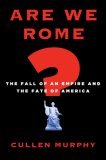
Are We Rome?

Are We Rome?: The Fall of an Empire and the Fate of America (2007) by Cullen Murphy. Houghton Mifflin, 262 pages.

A short, engaging book covering the ways in which we really are like ancient Rome – and the many other ways in which we are nothing like them at all.

Ancient Rome is an area of history that I don’t know much about. I’ve (so far) never read The Decline and Fall of the Roman Empire, never learned anything about it in school beyond the most trivial overview, and never took a course in Roman History in college. My knowledge of Rome is limited solely to what I’ve picked up in reading other books, watching movies, and the few sections in the Bible that touch upon to politics in Rome. Oh, and I did spend one entire semester in high school studying Shakespeare’s Julius Caesar.

Nevertheless, it’s a subject I’ve always meant to learn about, I just haven’t gotten around to it. So I was delighted when I heard about this book, which was described to me as both an excellent (albeit brief) overview of Roman history, as well as a timely analysis of the oft-repeated pop culture meme that we “are doomed to fall like Rome”.

The book succeeds on both counts. Perhaps the best thing about this book is that now I am fascinated, and would like to learn a great deal more about this civilization. A democracy (well, sort of one) that lasted for over 800 years and spread its influence across most of the (then) known world? Who could not be interested?

But it’s the more timely approach of this book that makes it such a fun read. Haven’t we all heard that old saw about “bread and circuses” in Rome? About how the empire fell because the populace became jaded and bored, and just cheered on gladiators as they fed Christians to the lions? About how the Romans gorged themselves on food, then vomited it up so they could eat more? About how, if we’re not careful, we’ll end up “just like them”, victims of a fallen empire overrun by barbarians?

Well, as it turns out, almost all of the things in the previous paragraph turn out to be gross exaggerations or outright myths. There were never any rooms where diners vomited up dinners so they could eat some more, for example – “vomatorium” turns out to simply mean “the entrance to the arena”.

Murphy does identify six parallels between our country and the Roman Empire, however, which he breaks down and talks about in five chapters: The Capitals, The Legions, The Fixers, The Outsiders, and The Borders (the sixth parallel being simply “complexity”, which he interweaves with the others).

Capitals covers the similarities between Washinton, D.C. and Rome – mainly how the citizens and politicians in both cities live insular lives that are divorced from the rest of the country, and indeed the rest of the world. Rome is where politics was invented – and it doesn’t seemed to have changed much in 2800 years, honestly. The same scandals. The same overblown sense of importance. Both in Rome and Washington, issues that seem drastically important to politicians, in order to get votes and stay in office, turn out to have almost no bearing on day to day life. Thin about it: what impact does, say, flag-burning have on anyone? And yet politicians have collectively spent literally years arguing this issue.

Legions discusses military power, and how it is used to both secure typical military advantages (land, resources) as well as server as a means of carrying the empire’s culture around the world. In the ancient world, if you were anyone, you spoke Latin. If you joined the Roman Legion, you spoke and wrote Latin. And the military, in bases and forts around the world, spread its influence not so much during battles, but by spending money in the local restaurants, marrying the local women, and bringing back bits and pieces of the places they lived for so long to their home cities in their retirement. I think of how my parents have two large ceramic elephants on their back porch – from Viet Nam. And furniture from Korea. And how we all learned to eat and love Chinese food. It’s not just the soldiers themselves – it’s the entire structure and environment of the whole military family that spreads the culture of the empire around the world.

Fixers talks about the whole concept of privatization and its close uncle, corruption. About how if you want to get something done, you’ll have to grease a few palms. Lobbyists, it turns out, are not nearly as new an invention as I had always thought. And the idea of a politician securing funds for a bridge or school in his district? Yup, turns out they’ve been doing that for thousands of years as well.

Outsiders describes how both Rome and the United States deal and feel about immigration. On the one hand, it is necessary to keep the country going – without immigration, we’d quickly become a stagnant “old world” kind of country. But those who have been here over a generation feel that we are the “real” citizens, and that “they” are despicable freeloaders who just want to steal our hard-earned jobs, etc. As it turns out, that’s what the word “barbarians” actually means: immigrant outsiders. All the conversations we’re having these days about “illegal aliens”? Yep. The Romans been there, done that. Some of the articles written around 200 A.D. in Rome sound exactly like Lou Dobbs today – just change the nationality of the players and read the same script.

And finally, Borders tells how both empires have somewhat fluid, expanding borders. Borders that are so large that they cannot be effectively protected, unless the entire country wanted to spend a fortune doing nothing but that. Borders over which people come and go, spreading their influence, their skills, and their cheap labor. And borders over which neighboring countries become, over time, much more like their more powerful neighbor.

Sound interesting? Well, it is. In every chapter, Murphy brings up tons of fascinating examples from Roman history and current American events. The book has a spry and entertaining tone that makes it great bedtime reading, and the structure of the chapters makes it both fun and easy to follow. I love history books like this, that not only tell you stuff you didn’t know, but help you to better understand all the things that you think you already know as well.

So… are we Rome? Well, of course not. But it would certainly behoove us to learn well what happened before… if for no other reason than to take us down a peg. We’re not so unique. The entire concept of our immigrant-settled, democratically ruled empire has been done before. And it’s worth noted that despite what we may think, Rome never truly “fell” – it just sort of morphed and changed into something else, and its people spread out and divided up into other countries.

Buy yourself a copy ofAre We Rome? and you’ll not only have an enjoyable, fascinating read – but you’ll learn something at the same time.

Categories
Books

Harry Potter and the Deathly Hallows

Harry Potter and the Deathly Hallows (2007) by J.K. Rowling. Scholastic, 759 Pages.

This is a spoiler-free review. I talk about how I feel about the book, but I’m not going to give away any but the most superficial plot details. This series will be enjoyed for years to come, and I don’t want to ruin the surprise for anyone.

I read the first Harry Potter book, Harry Potter And The Sorcerer’s Stone, in 2000, about 3 years after it was first published in the United States. The media was gearing up for the release of Harry Potter and the Goblet of Fire in the summer, and I was curious what all the hype was about. So I bought the first book and read it. And then the second and the third, and then I was one of those ridiculous adults who spent the first half of 2000 waiting with baited breath for Goblet of Fire to come out.

Of course I’ve been a fan ever since, and got each book the day it came out, and began reading it the same day. And now it’s over. I finished the last page of the last Harry Potter book Thursday night, July 26, 2007 – five days after I got it. I purposely limited myself to no more than 150 pages a day, so that I could stretch it out as long as I could. I stopped 100 pages before the end the night before, so that I could read the end without being too tired and without racing through it.

And I have to say – I’m very pleased. This was the most thrilling and riveting of all the books in the series (despite a few chapters in the middle that do drag on), and it ends in the best way possible. Characters that you have come to love and enjoy do die, but many others live. All the mysteries that were laid out over the previous six books are explained, or at the very least are clearly dealt with.

Usually, I don’t think much of movie adaptations of books, but the Harry Potter series has done an admirable job so far, and this has the potential to be one hell of a great movie, if they pull out all of the stops. Hopefully, I’ll refer back to this review three years from now when the movie version comes out!

I’m sorry it’s over. Yes, these are “children’s books”, but I dare anyone who enjoys reading novels at all to just try and put down this series once you’ve started it. The Harry Potter series are for children in the same way that the The Chronicles of Narnia books are for children. The same way Philip Pullman’s His Dark Materials are for children. The same way Tolkien’s Lord of the Rings is for children. And so many more.

The one other series I have to compare this to is Stephen King’s The Dark Tower, which also spans seven novels. The Dark Tower books, however, came out in spurts and fizzes over 3 decades, are most definitely not for children, and I can’t imagine how they could ever be made into a movie. But like Harry Potter, the Dark Tower came to a riveting conclusion at the end of the seventh book. Like Harry Potter, some characters die, and others live. Like Harry Potter, I was sorry to see it end.

So, if you have children, or if you ever were a child, and if you or your children haven’t read the Harry Potter books… it’s never too late to start. And rest assured that when the journey ends, you not only will have greatly enjoyed the trip, but you will be satisfied and comforted at the resolution.

I look forward to whatever J. K. Rowling decides to write next. May she take a page from Stephen King, who ended his series but continues to write. And maybe, just maybe, she’ll see fit to give us some more adventures set in the world of The Boy Who Lived.