Categories
Books Technology

5 Reasons I Don’t Have a Kindle

Kindle: Amazon’s New Wireless Reading Device, $399.00

Several people have asked me for a demo of an Amazon Kindle, just assuming that I have one. It’s a logical assumption to make: two of my greatest loves are books and gadgets. And since the Kindle is a gadget for reading books, you’d think it would be a no-brainer. Yet I do not have one, and currently I have no intention of getting one.

It’s not that I don’t like the idea – far from it. I’ve been waiting for years for a good electronic book reader to appear, and I’ve tried out several over the years. I used a Rocket eBook for about six months on and off: too heavy, screen was too hard to read. I read a few books on my old Palm Tungsten: screen too small, too hard to read for long periods of time.

I used a Fujitsu Stylistic Tablet PC for about a year, and used its electronic book software quite a bit, purchasing dozens of books from Fictionwise.com. That was the best yet, but using a PC as a reader – even a tablet laptop that didn’t have a keyboard – was way overkill. It was heavy, got very hot, and the buttons weren’t suited very well for page flipping. I also felt that using a $3,000 laptop for reading a book was… well, just wrong.

I thought about getting a Sony Reader, but felt that it was overpriced and underpowered, even for an electronic book reader. I guess my earlier experience with the Rocket eBook has made me more discerning. In addition, thanks to my Apple-powered technological renaissance, I have a new-found appreciation for style in addition to function, and I found the Sony product lacking. It simply didn’t feel like reading a book to me, and it also looks kind of tacky.

The Kindle is supposed to be the first device that lets you buy and read books electronically – without the need for any computer to connect it to. It was featured on the cover of Newsweek. Its debut made the nightly news the day it came out. It was sneak-peeked and revewed by numerous technology writers and blogs. And I still don’t have one.

Here’s why I don’t have one, and what I’m waiting for before I buy an electronic book reader:

5. It’s Too Expensive. A book reader is, or at least should be, a single function product: You use it to read books. It’s not a computer, it’s not a web browser, it’s not an MP3 player. It’s a device to read books. And using the time-honored analogy of the razor and razor blades, the reader itself simply should not cost very much money. My Rocket eBook was $199.00. My Palm Tungsten was $179.000. An iPod is $149.00. A Blu-Ray player is $299.00. An Nintendo Wii is $249.00. And Amazon wants to charge me $399.00 for a device to read books? I don’t think so. An electronic book reader should cost no more than $150.00 maximum, and should preferably be under $100.00.

4. The Books are Copy-Protected. DRM (Digital Rights Management) rears its ugly head yet again. I am especially disappointed to see Amazon taking this tact, since they have done such a nice job with their MP3 store. I’ve spent over $100.00 at Amazon’s MP3 store since they started, and I’m going to be spending a lot more over the coming year now that they have 3 of the 4 record labels supplying them with content.

Books for the Kindle are in a proprietary, copy-protected format. It’s such a closed format, in fact, that there is no way to simply copy your own material to the device – you have to email a document to Amazon, pay a fee, and then have them send the converted document back to you. A collection of books, just like a collection of music, is something I like to keep forever. Purchasing a book in some transitory, proprietary format that I cannot even back up is of no interest to me. An electronic book reader should use an open format and should not use any form of DRM or copy protection. Ideally, it should also read multiple formats, with PDF at the top of the list.

3. The Screen is Too Small. The Kindle uses exactly the same screen as the Sony Reader. The good news here is that the screen quality is excellent: it actually looks as good as a printed page. The high contrast black and white screen with very high resolution print is just the breakthrough that has been needed in order to make an electronic book reader a viable product. But after playing with a Sony Reader for a while, and after comparing it to a paperback book, a trade paperback, and a normal-size hardcover, it was clear that the 6″ screen is just plain too small.

Here’s my simple rule of thumb: Get a physical paperback edition and an electronic edition of the same book. Turn to a page. They should be identical. With the 6″ screen the Kindle uses, that is not the case: there is always less text on the Kindle’s screen. This means that a 300 page printed book ends up as a 400 page Kindle book, for example (I’m approximating, since I do not have a Kindle to do the actual comparison with). And the small size just doesn’t feel like a book. Pick up a trade paperback or a hardcover book; an electronic book reader should have the same screen size as the printed page on any of those, including page headers and footers. Assuming the same screen technology used by the Kindle and the Sony Reader, an electronic book reader should have a screen that is at least 8″ tall and 5″ wide (9.5″ diagonal), and should be able to support page-for-page matching between the printed version and the electronic version of the same book.

2. The Books are Too Expensive. I place this one a lot higher than the device costs, because if all the other issues were dealt with, I’d probably be willing to pay more for the device itself. However, an electronic book must always be cheaper than the paperback version of a book. And right now this is not the case.

Amazon is trying to get away with comparing the hardcover price with the Kindle version price, in order to justify their price range of $9.95 to $7.95 for electronic books. Sorry, folks, but that’s not the comparison. Let’s take The Kite Runner by Khaled Hosseini as an example. The paperback version of this book is $8.99. The Kindle version of this book is $8.99 – the same price. But – I can give the paperback book to someone else. I can keep it forever. I can make copies of it if I need to. I can re-bind the book in 20 years. I can re-read it 10 years from now just by pulling it off the shelf. I can’t do any of these things with the Kindle version – and yet it’s exactly the same price. Why would I ever bother with the electronic version? Books for an electronic reader should be priced well below the price of the paperback version of the same book – at least $2.00 cheaper, in my opinion, since there are no physical costs associated with it. And that’s assuming that all of my other points have been addressed. If the book is copy-protectecd, it should be at least $4.00 less than the paperback!

1. The Kindle is Butt Ugly. This is the 21st century. We expected our devices to look like it. Look at an Apple iPhone, a Toyota Prius, a Panasonic plasma TV, a Samsung laser printer, an iPod Nano, even a single cup coffee maker. I expect smooth lines, smart design. I expect gadgets that are as beautiful to look at and as pleasing to the touch as the best of these. Asking me to pay $400 for something that looks like it was designed by a Soviet planning committee is not going to cut it. I mean, look at this thing! It’s all sharp edges and angles. It’s the same bland off-white color as generic PC’s from the 1990s. The keyboard (and why the hell does a book reader even need a keyboard, anyway?) looks like it belongs on a Fisher-Price toy.

The whole look of the device is just wrong. It looks cheap and flimsy – even though it is neither. In an age of shiny piano black surfaces, aluminum finishes, aerodynamic shapes and streamlined edges, the Amazon Kindle is an orphan. I get the impression someone designed the shape and layout about 20 years ago, and has just been waiting for the technology to finally allow it to be built. Amazon should have hired a high-end industrial designer and made this product a beauty, something to show off, instead of something to keep hidden under a cover so that no one could see it. An electronic book reader should be attractive, sleek, and well designed.

So, Amazon, no sale to me. I thought for sure the Kindle would flop big time, and yet when I checked Amazon for information while writing this entry, I see that they are currently sold out. Obviously, quite a lot of customers don’t have the misgivings that I do. I’ll just keep waiting. My guess is it will take another 5 years or so until an electronic book reader appears that follows all 5 of my suggestions. I look forward to writing a glowing review of that product at such time as I can get one.

Sadly, however, the Amazon Kindle is not that device.

Categories
Thoughts and Comments

Observations from London

This week I returned from a quick business trip to London, England. This was my first time traveling across the Atlantic since “the events of September the 11th”, as the politicians like to say, and it was educational to see how much international travel has changed since the last time I traveled extensively overseas during the late 90’s. I also found it very interesting to see how the British people view Americans and the United States in this still-relatively-new century we’re living in.

In no particular order, then…

Don’t Fly Coach Across Oceans. Coach (also called “Economy”) seats just don’t cut it when you’ve got to sit in one for eight or nine hours. My company has a policy that if a particular leg of your flight is 12 hours or more, then you’re allowed to purchase the next higher class of ticket. But from Miami to London is only nine hours – so it didn’t qualify. At the time I booked the ticket, I didn’t think that much of it. Sure, I like First Class air travel as much as the next guy, but I travel in coach all the time, so what? I had forgotten how long nine hours can be when you can’t lie down, walk, or even turn around when you want to.

I also discovered that my old trick of getting the emergency exit row seat doesn’t work out very well on some of these fancy planes. This was a British Airways 747-400, and as it turns out, the emergency exit seats were much narrower than the normal seats – mainly because, since there was no seat in front of them, the whole personal video screen mechanism is built into the armrest. This also means that you cannot swing up the armrest. It also means that the entire seat is one solid metal block, with no spaces or gaps that you can stick your knees through. بنك payeer مصر It was, in fact, the most uncomfortable seat I have ever had on an airplane – and I am counting the time I flew in the rear cargo area of an Army C-41 transport plane.

The next time, even if I have to pay the difference out of my own pocket, I’ll travel in at least Premium or Business or whatever the airline in question happens to call it.

Beware Of Fat People On Planes. Now, when I say “fat”, I really mean “wide”. I’m not talking about somebody with a big stomach. I’m talking a large, wide person. On my return flight, having learned the lesson of the bad emergency exit row seats, I got a seat in the rear of the plane on the aisle (row 51). I got the aisle seat…. and then Jumbo the Elephant took the seat next to me.

Jumbo was a very large woman of unknown nationality – no one could communicate with her, nor she with them. She was decked out in red and gold, in a sort of combination mumu meets paintsuit type of outfit. It had gold tassels hanging off the sleeves as well.

When Jumbo took the window seat next to me, she was so large that she could not really put her arms down. Her stomach held the tray table in place. And she somehow just sort of oozed over into my seat. There was no question of me having any of the shared armrest. Since she spoke no English (nor French, Spanish, German, Chinese, or Norwegian – the crew tried all of these) there was no way I could think of to communicate with her that I was finding it hard to breath.

As soon as we took off, I found an empty middle seat in the second to the last row. And even though a little girl kept kicking the back of my seat nonstop for the entire flight, it was a pleasure compared to the seat I had just escaped.

Incidentally, when I vacated my initial seat, the woman gave a huge sigh of relief and immediately expanded to take up the entire row. There was actually a popping sound as she swung up the armrest to allow her ample girth to occupy its normal volume.

British Food Really Is Terrible. The last time I traveled in the UK, I was with my old boss Elmer Easton, who is a very well traveled food connoisseur. Luckily for me, he made reservations weeks in advance at restaurants that either he had dined at before, or knew from his contacts served excellent food. These places were often hidden and catered only to a select few. In the years that I worked for Elmer, I got spoiled, thinking fine food was relatively easy to come by. I could not have been more wrong.

Despite my best efforts – and on one evening, even when accompanied by a colleague who used to be a professional chef – I did not have one good meal during the four days I was there. And I tried. I ate at a supposedly well reviewed Greek restaurant (which had the most unusual decor of any place I’ve ever eaten at – check out their website if you don’t believe me), a true steakhouse, and a named chef’s restaurant. All of them served bland, overcooked food. Even my breakfasts were bad. I had to sprinkle pepper liberally on everything just to add some taste.

Even Starbuck’s and the local sandwich shop seemed to have misplaced their shipment of spices. Everything I ate just tasted… I don’t know, boiled. No wonder it was Spain that set out to find a way to get spices from India quicker – the British obviously didn’t care.

Somehow, I’ll have to master the trick of finding all those hidden places that Elmer always knew about. I now understand why they were so carefully guarded… believe me, you’d hide them too if you knew the secret of finding good food in England.

The Dollar Has Gone To Hell
. Yes, I knew this intellectually from watching the news, but it’s another thing to experience it in person. Last week, the exchange rate was $2.10 to one British pound. That means, to figure out what something cost in dollars, double it and then throw in a few more dollars. So, my 80 pound taxi ride from the airport was 8. كم سن كريستيانو رونالدو 00. And so on. It’s almost unbelievable how expensive everything is for us Yanks. قوانين لعبة الروليت

And for the British, it’s the reverse. They cannot believe how cheap everything is in America. Several people I spoke to talked about how it was cheaper to buy British products in the United States than it was to buy them right where they were made. I’m sure that somehow the cost of fuel is tied up in this….

We Don’t Know How Good We’ve Got It. My favorite comment of the entire trip came during a taxi drive. Monday morning, I got into a good ‘ol London black cab to go from my hotel to the company I was visiting. During the drive, I began chatting up the taxi driver, who, as it turned out, had vacationed quite a bit in the United States. I asked him what the British people thought about us Yanks in this, The Age of Bush. He said that they didn’t hold it against us, since everyone knows how politicians lie and screw over everyone regardless.

And then, he gave me the winning comments:

“The only thing I don’t like about you Americans is – you don’t know how good you’ve got it.”. As we waited at a stop light, he turned around to me for emphasis. “You have the cheapest gas in the western world, and yet you complain when the price goes up by a few cents. Your grocery stores have every kind of food imaginable, and yet you complain about not having the right kind of nutrition and that your kids are getting too fat. You have the oldest fully functional democracy on the planet, and you gripe and bitch about how your leaders don’t listen to you. And while the rest of the world has been putting up with terrorists for 50 years, you folks get hit once – one time – and you completely loose it and go apeshit.”

He turned around as the light changed. “I’m telling you, you just don’t know how good you got it. I’d give anything to live in America.”

And that’s the thought I returned with, back to the United States of America. So, at least for the moment – I do, in fact, know exactly how good I’ve got it.

It’s great to be home.

Categories
Books

An Embarrassment of Riches

An Embarrassment of Riches by Gerald Hansen (2007). iUniverse, 261 pages.

This is a rare privilege. For the first time, I’m going to review a book written by someone I know. Someone I have known, in fact, for over 30 years.

Gerald Hansen and I were friends during our tween years when we both lived on an military base (Patch Barracks) in Stuttgart, Germany during the 1970’s. We hung around together, shared books, explored underground tunnels and old attics, and watched a ton of movies at the small base movie theater. In fact, as I recall, Gerald’s father actually worked at the movie theater – although we never got free tickets or anything like that.

Something else we did was collaborate on plays, comics, and stories. Most of these were extremely derivative, spoof-type things, about what you’d expect from a couple of 14-year-olds passing time in a country not their own. I remember “Hush, Hush, Sweet Margaret”, which was basically a much sillier and more violent version of Hush, Hush, Sweet Charlotte. There were also comic books where we re-created our teachers as various comic book heroes and villains. For example, Ms. Marvel was a popular comic at that time, so we created a “Ms. Nazi” version starting our German teacher. Politically correct we were not. But hey, we were teenagers, and it was the 70’s.

I was going to be a famous filmmaker, Gerald was going to be a famous writer. Now, I work in computer software and web development, and Gerald is a high-class teacher at a fancy New York City private school. But, as it turns out, Gerald never gave up the writing dream… and here I am, many years later, finally reading and reviewing Gerald’s first novel.

Before reading it, I had privately decided that if I didn’t like it, I just wasn’t going to say anything. There was no way I was going to give my oldest friend a bad review.

As it turns out, I indeed have something to say, because this is a flat-out great book. Am I biased? Well, probably somewhat. But I could not stop reading for the last 50 pages, and as I finished the novel on a plane, I could not hear the jet engines, or the other passengers, and I passed up extra chips and soda because I did not want to be bothered. I just had to see how the communion turned out.

I haven’t read a novel like this in quite a while. An Embarrassment of Riches is a true black comedy, filled with richly-drawn characters that are both larger than life and small minded at the same time. The novel takes place entirely in the city of Derry (or Londonderry, depending on your religion – you’ll understand that statement after reading the book), Ireland, right around the turn of this century. It concerns the intertwined families of two sisters, one of whom, having recently won the Irish National Lottery, is relatively well off – and the other, who is poor, uneducated, and nasty.

The style reminds me very much of the works of Hubert Selby, particularly Last Exit to Brooklyn and Requiem for a Dream. With perhaps a bit of James Joyce thrown in there as well. Hansen writes much of the character’s dialogue directly in the dialect of the area, using a technique honed by Mark Twain in The Adventures of Huckleberry Finn. As such, it can sometimes be difficult to understand exactly what is being said… but one of the characters is conveniently married to an American, who, near the beginning of the novel, shares his “Derry Speak Dictionary”. I found myself referring often to this two-page spread of Irish slang during the course of the book.

In fact, the city of Derry itself is probably the most important character in the book. It is almost as much a part of this book as Los Angeles is a part of Raymond Chandler’s works. Jed Barnett, the sole American in the book, sums it up well:

“You dragged me off to this godforsaken hellhole where I can barely understand what anybody says, where the sun shines three days a year, where the city center is crawling with thugs wielding broken bottles after dark so I have to do all my drinking during the day, where the dollar’s so weak against the pound my retirement checks disappear before they’re even cashed.”

LIke most great literary comedies (A Confederacy of Dunces, anyone?), the real charm and power lies in the interactions between rich, larger than life characters. An Embarrassment of Riches is no exception:
Dramatis Personae

Ursula Barnett – Mid-fifties Irish woman, married to an American Navy man, both now retired and living in Londonderry, Ireland. She recently won 1 million pounds in the Irish lottery. She has a hot temper, but of all her family, she’s probably the kindest person. She has no idea how truly vile and evil most of her family really is.

Fionnnuala Flood – Ursula’s sister. A conniving, trashy, filthy woman who thinks only of how she can lie, cheat, and steal her way through life. She’s convinced her sister owes her and her entire brood a free ride, and she’s determined to do anything she can to get it. Her children are playthings in her theater of cruelty.

Jed Barnett – Ursula’s “Yank” husband, a retired Navy man who has reluctantly settled with his wife in Londonderry. He hates the city, hates the country, and wants nothing except to leave it and return home to Wisconsin. Only his love for Ursula keeps him here, a prisoner in a place he wants no part of. Unbeknownst to Ursula, he has long ago gambled away all their lottery winnings.

Dymphna Flood – The 18-year-old daughter of Fionnuala. Pregnant out of wedlock (and by a Protestant no less!), working at a low-end job just enough to keep the welfare office happy, Dymphna is just as scheming as her mother, but only half as intelligent.

Paidrag Flood – Fionnuala’s 10-year-old son. Destined to become a drug dealer like his brothers, Paidrag has already learned the ins and outs of making petrol bombs to lob at his relatives, confident that the police will never arrest a tiny boy like himself.

Siofra Flood – 8-year-old daugher of Fionnuala, who is studying for her communion under her Aunt Ursula’ tutelage. However, she’s in it only for the fashion accessories: Siofra dreams of having the perfect dress to impress her friends with. And she’s going to gather the money by assisting her brother in selling his “disco sweeties”, Ecstasy. Yes, she is an eight-year-old drug dealer.

Eoin Flood – 17-year-old son of Fionnuala, a drug dealer. He’s the current apple of his mother’s eye, since he’s the main breadwinner in the family at the moment.

And these are just the main characters. There’s also the addled Grandmother, the boss at the horrible little retail shop, the estranged sister from Hawaii, the trashy co-workers, the drunken husband, and a passel of ex-IRA goons to boot. Set this in a run-down, burnt-out Irish city that all the good parts of the 20th century seem to have passed by, mix with tons of ridiculous religious prejudice and greed, shake, stir and serve. The result is An Embarrassment of Riches.

The last 50 pages of this book are classic, I can’t-stop-reading literature. Yes, Siofra does get her communion. And yes, all the disparate threads of plot and character do all come together at the end. And yes, all the questions about Ursula’s past with the IRA are answered truthfully, if surprisingly. And yes, you will laugh until your sides hurt.

Sure I’m biased. So what – I know a good book when I read it. And this… is a very, very good book. I hope never in my life to find myself in Londonderry, Ireland – with the sole exception of when I re-read this novel. Click on over to Amazon, demand a copy from your local bookseller, download it to your e-book reader, whichever way works for you – but whatever way you do it, read An Embarrassment of Riches.

Categories
Books

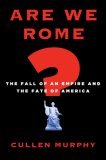
Are We Rome?

Are We Rome?: The Fall of an Empire and the Fate of America (2007) by Cullen Murphy. Houghton Mifflin, 262 pages.

A short, engaging book covering the ways in which we really are like ancient Rome – and the many other ways in which we are nothing like them at all.

Ancient Rome is an area of history that I don’t know much about. I’ve (so far) never read The Decline and Fall of the Roman Empire, never learned anything about it in school beyond the most trivial overview, and never took a course in Roman History in college. My knowledge of Rome is limited solely to what I’ve picked up in reading other books, watching movies, and the few sections in the Bible that touch upon to politics in Rome. Oh, and I did spend one entire semester in high school studying Shakespeare’s Julius Caesar.

Nevertheless, it’s a subject I’ve always meant to learn about, I just haven’t gotten around to it. So I was delighted when I heard about this book, which was described to me as both an excellent (albeit brief) overview of Roman history, as well as a timely analysis of the oft-repeated pop culture meme that we “are doomed to fall like Rome”.

The book succeeds on both counts. Perhaps the best thing about this book is that now I am fascinated, and would like to learn a great deal more about this civilization. A democracy (well, sort of one) that lasted for over 800 years and spread its influence across most of the (then) known world? Who could not be interested?

But it’s the more timely approach of this book that makes it such a fun read. Haven’t we all heard that old saw about “bread and circuses” in Rome? About how the empire fell because the populace became jaded and bored, and just cheered on gladiators as they fed Christians to the lions? About how the Romans gorged themselves on food, then vomited it up so they could eat more? About how, if we’re not careful, we’ll end up “just like them”, victims of a fallen empire overrun by barbarians?

Well, as it turns out, almost all of the things in the previous paragraph turn out to be gross exaggerations or outright myths. There were never any rooms where diners vomited up dinners so they could eat some more, for example – “vomatorium” turns out to simply mean “the entrance to the arena”.

Murphy does identify six parallels between our country and the Roman Empire, however, which he breaks down and talks about in five chapters: The Capitals, The Legions, The Fixers, The Outsiders, and The Borders (the sixth parallel being simply “complexity”, which he interweaves with the others).

Capitals covers the similarities between Washinton, D.C. and Rome – mainly how the citizens and politicians in both cities live insular lives that are divorced from the rest of the country, and indeed the rest of the world. Rome is where politics was invented – and it doesn’t seemed to have changed much in 2800 years, honestly. The same scandals. The same overblown sense of importance. Both in Rome and Washington, issues that seem drastically important to politicians, in order to get votes and stay in office, turn out to have almost no bearing on day to day life. Thin about it: what impact does, say, flag-burning have on anyone? And yet politicians have collectively spent literally years arguing this issue.

Legions discusses military power, and how it is used to both secure typical military advantages (land, resources) as well as server as a means of carrying the empire’s culture around the world. In the ancient world, if you were anyone, you spoke Latin. If you joined the Roman Legion, you spoke and wrote Latin. And the military, in bases and forts around the world, spread its influence not so much during battles, but by spending money in the local restaurants, marrying the local women, and bringing back bits and pieces of the places they lived for so long to their home cities in their retirement. I think of how my parents have two large ceramic elephants on their back porch – from Viet Nam. And furniture from Korea. And how we all learned to eat and love Chinese food. It’s not just the soldiers themselves – it’s the entire structure and environment of the whole military family that spreads the culture of the empire around the world.

Fixers talks about the whole concept of privatization and its close uncle, corruption. About how if you want to get something done, you’ll have to grease a few palms. Lobbyists, it turns out, are not nearly as new an invention as I had always thought. And the idea of a politician securing funds for a bridge or school in his district? Yup, turns out they’ve been doing that for thousands of years as well.

Outsiders describes how both Rome and the United States deal and feel about immigration. On the one hand, it is necessary to keep the country going – without immigration, we’d quickly become a stagnant “old world” kind of country. But those who have been here over a generation feel that we are the “real” citizens, and that “they” are despicable freeloaders who just want to steal our hard-earned jobs, etc. As it turns out, that’s what the word “barbarians” actually means: immigrant outsiders. All the conversations we’re having these days about “illegal aliens”? Yep. The Romans been there, done that. Some of the articles written around 200 A.D. in Rome sound exactly like Lou Dobbs today – just change the nationality of the players and read the same script.

And finally, Borders tells how both empires have somewhat fluid, expanding borders. Borders that are so large that they cannot be effectively protected, unless the entire country wanted to spend a fortune doing nothing but that. Borders over which people come and go, spreading their influence, their skills, and their cheap labor. And borders over which neighboring countries become, over time, much more like their more powerful neighbor.

Sound interesting? Well, it is. In every chapter, Murphy brings up tons of fascinating examples from Roman history and current American events. The book has a spry and entertaining tone that makes it great bedtime reading, and the structure of the chapters makes it both fun and easy to follow. I love history books like this, that not only tell you stuff you didn’t know, but help you to better understand all the things that you think you already know as well.

So… are we Rome? Well, of course not. But it would certainly behoove us to learn well what happened before… if for no other reason than to take us down a peg. We’re not so unique. The entire concept of our immigrant-settled, democratically ruled empire has been done before. And it’s worth noted that despite what we may think, Rome never truly “fell” – it just sort of morphed and changed into something else, and its people spread out and divided up into other countries.

Buy yourself a copy ofAre We Rome? and you’ll not only have an enjoyable, fascinating read – but you’ll learn something at the same time.

Categories
Audio Visual

Chuck and the Incredible Exploding Computer

Ah, the new fall television series. An American event that has survived from my childhood up until the current day, albeit in a somewhat altered form. It was 1977, I believe, when I first started to pay close attention to the fall season, and all the new shows that would debut at that time. In ’77, I remember The Man From Atlantis, Spider-Man, and Soap. 1978 was Battlestar Galactica. And so on.

Despite the fact that now, through satellite and cable, I have many, many more television viewing options these days, it seems that I am always drawn back to the main, over-the-air television networks and their shows. At the moment, all of my favorite television shows (baring a few oddball reality series here and there) air on one of the Big 4 broadcast television networks. I don’t know why this is… but it is.

And so, this year I find myself drawn, like a moth to the flame, to the new fall television series. Thanks to the modern miracle that is Tivo, I have recorded the premiere episodes of all the new shows I could find that seemed of interest, and I’ve been slowly previewing them over the past few weeks. The season premiere of Heroes, of course, I watched live, and it’s as good as the previous season. I’m in for the ride on that one.

Possibly I’ll get around to reviewing some of them as time goes on (Bionic Woman is my current favorite of the new crop), but this post is about Chuck (Mondays at 8pm on NBC) .

Chuck‘s premiere episode came with a good pedigree; it was directed by McG, who directed both Charlie’s Angels and its sequel, Charlie’s Angels: Full Throttle, two films which I enjoyed immensely. The tone of this show is comic with dramatic elements, not unlike the two Charlie’s Angels films themselves. That’s an odd mix that somehow works in a film, but somehow doesn’t seem to work very well on TV. I’ll expand on that in a bit.

Here’s the premise of Chuck: A hapless nerd – the titular Chuck – works at a “Buy More” store, an obvious clone of Best Buy. If you’ve seen The 40-Year-Old Virgin, just think of the scenes with Steve Carell in the electronics store, and you’ve got the exact picture. Chuck lives with sister and her husband / boyfriend (it’s not clear and it doesn’t seem to matter), and hangs out with his nerdy friend who also works in the Buy More store.

In a side-by-side story, we see Chuck’s college roomate, now a CIA spy, downloading a shitload of stuff from some strange government computer room, and then e-mailing a file to Chuck before he gets shot. Did he email it to Chuck on purpose, or did his dying hand just happen to hit upon his address at random? It’s not clear.

Chuck gets the email, opens the file, and “all the secrets the government has” download into his head. He now becomes a walking, talking computer with all NSA and CIA information available to him for instant analysis. And so two agents – a guy from one agency and a girl from the other (the girl being the former girlfriend of the now-dead agent who emailed the massive file to Chuck), tag along with him to do, well, spy shit.

There you have it. On paper, it sounds like fun, sort of Charlie’s Angels meets The 40-Year-Old Virgin, which I’m sure was how it was pitched to the NBC executives. “The nerds will love it”, they must’ve said. “A pretty girl and a heroic nerd. It’s television gold!”

Not so fast. The problem with this show? It’s really, really dumb. Too dumb to be funny, and way too dumb to be even vaguely dramatic. Now, Charlie’s Angels was “dumb”, but it was sort of in its own little world, so you buy it. This show is not. It tries for the same goofy vibe, but it just does not fly when you try to merge that into the real world that you and I actually live in. And, far worse, no nerd or geek will ever like this show – because they are just waaaayyy too stupid with the computer stuff.

For example, I’ll bite on the concept that somehow a guy could “download” a bunch of government secrets into his head. Of course this could not happen in “real life”, but along the lines of Bewitched or I Dream of Jeannie, I’ll go along with it if that’s the premise. But they didn’t even try. Instead, we get crap like the following…

The big giant government computer in the beginning? It consists of a single room, which is covered floor, walls and ceiling with LCD screens. And a single Macintosh on a pedestal in the middle. Not even a modern “Mac”, mind you. But an original issue, 1984 type Macintosh. Which magically has a color screen and can send email. And somehow can stream all of the data from a government computer over the internet in real time. Uh huh. Right.

Next, the downloaded data is sent to Chuck in an email, sent from a weirdo non-existent hand-held device that doesn’t look even remotely like anything sold today. OK, so it’s fantasy, right? No iPhone product placement for them, they’ll make up a completely phony science-fictional hand-held gizmo for our government agents to use.

But then – Chuck receives the resulting email on a very normal Mac Pro, complete with Apple Cinema Display and keyboard. He opens the email – and it does things no email attachment could ever do. It takes over the entire screen instantly, turns into a full-res HD video stream, and plays all night long, as a hypnotized Chuck gets data fed directly into his brain. Uh…. exactly what kind of computer network on the planet we live on can do that? If they had given Chuck a made-up computer as well, I might have gone along with it – fantasy device and all that – but they don’t. Or they could have had him somehow get hooked up directly to some sort of bizarro secret device that tapped directly into his brain… there are millions of ways they could have done it that would not have had to use real-world computers doing ridiculous things.

Later, a ninja (!) tries to steal Chuck’s Mac Pro. And drops it. And, in true movie fashion, it instantly smashes apart, with parts flying out of it willy-nilly. Most of the parts which fly out don’t exist inside any computer I’ve ever seen (and I have, in fact, seen the inside of my own Mac Pro many times), such as mounds of wires, LEDs, several metal gears, etc. He takes it into his Buy More store, where the geeks gather all around the pieces and say, “It’s hopeless”. Uh… what? Dropping a computer causes everything in it to instantly become so destroyed that nothing can be retrieved? This is key, because since apparently no other copy of this data exists anywhere else, they have to rely on Chuck. Uh…. sure. I can see the director now: “Throw some more parts into that computer case, so when it gets dropped, more stuff flies out!”

I’m sorry. but this show just doesn’t work. It’s annoying and frustrating instead of being funny and endearing. For example, in Bewitched, Samantha still drove a normal car that did normal car things, unless and only unless she did some magic on it. She didn’t walk around and have magic just happen for no reason. Chuck wants us to go along with a silly premise, but they hang the silly premise on stupid, ridiculous interpretations of how computers work. What self-respecting geek is going to be able to see past that? I’ll accept 24th century Star Trek technobabble about crystals and hyperspace, but you can’t show me a computer that’s for sale right here and now and expect me to go along with it having magical capabilities that no real computer can ever have.

TV executives, listen to me carefully, OK? Here’s a checklist for you:

  • A Mac Pro will not fall instantly apart and break into pieces if you drop it.
  • Even if a computer did fall apart, you could just pick up the hard disk and get the data off of it easily.
  • Email attachments are limited to about 5 megabytes in most cases. That’s about 10 photos or so.
  • Little handheld gadgets that can send email would take at least a minute or two to send even a normal, large size attachment. Never mind 8 hours of high-definition video.
  • Emails, when opened, do not go into full screen and show video nonstop.
  • You cannot stream high-definition video through an email that will play for eight hours.
  • Macintosh computers from 1984, while certainly cool and retro looking, will not function as interfaces for government supercomputers.

So, no season pass for Chuck. It goes into the ashcan of stupid TV shows. Will it last? I predict not. We’ll see if I have to eat my words in the future. You can’t make a show targeted for a certain demographic (geeks), insult their intelligence with the same show, and then expect them to watch it. For Christ’s sake, couldn’t they have just asked any real geek for a half-hour’s consult? Wil Wheaton lives in Los Angeles, they can give him a call. He’s even got years of experience in dealing with Star Trek technobabble!

Oh, and one more thing… the guy who plays Chuck? Zachary Levi? He is about as convincing a nerd as Brad Pitt or George Clooney. This guy is tall, dark, handsome, and physically very well-built. He tries to look “geeky” by having, uh, slightly unruly hair. That’s about it. Sure, I’m gonna believe this guy is perennially dateless and working at a Buy More.

A good comedy has to have a sense of smarts and style about it, no matter what its stated situation. And a good action drama needs a key binding theme that everyone watching can buy into and believe in. Chuck has neither, and is neither.

Chuck – You Are The Weakest Link. Goodbye!

Categories
Thoughts and Comments

A Wrenching Tale at The Home Depot

I know we live in a technological age. But sometimes…

Earlier this afternoon I was putting together a stand for the patio. During the process, I discovered that for some reason, the bolts used in this stand were metric. Now, personally, I’m fine with the metric system. I wish we had switched over to it during the ’80s like we were supposed to, before Reagan became president and decided that the metric system was Un-American and For Commies Only. But we didn’t. And therefore, I don’t have any metric wrenches. ingyenes online nyerőgépes játékok

So, because I did not want this half-finished stand lying in the garage, I drove over to The Home Depot (I learned several years ago, when working on a branded web site for them, that the company name must always be referred to as “The Home Depot” and never as just “Home Depot”) to get a 10mm wrench. As I scanned the tool aisles at The Home Depot, I discovered something interesting… a single Husky Pro 10mm wrench was $22.99, but an entire set of 10 metric wrenches was $44.99 – less than the cost for two of them. Well, Cynthia Henderson didn’t raise no dummies, so I decided right on the spot to get a set of 10 metric wrenches, so that if I ever encountered a metric problem again, I would be all set.

I paid for the wrenches with my debit card, and drove back home to finish putting together my patio stand. No problem, right?

Except that when I got home and opened the package, I discovered that one wrench was missing… and of course, you guessed it, it was the 10mm wrench which was the only one I actually needed in the first place. So, making sure I had the receipt, I drove all the way back to The Home Depot, and stood in line to exchange my set of wrenches for one with all 10 in the box.

The return cashier seemed flummoxed by my explanation. “There were only nine?” he said, staring at the package. “Yes,” I replied, indicated the empty slot for the missing 10mm tool. “Uh, I have to call somebody”, he said. He then muttered into the phone, cupping his hand over the mouthpiece so that I could not hear what he was saying.

I tried to put myself in his place. I imagined that, perhaps, a mob of wrench thieves was running amuck. These fiendish ruffians would purchase a package of wrenches, remove a single wrench from the package while cackling with glee, and then return the package to get their cash back. What a horrible plot!

Not wanting to have The Home Depot suspect me of being a tool thief, I spoke up again. “You know, I just want to exchange it for exactly the same thing”, I interjected. “I just want the missing wrench, and as you can see, I bought this less than an hour ago”. I waved the receipt to emphasize my point, hoping he would notice the time stamp.

He finished muttering into the phone, looked me up and down, and decided that apparently I was not a member of the Wrench Ripoff Ring. “Well… I have to give you a refund”, he said.

“That’s not necessary, I just want to make a straight exchange”, I smiled.

“I’m sorry, sir. I can’t do that. I can only do refunds”.

“OK”. I pursed my lips and said nothing more.

He scanned my receipt, then frowned. “You paid with a debit card”, he said accusingly. “I can’t issue a credit for a debit”.

Instantly, I flashed back to years of accounting and finance classes in grad school, where I spent untold hours calculating columns labeled “Credit” and “Debit”, for amounts both large and small. I suddenly had an image of my first accounting professor, lecturing about how Credits must always equal Debits. Should I educate this fellow, this diamond in the rough working at The Home Depot’s return counter? Should I tell him that, in fact, the only way he can refund my Debit is to issue a Credit? Should I do my part to spread knowledge and education throughout greater Broward County? I quickly decided the answer was a resounding “No”.

“Um,” I said instead.

“I’ll have to give you cash. With tax, that comes to $47.54”. He muttered that I was taking all of his cash, but then dolefully counted out the exact amount, including the change – two quarters and four pennies.

“You are just getting the same thing, right?” he said as handed me a Refund Receipt, showing I had been issued cash for my wrench return. I nodded in the affirmative, afraid to say anything more out loud for fear of confusing the issue further. I clutched my $47.54 (that’s Forty Seven Dollars and Fifty-Four Cents, remember) and walked back to the tool aisle.

I found another package of the metric wrenches, and counted carefully through the bomb-proof plastic to make sure that there were, in fact, 10 wrenches. I also checked carefully to make sure that the all-important 10mm wrench was there.

I stood in line to pay for the replacement wrenches at the cashier one over from my friend the Refund Dude. The woman rang up my wrenches. “That will be $47.55, sir”, she said with a smile. I frowned, and placed my cash on the counter. “Well, I have $47.54”, I said, pointing.

She looked at me with concern. “I’m sorry sir, but you need another penny”, she said, apparently thinking that I was not very bright, and perhaps needed help counting my change. “I know that”, I said accusingly, “but he only gave me $47.54 for the same wrenches. He owes me a penny!” I stabbed a finger at the hapless refund cashier, who was already helping another customer.

Refund Boy turns around, his eyes glazed. Smiling Cashier points at me. “Did you give him a refund for some wrenches?” she asks. He nods, and points at the wrenches I am buying, then turns back to his customer. I show Smiling Cashier my previous receipt, with the Credit Receipt. “Hmmm”, she says. “I guess the different computers calculated tax differently, huh?”

I thought to myself, “That’s the stupidest thing that I ever…” And then it occurred to me, that after working in the software business for over 25 years, nothing really surprises me anymore. So I nodded. “Yup, I guess so”, I said. I prepared to leave. She gently put her hand on my bag of wrenches. “Sir, I still need that penny”, she said with concern.

I stared at her. She stared at me. Refund Boy turned around slightly, obviously not wanting to get involved. The people behind me in line were starting to shift from one foot to another. I sighed… this is 21st century America, after all. “OK”, I said.

But of course, I didn’t have a penny. Or a dollar. The only thing I had in my wallet was a twenty dollar bill. Solemnly, I handed her the twenty, which she snatched from my hand and happily tapped into the cash register. “Your change is $19.99” she said with excitement, and counted out my change.

I drove home, dumped 99 cents into my change jar, and finished putting together my patio stand with my new 10mm wrench.

Years ago, I could walk into a hardware store, say “I need to exchange this”, pick up another one off the shelf, and walk out with a smile. gaminator trükkök In fact, when I used to work at Osco Drug in 1981, this was exactly how we handled exchanges. But now, in 2007, things are so much more efficient.

At least I’m all set for metric wrenches now. If you need a patio stand assembled, I’m your man.

Categories
Audio Visual

Disturbia

Disturbia (2007). 105 minutes, Dreamworks Pictures. Directed by D.J. Caruso.

A taut, engaging and extremely gripping thriller done in true Hitchcock style – paired with a modern feel and a snappy sense of humor.

I heard about this movie back in the spring sometime when Shia LaBeouf was making the rounds of all the talk shows. Since it sounded to me like just some cheesy Rear Window rip-off, I wasn’t particularly interested in it. I’ve always loved Rear Window, and I didn’t think it needed to be remade, especially as a teen slasher flick.

I love it when I’m wrong. This movie was an absolute blast.

I decided I would watch it after I saw Transformers in the theater earlier this summer. Now, I couldn’t stand Transformers – I told the group I was with that apparently I “was not in the target demographic” (meaning idiots who would enjoy an Independence Day remake that is way more stupid than the original, only with toy robots instead of aliens) – but I did think Shia LaBeouf was the only good thing in the movie. His acting made that eight hour movie (well, that’s how long it felt to me, anyway) a little more bearable, and I thought that he was certainly way better than this piece of crap about giant robots deserved. So, when Disturbia came out on Blu-Ray, I decided to give it a spin.

Many of those reading this may have never seen Rear Window, so before I go into Disturbia, let’s go over the original briefly. L. B (Jimmy Stewart) is holed up in his apartment, recovering from a badly broken leg that keeps him wheelchair bound. He can’t leave until his leg heals, so his only entertainment (apart from visits from his girlfriend Lisa, played by Grace Kelly) is watching the neighbors in his large apartment complex through the back window of his living room. Every time Lisa visits, L.B. gives her the run-down on what he thinks everyone else around him is doing, based on what he has deduced from watching them through his binoculars. But one night, he spies one of his neighbors apparently committing murder… or did he? The rest of the movie is a great cat-and-mouse thriller as he tries to figure out if the neighbor really did commit murder. At the end, a murderer is dealt with, and L.B. now has two broken legs – among several other injuries. If you haven’t seen it, or if you have forgotten it, go get it and watch it now. I’ll wait.

Back already? Great. Now that you have that background, let’s go into our modern update/remake Disturbia. Kale (Shia LaBeouf) is a high school student still reeling over the death of his beloved father (whose death is stunningly revealed in the first five minutes of the film). In a fit of righteous anger, he slugs one of his teachers during a heated argument. Pleading guilty to assault, he is sentenced to three months of house arrest. He must wear an ankle bracelet that allows him to get no more than about forty feet outside of this front door. And, to further his punishment, his mother has cut off his access to video game and music networks over the internet. And his best friend Ronnie (Aaron Yoo) has gone off to Hawaii on vacation.

So, Kale starts to spy on his neighbors through the windows of his father’s study. One of his favorite viewing subjects is new next door neighbor Ashley (Sarah Roemer). By the time his friend Ronnie returns from Hawaii, Kale has deduced the entire lives of his neighbors. And as he explains all this to Ronnie, they spy what appears to be a murder by the strange man next door – the man that Kale has already begun to suspect as being connected to a recent missing person’s case shown on the news.

Of course, Kale, Ronnie, and Ashley are drawn into the story as they attempt to solve the murder – while trying to avoid becoming the killer’s latest victims. As they get more and more involved, so will you: I yelled at the screen constantly during this movie, including an “Oh my God is that gross!” near the end.

Honestly, I have nothing but good things to say about this movie. Every member of the cast is perfect. Shia LaBeouf really may be the next Tom Hanks – he’s that good, and he really is almost instantly likable. I was also very impressed with the performance of Aaron Yoo, who plays best friend Ronnie. It’s great to see a multicultural friendship in modern America that is so normal that it’s not even commented on during the movie.

The story moves along perfectly. There are no gaping plot holes. Everyone does exactly what real people would do in the same situations. And while there is a lot of humor that arises from the natural interplay of the characters, this is an honest-to-God scary movie with real danger and real thrills.

Watch this one with the lights out, watch it all in one sitting, and be prepared to yell and scream at the screen (“Don’t go in there! Are you crazy? He’s right behind the door!”). And if Disturbia doesn’t disturb ya, then you are one hardened puppy.

Categories
Politics

American Fascism

It’s been a while since I’ve written anything political here in this blog. The fact is, I figured that after the Democrats took control of both houses of Congress last November, that we would start to see a gradual change for the better. I figured we’d start to draw down our troops in Iraq slowly but steadily, and that the phony “war on terror” would fade away to become just a bad memory, a one-time overreaction to the murderous actions of a few thousand religious nutjobs.

Instead, since then we’ve increased our forces in Iraq, made threats against Iran, revoked the concept of habeas corpus from our legal system, had our Attorney General revealed as a habitual liar, received Supreme Court decisions striking down a number of long-standing freedoms, and just last week had Congress give the President the power to eavesdrop on anyone, anywhere, anytime, without a search warrant or even a court overview of any kind.

I know we’re all waiting out the Bush presidency – as of this writing, it’s got roughly a year and a half left – but I wanted to put some thoughts down here for later perusal. It’s my belief that in the years to come, we’re going to look back on the first decade of the 21st century as being the closest the United States has ever come to almost turning into a fascist dictatorship. Just as we now look back on the early 1950’s as the McCarthy era, and speak of witch hunts based on spurious or nonexistent evidence, so too shall we look back on this period right now and say “What the hell were they thinking?”

President Bush and the current faction ruling the Republican party believe that “democracy” means one election for one office held once every four years. They believe that the President’s power is unitary and all-consuming: the President does not have to answer to anyone, ever. They believe not only that the President can decide which laws he will honor and which laws he will ignore, but that the President has the power to make laws himself.

President Bush has ordered everyone in the Executive Branch to refuse to answer Congress’s subpoenas, and says that he cannot by definition be held in contempt. Vice President Cheney has stated he is not a member of the Executive or the Legislative branch, but that he is an independent authority on his own.

Our Founders believed that the Constitution’s built-in system of checks and balances would prevent a situation like this from ever occurring. But what they did not envision – and what I never expected to see either – was that Congress would actually voluntarily give up all its power directly to the Executive, without argument. And that even now, when the opposition party has a tiny majority, Congress still bows to the will of the president.

This, in essence, is exactly the definition of fascism: the subordination of all arms of government to the will and power of one man. And that is what we have today. President Bush, by stretching the meaning of the Commander in Chief clause of our Constitution, believes himself to be “The Decider”. He has stated on numerous occasions that he will do anything, break any law, override any act of Congress, in order to “protect” the people.

In the past six months, I have re-read the entire Federalist Papers, and read the Constitution very carefully, including a detailed legal analysis of it. As our government is set up, the President is supposed to have control of almost nothing. His job is merely to “faithfully execute” any laws that Congress passes. sportfogadás újság He is never supposed to question or interpret anything – interpretation is to be left to the courts. And only when ordered to do so by Congress is he ever supposed to take any military action: thus the “Commander in Chief” clause, which quite clearly states only that the President is supposed to be the top field commander when our troops go into battle, and nothing more.

I guess Orwell should have titled his novel “2004” instead of “1984”. Now we have a President who has the supreme power to spy on anyone he wants to… who can put anyone in jail for anything without trial or charges… who creates his own laws and makes his own interpretation of laws that Congress makes… who openly states that he will not abide by the decisions of Congress… who makes his own decisions about who we will go to war with and when we will leave… and whose minions state that anyone who opposes him is “with the enemy”.

Our country is strong, our Constitution is sound, and as a nation, we will survive this nightmare. gaminator free coins Despite all that Bush and Cheney have done, they will not extend their power past the end of their second term. And so I’m writing this, to remind myself years from now, once all the inevitable investigations and recriminations and charges and God only knows what else will come to light in the coming years… that I did see at the time what was happening, and at the very least that I wrote it down.

And the next time, in the next election and for all elections to come… let us all remember that whenever some snake oil salesman runs for office promising to “protect us”… we should run him out of town on a rail and never look back.

Categories
Audio Visual Technology

HD-DVD Combo Discs: Whose Bright Idea?

On Tuesday, I was in Circuit City picking up a new TivoHD machine. While I was there, I noticed that 300 was out on both high-def disc formats. I haven’t seen 300, but have heard mostly good things, and figured it was worth a try.

I noticed it first on HD-DVD. Since I can play both formats, I’m pretty neutral when it comes to which one I pick up. Usually it’s whatever one I find first. If I order, I choose Blu-Ray most of the time, unless the HD-DVD of the same film is significantly lower in price. Which, so far, has not happened much. tippmix tippek százalékos

Now, Circuit City is not exactly a user-friendly store, but I did manage to find their high-def disc section. I found 300 in HD-DVD first – it was $34.99. That’s over my $30 limit for a movie, so no go. Then I turned the corner and saw the Blu-Ray version of the same movie for $27.99. An easy choice! But why such a significant price difference? Aren’t HD-DVDs supposed to be cheaper, as they can use the same mastering equipment?

Ah… but now I see what is different. 300 is being sold in the moronic dual format, the HD-DVD Combo Disc! This is an HD-DVD disc on one side, with a regular DVD on the other side. So, you get two versions for one! For the price of both combined! This is the stupidest idea I’ve seen since this idiotic format war began.

Why would anyone want both formats? ingyenes kocsmai nyerőgépes játékok If you can play HD-DVDs… you have no need at all for the regular DVD version. And if you don’t have an HD-DVD player – then why would you pay $35.00 for a “combo” version when you can get the regular DVD version for $15.00? It makes no sense whatsoever. To make matters worse, the studios never offer a “non-combo” version. If you want the HD-DVD of the movie, it’s the combo version or nothing.

And – HD-DVD combo format discs have a host of problems that normal HD-DVDs do not. For example, I bought Children of Men the day it came out. And, sure enough, it was a combo disc. I put it in my XBox360 HD-DVD drive… and nothing. It just spun around and never loaded. So, I sent it back to Amazon for a replacement. A week or so later, I got a replacement copy – which also did not work. Finally, after 3 weeks, I got a copy that worked.

Come to find out, the reason it took so many tries… was that apparently there’s a problem when making these combo discs. Basically, they glue a regular DVD onto the back of an HD-DVD. And apparently, sometimes this gluing process screws up the HD side, and renders it unplayable. Had Universal simply made it a regular HD-DVD, there would have been no problems.

So, let’s sum up:

  • HD-DVD combo Discs costs more than regular, plain HD-DVD discs.
  • You get a extra side that you will never play, and which is duplicate of the side you actually want.
  • The discs have a higher failure rate than normal HD-DVDs

What idiot thought this up? And how long before these go the way of the dinosaur? I cannot for the life of me understand why the backers of HD-DVD continue to put out these expensive lemons that no one wants. If they want HD-DVD to survive (and/or “win”), drop the combo concept. Now.

Categories
Books

Harry Potter and the Deathly Hallows

Harry Potter and the Deathly Hallows (2007) by J.K. Rowling. Scholastic, 759 Pages.

This is a spoiler-free review. I talk about how I feel about the book, but I’m not going to give away any but the most superficial plot details. This series will be enjoyed for years to come, and I don’t want to ruin the surprise for anyone.

I read the first Harry Potter book, Harry Potter And The Sorcerer’s Stone, in 2000, about 3 years after it was first published in the United States. The media was gearing up for the release of Harry Potter and the Goblet of Fire in the summer, and I was curious what all the hype was about. So I bought the first book and read it. And then the second and the third, and then I was one of those ridiculous adults who spent the first half of 2000 waiting with baited breath for Goblet of Fire to come out.

Of course I’ve been a fan ever since, and got each book the day it came out, and began reading it the same day. And now it’s over. I finished the last page of the last Harry Potter book Thursday night, July 26, 2007 – five days after I got it. I purposely limited myself to no more than 150 pages a day, so that I could stretch it out as long as I could. I stopped 100 pages before the end the night before, so that I could read the end without being too tired and without racing through it.

And I have to say – I’m very pleased. This was the most thrilling and riveting of all the books in the series (despite a few chapters in the middle that do drag on), and it ends in the best way possible. Characters that you have come to love and enjoy do die, but many others live. All the mysteries that were laid out over the previous six books are explained, or at the very least are clearly dealt with.

Usually, I don’t think much of movie adaptations of books, but the Harry Potter series has done an admirable job so far, and this has the potential to be one hell of a great movie, if they pull out all of the stops. Hopefully, I’ll refer back to this review three years from now when the movie version comes out!

I’m sorry it’s over. Yes, these are “children’s books”, but I dare anyone who enjoys reading novels at all to just try and put down this series once you’ve started it. The Harry Potter series are for children in the same way that the The Chronicles of Narnia books are for children. The same way Philip Pullman’s His Dark Materials are for children. The same way Tolkien’s Lord of the Rings is for children. And so many more.

The one other series I have to compare this to is Stephen King’s The Dark Tower, which also spans seven novels. The Dark Tower books, however, came out in spurts and fizzes over 3 decades, are most definitely not for children, and I can’t imagine how they could ever be made into a movie. But like Harry Potter, the Dark Tower came to a riveting conclusion at the end of the seventh book. Like Harry Potter, some characters die, and others live. Like Harry Potter, I was sorry to see it end.

So, if you have children, or if you ever were a child, and if you or your children haven’t read the Harry Potter books… it’s never too late to start. And rest assured that when the journey ends, you not only will have greatly enjoyed the trip, but you will be satisfied and comforted at the resolution.

I look forward to whatever J. K. Rowling decides to write next. May she take a page from Stephen King, who ended his series but continues to write. And maybe, just maybe, she’ll see fit to give us some more adventures set in the world of The Boy Who Lived.