Categories
Books

World War Z

World War Z: An Oral HIstory of the Zombie War by Max Brooks (2006). Three Rivers Press, 352 pages.

I just love zombies. As a fictional type, they’re hard to beat. So much can be done with them. You can have your outright horror, like Night of the Living Dead. You can up it a notch, add gore and social commentary: Dawn of the Dead. You can use them in a comedy, like Return of the Living Dead. And you can even use them as the focal point of a surprisingly good novel, like this one.

World War Z is a pastiche, a novel written in the form of another type of book: the oral history. This type of book is best known in the works of Studs Terkel. Terkel’s most famous book (and my introduction to his works) is The Good War: An Oral HIstory of World War II. Quite obviously, the novel we’re talking about here is a direct takeoff of that book.

When I first heard of this book, I figured it would be a one-note joke, not really worth reading. But several people I know read it and really liked it. And then I heard from a Studs Terkel fan that this one one of the best fictional emulations of the “oral history” style he’d ever read, regardless of genre. So I figured, what the heck.

World War Z starts out with an introduction from our nameless narrator, written in a dead-on mimic of the Terkel style. In the introduction, written approximately 25 years from now, we learn that this is a collection of remembrances of the Zombie War that broke out “twenty years ago”. Or, in other words, a year or so from “now”. The war, in which most of the population of the earth was converted into zombies by means of an unspecified plague, nearly destroyed humanity. These collected remembrances are about how the world fought back and recovered from the Zombie apocalypse.

As a novel, my only plot complaint is that we never learn what exactly causes “zombieism”. We hear over and over from various surviviors that it’s some sort of virus. Once a person is infected (by being bitten by a zombie), that’s it. Within a few days, you die. A few minutes after death, you “reanimate” as a brainless, dead zombie. Although many people refer to the “virus” that causes the zombie plague, that’s as far as it goes.

In this story, zombies are really, truly walking corpses. They don’t eat, they don’t breathe. They can only be killed by destroying their brains. They crave living flesh – presumably to infect it, since these zombies don’t seem to gain anything by eating people. They also don’t seem to want to eat brains any more than any other part of the body. In this respect, they are much more like the George Romero zombies from Night of the Living Dead, et al, than the brain-craving zombies from Return of the Living Dead, et al.

Wow. I just used the phrases “in this respect” and “et al” in a post about zombies.

What’s surprising about this book is how realistic and moving it is, especially in light of the ridiculous premise. Brooks takes great pains to make this sound like it really, truly is a collection of interviews of survivors from this war. He interviews the doctor in China who witnessed the first outbreak. A soldier who was there in Yonkers, when the military tried in vain to hold back a zombiefied New York. An Australian austronaut, who survived for three years on board the International Space Station as the zombie war played out. The man who was vice president during the war. And so on.

Many of the people in the book are thinly disguised characterizations of real people. There’s a movie director names “Elliot” who is obviously supposed to be Steven Speilberg. The president during the war is clearly Colin Powell, although he is never referred to by name. An unnamed potty comedian on the radio must be Howard Stern. And so on. It’s fun to try to figure out who each figure in the book is supposed to be in real life.

This isn’t they type of novel that grabs you and doesn’t let go; the plot meanders quite a bit. However, that’s to be expected since the book presents itself as a collection of audio interviews, not as a continuos third-person or first-person narrative like a normal novel. It sure does make for a fun read, however, and it’s easy to pick up and put down. I read World War Z over a period of a week, picking it up every now and then to read additional interviews. This would be a great book for a long plane trip, or for situations when you might get interrupted a lot.

World War Z has already been optioned as a movie, and it’ll be interesting to see how Hollywood turns a fictional collection of made-up interviews into a coherent film. I look forward to hundreds of thousands of zombies in Manhattan, zombies strolling across the ocean floor, zombies in the sewers, zombies trapped inside abandoned cars, and zombies unthawing from the snow in the spring. Let’s hope they don’t CGI it to death.

And by the way… if you’re worried that the Zombie Apocalypse might actually occur, well, Brooks has an earlier book called The Zombie Survival Guide that you might want to take a look at.

Peace out, and guard those brains.

Categories
Thoughts and Comments

In Defense of Elitism

This being political season and all, I hear a lot these days about “elites” and “elitism”. Apparently, to the media and to the majority of the American public, being “elite” is a bad thing.

That’s not how I was brought up to think.

My whole life, to be “elite” was something to strive for. On both sides of my family, every single person wanted to be a member of the elite. My father is one of five children, all born in the 1930’s and 1940’s. Every one of those five children went to college. 3 of them served as officers in the military. All of them learned to speak at least one additional language. And they were raised by a single mother in a very small house, who lived only on social security and what she made baby sitting.

On my mother’s side, both of her parents were college educated – in fact, my grandparents dated in college. My grandfather was a teacher, and later, the superintendent of the local high school. sportfogadas stratégiák My mother is one of 4 children – all of whom also went to college. 3 of the 4 majored in music (my mother, a nursing major, was the only exception).

I grew up as a military brat. But as you can probably guess from the background outlined in the previous two paragraphs, the value of learning was instilled into me at an early age. I watched only a little television as a child; instead, I was read to. I didn’t get to watch TV on my own until long after I learned how to read.

In my family, the pursuit of education and knowledge in general was considered a prime pursuit of life. My parents valued academics above sports (this was made easy since, with the exception of my brother for a few years, we all sucked at sports). Grades were important. Knowledge was important. Reading was important. My parents were members of several book clubs, and we passed books around all the time. By the time I was twelve years old, I was reading the same books my parents did.

My sister and I have had a gentle rivalry over the years: who can get the most degrees? I have a bachelor’s and an MBA. She has a bachelor’s and a M.S. But she keeps threatening to go back and get a doctorate. My mother returned to college at the age of 50, to finish two years later with another bachelors’ degree. My father got an MBA and a Masters in Petroleum Engineering at the same time, while I was in the second and third grade.

And we were not – and are not – “rich”. In my direct family, I’ve probably gotten the closest to that status, but even my double-income-no-kids household is only upper middle class at best. mobile gaminator At times during my childhood, living on my parent’s Army income… well, we were never poor…. but when we got our first color television in 1972? That was quite an event. The entire family went down to Sears to pick it up.

When I got into Northwestern, my parents were proud – but very concerned about how in the world they were going to pay for it. So, I worked three jobs throughout college and maxed out on my student loans. All of which I paid back in full, by the way. tippmix mobil eredmények I never gave a thought to not going; that was simply not an option.

Look up at the quote in the header of this web site. Consider that I am writing this post on a chair in the middle of my personal 3,000 volume library. You can see where all of this led. To a lifetime of pursuing knowledge, a fascination with the written word, an avid interest in history and science.

In short: Elitism.

My parents left the small town they grew up in and swore they would never return to it. And except for visits, they never did. I lived in two small towns for periods while I was growing up: four months in Giddings, Texas, and 3 years in Hodgenville, Kentucky. I swore I would never live in a small town ever again. And I never have.

Elitism. Yet again.

So let me state for the record: I do not have “small town” values. In fact, I reject them. Heartily. And enthusiastically. I can’t stand “small town values”. In my experience, most people in small towns are provincial know-nothings who would like nothing better than to drag everyone else down to their level.

Who do I respect? Who do I look up to? People who are smarter than me. People who are more educated than I am. People who know more than I do. People who are experts. People who have a burning passion to learn everything they can about whatever subject it is that drives them.

Elites.

I try as hard as I can, to this very day, to expand my vocabulary, my knowledge, my experience. And I know that as long as I live, I will never be able to read all the books I want to read. I’ll never have enough time to absorb and learn all the things I want to learn. I’ll never be able to go back to college enough times to earn as many degrees as I want.

I want to be a scientist, an author, and a teacher. I want to become a fan of the opera. I want to hear classical music live at least once a week. I want to travel the world and visit art museums and historical places.

I want to be elite. I want to be better than I am. I want to be the best that I possibly can be, and then try to be better still.

Every time I hear some talking head on TV say “elitist” with disdain, my stomach churns with anger (and by the way, doesn’t anyone who is a talking head on TV qualify as “elite” themselves?). Why are we teaching the public and the next generations that to be “elite” is a bad thing? I want some politician to stand up and say, “You’re damn right I’m elite. Isn’t that what you want in a leader?”

Elites! Stand up and be counted. Let the whole world know you’re better than you were, and you want everyone else to be better than you are. Because that, after all, is what “elitism” should really mean.

Categories
Books

The Post-American World

The Post-American World by Fareed Zakaria (2008). W.W.Norton, 288 pages.

A few days ago I was having lunch with my friend and colleague Frank Anderson (despite the name similarity, he is no relation to “my” Frank, who is Frank Henderson). Since both Frank A. and I love to talk, we were both going on at high speed about the presidential election, politics, the economy, oil prices, you name it. In between bites of Thai food (Thai Spice in Fort Lauderdale – great food, great atmosphere, great service) we both carried on at quite some length about the need for our country to switch to some other fuel source rather than oil.

Having recently finished reading Fareed Zakaria’s new book, The Post-American World, I felt flush with knowledge about the current world economy, and I pontificated at length about how I thought we should go about “getting rid of oil”. Frank A. and I both agree on the basics: Rather than spending money on ridiculous, pointless wars just so we can have leverage over some oil supplies, why not spend the same money and encourage a full-on switch to ethanol or biodiesel? It’s a discussion we have had several times, and we’re both enthusiastic about the topic.

The state of the world we live in – and our place in that world – is on a lot of people’s mind these days. And that is the subject matter of The Post-American World. Despite the first impression that one might get from the title, this is not a book about the decline and/or fall of America or even the American way of life. Instead, what this book is about is the rise of the rest. It is, in fact, actually a very optimistic book, laying out a very logical path for how the rest of the 21st century might come to pass.

I’ve respected Fareed Zakaria for a few years now. He first came to my notice as a columnist in Newsweek . Later, I started to see him on a couple of the Sunday morning talk shows here and there. And more recently he starting making occasional guest appearances on The Daily Show with Jon Stewart. Zakaria is an enthusiastic, highly intelligent student of the world stage, and I’ve always found his opinions to be pretty well thought out and on the mark.

Zakaria belongs to the Realist school of geo-political thought, a camp in which I count myself as well. Unlike Conservatism, Neo-Conservatism, Liberalism, Socialism or any other current ideology, Realism tries its very best to discover and deal with the world as it really, truly is. No idealism, no ideology, just plain, straightforward analysis. Exactly why are people doing what they are doing? What are the real driving forces behind various actions? What’s the most logical outcome, based on what we know has actually happened before? Realism strives to avoid wishful thinking, and concentrate solely on how things actually work in the real world.

The Post-American World is divided up into seven chapters, each dealing with a particular main theme. Two of the chapters, “The Challenger” and “The Ally” deal with China and India respectively. The first chapter, “The Rise of the Rest”, lays out the overarching philosophy of the book.

The cold war is over. We won. Or, more specifically, the economic system of capitalism won and the economic system of communism lost. For decades, we in the West had been preaching that free markets, stock exchanges, a strong currency, and an open economy were the best way to bring prosperity to any country or region. The rest of the world finally agreed. And once they agreed, they began to work at a feverish pace to make up for past mistakes and to catch up with the West.

For the last 30 years, and especially in the last 20 since the fall of the Soviet Union, Communism as an economic system has pretty much ceased to exist. Every country in the world is now trying as hard as it can to acquire all of the same economic benefits that the United States and other Western states has had for over a century. And, with the ability to study our very well documented history, they are able to do a very good job of it.

In Chapter 4, “The Challenger”, Zakaria outlines how China has done this. 30 years ago, China had 800 million people living in poverty. Today, it has 400 million – and the population is the same size. That’s 400 million people who have moved into the middle class in just 30 years. China has the 2nd largest economy in the world. It has a population of 1.3 billion people, almost 4 and a half times that of the United States. And China remains “communist” only in the sense that the ruling party still uses that name. Their economy is almost completely market driven, with private property, a strong currency, stock markets and exchanges, the works.

Thanks to their robust economy, China now supplies the World, as anyone who has shopped at Wal-Mart in the last decade can clearly see:

Wal-Mart imports about $18 billion worth of goods from China each year. The vast majority of its foreign suppliers are there. Wal-Mart’s global supply chain is really a China supply chain.

What I found most educational in this chapter was how the Chinese people feel about all this. They are an intensely patriotic people, very proud of their country and their accomplishments. Unlike the rest of the world, they just don’t see much of a problem in having an authoritarian form of government. Their attitude seems to be: I have a great job, a nice house, money to spend, and my children are living in the fastest growing economy in world history. Who cares if we don’t have freedom of speech, or elections?

In fact, the vast majority of Chinese see their form of government as a strength, not a weakness. They want an interstate system? No problem. Since there is no opposition, the government simply decrees “let’s have one”, and in five years… viola! For the most part, the Chinese think we’re the ones with the wrong political system – even though they agree with us completely on the economic system.

Chapter 5, “The Ally”, talks about India. Zakaria himself is originally Indian (he is naturalized U.S. citizen now), so he has a very good perspective on this. In much the same way that China has thrown off the shackles of communism, India is throwing off socialism. China now supplies the world with goods; India is positioning itself to supply the world with services. Why, you wonder, is India so well suited for this?

But more important is the fact that Indians understand America. It is a noisy, open society with a chaotic democratic system, like theirs. Its capitalism looks distinctly like America’s free-for-all. Many urban Indians are familiar with America, speak its language, and actually know someone who lives there, perhaps a relative.

For the rest of the book, Zakaria talks about how America can best take advantage of this new world reality. Sure, we’re still the strongest in military terms, and very likely we always will be. No other nation on earth is interested in spending the kind of money it would take to match us in that area, not even Russia. The rest of the world has learned from our mistakes, and is slowly trying not to repeat them. A strong economy beats a strong military any day of the week.

Towards the end of the book, Zakaria discusses the “smile curve”, so-called because it’s a simple U-shaped curve, like the smile on the “Have a Nice Day” happy face symbol. Picture a curve that starts on the left, curves down into a smile, and curves back up to the right:

At the top left of he curve one starts with the idea and high-level industrial design – how the product will look and work. Lower down on the curve comes the detailed engineering plan. At the bottom of the U is the actual manufacturing, assembly, and shipping. Then rising up on the right of the curve are distribution, marketing, retail sales, service contracts, and sales of parts and accessories. In almost all manufacturing, China takes care of the bottom of the curve and America the top – the two ends of the U – which is where the money is.

In other words, if we concentrate on what we do very well – education (the entire world values our universities as the best in existence), design, engineering , open immigration – and let the rest of the world do what it does best… then America can continue to ride high. America excels at the areas on both ends of the curve, which, after all, is where all the profit is to be made. So, we should stop whining about losing manufacturing to the rest of the world: There is simply not much profit in manufacturing. Get over it and move on. Let the rest of the world take care of that part.

I highly recommend The Post-American World. In fact, I’d say that anyone who works for a living should read it cover to cover. Zakaria has a great prose style; the book is a pleasure to read in addition to being highly educational. Especially at the moment, when we’re all caught up in the silly sport of a Presidential election, and people are complaining about using phrases like “putting lipstick on a pig”, it’s highly refreshing to read and appreciate a calm, cool, well-written tour of the actual world we live in, and our place in it.

Categories
Politics

Politcal Snapshot: Fall 2008

It’s been a while since I’ve written anything political on this blog. To tell the truth, I can only express disgust, horror, shame, and anger so many times before I just burn out.

The worst for me was the 2004 election of George W. Bush. I was in a state of shock for nearly a full week. I just could not believe that the American public had actually voted for the Prince of Darkness, the Anti-Christ himself, into a second term. He had lost the first election in 2000, then was appointed to the office by the right-wing activist Supreme Court. But this time… this time, the evil trickster actually won.

It was months before I could bring myself to pay any attention to politics again. I had decided that if my fellow countrymen were that blind, that stupid, or – worst of all, just simply that plain evil – that there was no hope. To this day, I still have a hard time wrapping my head around the fact that over half of the voters in this country of mine knowingly elected an admitted criminal – an admitted war criminal, no less – to the highest office in the land for a second time.

The 2006 mid-term election gave me a glimmer of hope. Maybe – just maybe – the blinders were coming off and America was starting to think for itself again. And almost right away, the 2008 presidential campaign began. From the start, Barack Obama was my first choice.

I had read Obama’s first book, Dreams From My Father, a few months after the 2004 election. I found it a stirring and visceral account of growing up during the late 20th century. What impressed me most was how alike he and I are.

Barack Obama and I are nine months apart in age. His parents moved him around the country and around the world – just like mine did with me (albeit for very different reasons). He did well in high school in an out-of-the-way location (Hawaii) just like I did (backwoods Kentucky, where my father was stationed at the time). He vaulted himself up a notch by going to an expensive private University (Harvard) just like I did (Northwestern). His political values – a conservative fiscal policy coupled with a liberal social outlook – match mine almost exactly. The only difference is that he is devoutly Christian while I am expressly Agnostic. And the skin color, of course, but here in America, we’re all mixed breeds anyway.

Obama is a man of my generation. He grew up watching the same TV shows that I watched, reading the same books I did, experiencing the same events that I did. We graduated from high school and college at the same time. Our paths just missed intersecting: my father had an opportunity for an assignment in Hawaii for two years, 1977 through 1979. If he had accepted that assignment, Obama and I might have even attended the same high school.

Originally, I was also pleased with the Republican Party’s choice of John McCain. The two other leading Republican contenders, Mike Huckabee and Mitt Romney, both made my “crazy sensor” light up bright red. I figured either of them would offer more of the same nonsense that George W. Bush has given us. When Romney said that rather than close Guantanamo, he would double the size of it – oh man. And I’ve always liked McCain, since I felt he was a true Conservative in the proper sense of the word. I liked the way he protested the execution of the war in Iraq while still sticking to his guns about the need to do it in the first place. Even though I didn’t agree with his politics, I respected him.

Either Obama or McCain would be an infinite improvement over George W. Bush, so no matter what, the country and the world will be far better off. But since getting the nomination, McCain seems to have transformed into another person. All of the things that I liked about him have vanished, to be replaced by standardized Republican talking points. Now, I’m not sure whether what we see now is the real McCain, or whether the old one was the real one. Either way, I no longer trust him.

Barack Obama, on the other hand, has just gotten better and better. I like his choice of Vice President in Joe Biden. I was quite happy he decided to bypass Hillary Clinton and all the “Bill Clinton Baggage” that would have come with her. I like the way he has given realistic explanations for exactly how he expects to accomplish what he is trying to do. He’s still a little too religious for me – this is a man who attended church every Sunday for the past 20 years – but I understand and accept that I am in a distinct minority in that regard, so I let it go.

I’m baffled by McCain’s choice of Alaskan Governor Sarah Palin as his Vice President. I lived in Anchorage for 2 years, and I’ve visited Alaska several times since, so I feel an affinity for the state. But by selecting her, McCain has to give up his one real criticism of Obama that resonates: lack of experience. And let’s face it: a 72-year-old man who’s gone through six bouts of cancer had better have a V.P. who is ready to step in instantly.

To me, it seems extremely likely we’ll be saying “President Obama” by early next year – but then I remember 2004. And while John McCain would be a tremendous improvement over The Evil One, it will still disappoint me tremendously if he wins. It’s time my generation had its own President – and Barack Obama is that man.

Oh, and Obama’s acceptance speech at the convention this past Thursday? The best speech I’ve ever personally heard in my lifetime. By anyone. About anything. No kidding.

Unless something earth-shattering happens between now and November 4th, that’s the last I’ll write about this until then. Enough political pontificating, and with my next post I’ll be back to the reviews.

Categories
Thoughts and Comments

The Soothing Sound of Rain

fay_front_01 Thanks to Hurricane / Tropical Storm / Tropical Depression Fay, we have now had six days of almost continuous, non-stop rain. Our swimming pool has been level with the back patio for four days now, and water flows out of it and down into the canal behind our house. Today, for the first time, we actually had flooding inside our house – thankfully, only in a small section of the house, and only about half an inch of water.

Everything is wet and muddy, and the outside smells extremely swampy. Of course, living right on the edge of the Everglades, one could make the very sensible argument that that is what it should smell like around here. Regardless, it’s still a unusual smell. The Everglades is actually a slow moving river, not a true “swamp”, and it usually does not smell like this.

fay_pool_01

Mosquitoes, gnats, dragonflies and “no see ums” are out in force. Just walking my dog for a few minutes results in over a dozen itchy bites. The sidewalks are becoming slippery with moss and algae. I haven’t been able to ride my scooter for a week now; the constant downpour just makes it too unpleasant (not to mention dangerous) to ride around on two wheels.

And yet… despite all that… I spent at least an hour today just gazing outside at the falling rain, and then lying down on the couch in the semi-darkness, just listening to the sound of the rain pounding outside. An occasional friendly rumble of thunder punctuated the sound. The almost spiritual sense of well being was all encompassing. I napped for a few minutes, the gentlest slumber I’ve had in weeks.

The sound of rain has always soothed me, and from conversations, I know I’m not the only one. Why is that? What is it about the sound of rain outside that seems to elicit an almost primeval sense of well being?

I have a theory.

We are, after all, savannah apes. Our ancestral cousins may have owned the forests, but our branch moved out into the open grasslands. Over thousands of generations, we evolved an upright gait, lost most of our body hair, developed legs and feet suited for running, a protruding nose, and many other subtle modifications that suited us for living out in the wide open plains.

This is why, I believe, that the sight and sounds of a meadow or an open field are instantly soothing. Such experiences reach deep into our subconscious, and trigger the part of our brain that reacts instinctively. We like open spaces, places we can run through, places we can see from horizon to horizon. And how does this relate to the sound of rain?

Think about it. Living out on the open savannah, rain would be miserable. No trees to shelter us from the rain. bbc ivermectin No coat of fur to keep the rain off our bare skin. We’d get soaking wet and chilled to the bone. Children and the elderly would become sick. ivermectina concentracion So, of course, we found (or built) shelter. And inside that shelter, we felt safe. We had defeated the rain. And secure inside our shelters, we looked out onto the rainy savannah and felt a great satisfaction.

Millions of years later, that deep sense of satisfaction at having shelter from the rain is so ingrained that it is no longer conscious. ivermectin for dairy cows We instinctively feel comforted by the sound of rain falling outside, without even knowing why. The savannah ape hid under a rock shelf and grinned his monkey grin at the thwarted elements. The 21st century concrete ape has long since forgotten why, but deep down inside, we still feel that sense of all-pervading satisfaction.

So the next time it rains, I’m going to curl up on my couch, listen to the wonderful sound of falling water, and embrace the ancient ape inside. I seek shelter from the storm, and I am comforted mightily by it.

Categories
Books

The EC Archives: Tales from the Crypt

The EC Archives: Tales from the Crypt, Volume 1 (2007). Gemstone Publishing, 212 pages.
The EC Archives: Tales from the Crypt, Volume 2 (2007). Gemstone Publishing, 212 pages.

By all rights, I should have been at Comic-Con 2008 during the last week of July. I bought a full pass more than six months in advance. I had a couple of old buddies from Los Angeles that I was going to team up with and “do the floor”. I had a place to stay. I had arranged a heavily discounted airplane ticket. I had my sessions planned out, what lines I was going to stand in for autographs, what panels I was going to attend. I had everything but a costume.

Fate intervened.

Two days before I was to leave, I came down with The Mother Of All Colds, expanding into a strep-throat-like illness that made me sound like Harvey Fierstein, and so congested that I could only breath through my mouth. I couldn’t work, much less fly. And so, very reluctantly, I stayed here in humid Fort Lauderdale, instead of breezy San Diego. Sadness and gnashing of teeth ensued.

For the record, my last San Diego Comic-Con was in 2000, the last year I lived in Los Angeles.

One of my Los Angeles friends whom I was hoping would go to San Diego with me this year is Jonathan Green (as I have said before on this site, Jonathans Rule). However, Jon, being a responsible father, decided not to go this year. He did not want to set a bad example for his eight-year-old son, especially at a time in the boy’s life when Jon is trying to teach him thriftiness and the value of a hard-earned dollar.

Jon was, however, hoping to live vicariously through me. This was especially true since we are both huge EC Comics fans, and we had been exchanging emails over the past few weeks outlining some of our dream acquisitions.

When I emailed Jon that I would not be able to attend this year thanks to an Evil Virus Attack, he opined that the best revenge would be to stay in bed and read comics.

Which I did.

And that finally brings us to the subject of this review. If, a few paragraphs earlier when I wrote “huge EC Comics fans”, you went, “What the hell is EC?”, I’ll give you a very brief summary. “EC” stands for “Entertaining Comics”. Without going into all the detail (go here if you want that), when I say “EC”, I’m referring to the comic books published by EC from about 1948 to 1956. This period, referred to as the “New Trend” by the EC editors at the time, introduced the greatest revolution in illustrated fiction yet seen. EC comics included The Haunt of Fear , The Vault of Horror , Weird Science , Weird Fantasy , Shock SuspenStories , and – the only title to survive the 1950’s – Mad .

During the brief period they were published, EC Comics completely changed the whole concept of comic books. EC hired highly talented artists who brought a cinema-like touch to the 4-color pages. The stories were aimed at teenagers and young adults, not at children. Most, if not all, of the stories taught a lesson. Most were considered “racy” or “shocking” at the time. And almost all are considered classics today.

But the New Trend line of EC comics did not survive after the summer of 1955, when the U.S. Congress – spurred on by a pop psychology book called Seduction of the Innocent, which claimed comic books turned children in murderers and rapists – held hearings about standards and practices in the comic book industry. EC comics, with their lurid covers and cutting-edge stories, did not hold up well during a time when the country was looking to clamp down on any freedom of expression. And so, they were effectively banned. Mad was the only survivor, as it converted to black-and-white and resized itself into a magazine.

The New Trend EC comics are very rare nowadays, especially since as time went by, so many of them got adapted into lucrative television shows and hit films.

Naturally, there have been several reprints and collections over the years. I looked at many of these collections with longing, but most of them were reprinted in black-and-white, not in the full color of the originals. And many of the reprints excised some of the humorous elements like the prose stories and the Editor’s Page. But in the last few years, they’ve finally gotten the deluxe treatment, and that’s what I’m talking about today.

The EC Archives is a series of thick, glossy hardcover collections of the New Trend EC Comics. I read through both existing volumes of Tales From The Crypt during the week of Comic-Con, and was reminded of what glorious storytelling is contained within these pages. These reprints are made directly from the original art (with a few exceptions where the original artwork has been lost forever in time), and have been recolored using modern techniques by one of the original EC colorists. The artwork jumps off the page.

In these volumes of Tales From The Crypt – one of the very first of the revolutionary EC line – we can see how the basics of the 20th century horror story actually work. The spurned lovers, the revenge stories, the guy/girl who had it coming to them, they’re all here. You got your zombies, your ghosts, vampires, werewolves, aliens, robots, immortals, you name it, they’re here. And of course, there is The Crypt-Keeper to present them all to you – along with his fellow “Ghou-Lunatics”, The Old Witch and The Vault-Keeper.

As a modern reader, it’s baffling to see how anyone could have taken these stories so seriously that they would seek to ban them – just the presence of the hilarious “hosts” for each story should have been enough to clue in even the most humorless person skimming any issue. These are the best forms of what I call Delicious Horror – the type of ridiculous phony gore that is delectable to watch (or read) because it’s so obviously not real.

Tales From The Crypt, like all EC Comics, specializes in the “Good Lord!” moment: the point in the story when some character realizes what is going on, or going to happen, or has been happening, etc. and then says “Good Lord!” followed by some sort of revelation. Here are some examples:

“Good Lord! Look! A dead man!”

“Locked! Good Lord! How will I get out of here?”

“Good Lord! It’s A… heart! A human heart!”

“Good Lord! I… I must be insane. Wanting to… No! Don’t let me do it!”

“Good Lord! How Horrible! He’s been… scalped!”

“Good Lord! Her pulse has actually stopped!”

“Good Lord! It’s locked! Chained… and locked from the inside!”

“Good Lord! My beard! It’s stopped growing!”

“Good Lord! He’s out of his mind! He’s fighting with that doll!”

And my favorite, from the cover of Tales From The Crypt #25 (found in Volume 2 of this collection):

“Good Lord! This isn’t wax! This is a human hand!”

These hardcover reprints are gorgeous to the eye, thrilling and entertaining to read. “Entertaining Comics” in the best of all senses of both words. I await the remaining volumes in this series, along with the other EC comic titles being reprinted in the same format. But beware, once you start reading them, you won’t be able to put them down.

Good Lord!

Categories
Technology

Goodbye Land Line

This week, we severed our final physical tie to the phone company. In favor of an all wireless tie to the same phone company. So, for the first time in my life, I don’t have a dial tone. It’s all just 0’s and 1’s across the ether now.

I remember so clearly when I got my own personal phone number. It was September of 1980, and I had just moved into my dormitory for freshman year (Northwestern University, Foster House, just down the block from the Technological Institute). Through some lucky twist of fate, I had won the lottery for a single room – an incredibly rare and valuable thing, especially for a Freshman. A glorious 8 x 12 foot room was mine, all mine. My own door, my own window, my own radiator… and my own phone jack.

After I got my keys and threw down my luggage, the first thing I did was go stand in line for my phone. A few months before I had opened my own bank account, but that was nothing compared to this. A phone! AT&T offered me an extravagant choice of models to choose from… a princess phone (!), a hang on the wall type, and the nice plain kind with a handset. And they were all push-button phones! Every phone in my house growing up had been a rotary dial phone; the only time I had used a push-button phone was in a phone booth.

I selected a moss-green unit, put down my deposit (in those days you didn’t buy a phone, you just borrowed it from the phone company), and half an hour later I plugged it in. I think my first phone call was to one of my aunts or uncles to let them know my new phone number… my parents and siblings were living in Korea at the time, and an international phone call was out of the question.

As the years went by, I went through many phones and many phone numbers. I continued to lease my phones from AT&T for several years after the court-ordered breakup, long after the time when you could buy a cheap telephone in any drug store. I just liked the nice solid feel. I had phones on the wall, phones shaped like pop culture objects, phones that made bizarre ringing noises. I got my first answering machine in 1983 – the first message left on it was: “Hi, Jon, this is Lenore. When the hell did you get this? Call me back.”

I got my first cell phone in 1993, after a car accident left me stranded on a residential stretch of Sunset Boulevard (the part past Westwood where it goes into Pacific Palisades). It was a huge Blaupunkt, with a leather case to carry it in and a long coiled cord with a cigarette plug on the end. It weighed about 2 pounds, as I recall. Cell service then was very spotty, and the battery would only last for about 30 minutes of talking before you had to plug it back in to charge it.

Since then, I’ve had flip phones, smart phones, candy bar phones, Motorolas, Nokias, Samsungs, and the first iPhone. I’ve had headsets both wired and bluetoothed. But what finally made me decide to yank the wire and go completely cellular was the iPhone 3G that I bought a month ago.

No, not because the phone is So Great That I Can’t Imagine Anything Else. Far from it. But the cost of cell phone service with high-speed data has now gotten so high that I can no longer justify duplicating my phone service over both a land line wire and over the air. With data, my cell phone plan is costing me almost $90.00 a month. My land-line phone with Super Duper Long Distance was costing me another $67 every month, and was used less and less.

The only thing standing in my way was the number itself. Our home phone number is (was) one of those great numbers that has a lot of the same numbers repeating, and is very easy to remember. We didn’t want to lose it. Our solution was to simply transfer the great home number to Frank’s cell phone. So, as of last Monday, our old home phone number is now Frank’s cell phone number. And my cell phone number is my only number.

My younger friends, colleagues and relatives have expressed surprise that I still even had a land line. Many folks under thirty that I’ve talked to have never had a wired phone, only cellular. And now, with the iPhone and other smart phones like it, phones have become the repository for email and web surfing as well. Within five years, I’m sure the cell phone and computer will merge together completely. Hardware designers, I have some ideas. Give me a call on my cell phone.

Isn’t it great living in the 21st century? At long last, I finally feel like I’m living in the future. Now when do I get my ticket to the wheel in space and my new spandex jacket?

Categories
Uncategorized

My L’il Buddy

2008 Genuine Buddy 150 “International” (Series Italia).

I’m not a motorcycle guy. In fact, the only time in my life I’ve ever ridden a motorcycle was once when I was in high school – I rode my little brother’s cross-country bike for a few hundred feet. It wasn’t for me. In fact, for a very long time, I thought motorcycles of any type were foolish and dangerous instruments of death. My friends in the health care business call them “Donor Cycles” for a good reason.

But about 10 years ago, I started making friends with some people who regularly ride motorcycles. And since moving to South Florida, I’ve met even more. These acquaintances made me realize that motorcycles in and of themselves are no more dangerous than any other vehicle: it’s how they are ridden and how they interact with the other vehicles on the road that makes them dangerous, and that’s why learning the common motorbike accident injuries and what to do if this happen is important to protect yourself. However, while I like and respect the people who ride them, I could never be one of them.

Therefore, I have no justification for why or how I got obsessed with getting a motor scooter.

It started a few months ago. 2008 has been about trying to save on gasoline and energy in general. I bought a hybrid car just before the beginning of the year. Although the Civic Hybrid gets great mileage, I miss the style and pep of my old Mini Cooper greatly. And so the idea of riding a retro-style scooter began to grip me. I remembered that a former colleague of mine, Mike Brady, got a Vespa scooter that I thought was the coolest thing on wheels at the time. I started to see myself driving one of those…

About two months ago I decided to get serious about this. I started visiting local dealers. I went by Honda, since I’d bought one of their cars, but I was underwhelmed with their selection: They had 2 scooters at the very low end (the Metropolitan and the Elite 80), and 1 at the extreme far end (the Silver Wing). Nothing in the middle.

I went to the Vespa dealer in Fort Lauderdale. This was more like it, but the prices ($4500 for the lowest) seemed like an awful lot for something that I intended to be auxiliary transportation. However, the folks at Fort Lauderdale Vespa did help me to understand the ins and outs of a getting a motorcycle license, and gave me a pile of brochures for motorcycle safety training.

My googling for “motor scooters” had turned up a lot of references to the “Buddy” scooter, including a Scooter of the Year award for 2007. The Buddy 125 and Buddy 150, made by the Genuine Scooter Company, sure looked like what I was looking for. And topping out at $3200, the price seemed a lot more in line with what I was willing to pay. I found a dealer near me, the Scooter Superstore of Hollywood, and stopped by to take a look.

And that was it. I had to have one.

Three weeks later – after taking a weekend long motorcycle safety training course, passing both a written and a driving test, getting a new driver license with a Motorcycle Endorsement, AND getting a new credit card (the dealer wouldn’t take Amex, the only card I had) – I drove out of the Scooter Superstore on my brand new, green two-toned “Series Italia” Genuine Buddy 150cc scooter.

My first ride was a 23 mile drive from the dealer to my house. In the pouring rain. Wearing a new helmet, gloves, and jacket for the first time.

I had a blast.

At the moment, I’ve got 285 miles on the Buddy, and I’ve filled it with gas 3 times. Each time, I’ve spent less than $5.00 for a tank of gas. My average mileage (well, of course I keep detailed records in a spreadsheet!) is 91 miles per gallon. My top speed has been just a hair over 65 miles an hour, when there was no one around and I just wanted to see how far the throttle would go. And no, I’m not planning on taking it on the freeway.

I’ve ridden the Buddy to work 3 times so far, and I’ve driven it to most of my regular places. This past Saturday, I sold my car (since I am getting a new one on order in a few weeks) and the Buddy is now my sole means of transportation – at least until my new Mini Cooper arrives.

This little scoot has put its hooks into me deep. I’ve been consulting the Modern Buddy forum daily, I’ve ordered a pair of specialty riding boots, and I’m waiting for my Kevlar shirt so I don’t have to wear my mesh armored jacket in the current hot and humid weather here in Broward County. And I’ll probably write up a review of my Bluetooth-enabled Nolan helmet, which lets me talk on my iPhone while keeping both hands on the “wheel”.

I’m sure I’ll have more to say, although I’ll probably say most of it on the Modern Buddy forum, rather than on this blog. But if you’re trying to think of a way to save on gas… and still have an enjoyable ride… you need to get yourself a new buddy. A Genuine Buddy.

And no, you can’t have mine.

Categories
Audio Visual

Funny Games

Funny Games (2008). 111 minutes, Warner Brothers Independent Pictures. Directed by Michael Haneke.

Pretentious, sadistic, and capricious film that advertises itself as a horror film, but is in reality a two-hour-long Film School project about the arbitrary rules of Hollywood style movie scripts. Unless you really feel like attending a lecture on didactics, avoid this one at all costs.

Funny Games starts out seeming like one of those mildly interesting remakes of a foreign horror film, like The Ring or The Grudge. It is, in fact, a shot-for-shot remake of the original Austrian film written and directed by the exact same man responsible for this version, Michael Haneke. May God have mercy on his soul.

A wealthy family of three – Husband, Wife, and Adorable Son – show up at their summer vacation house. Two teenage guys, who fit in seamlessly as prep school boys in tennis outfits, imprison the family in their home, then proceed to torture (mentally and then physically) all 3 family members, and finally kill them one by one. I will not identify the actors or character names, since they must have all been blackmailed into doing this film, and I don’t want to add to their obvious pain and embarrassment.

For the first 45 minutes, this seemed like any other annoyingly stupid slasher film. You, the audience, clearly see the danger, whereas the people on screen do not. We see a knife, in closeup, fall out of sight in the family’s boat – and we “know” that will come into play later in the movie. The family has a dog that barks at the psychotic teens. The couple’s son seems precocious and bright.

I watched this “movie” with 2 other people, and at about the 45 minute point, I paused the movie, and suggested we stop and forget it – it seemed obvious to me that this was a cheap stunt horror film, where we would just be screaming at the characters the whole way through, “You idiot!! Grab a knife, it’s right behind you!” or some such. I said let’s just challk up the $4.99 rental fee as lesson learned, stop now, and watch something else instead.

I was outvoted, and we continued watching. And slowly, the film revealed itself for what it really is: a “lesson” in the “games” that movies play with us:

  • “The cute dog won’t get killed”: So the dog is killed, and we watch its lifeless body fall out of the car.
  • “The kid will escape or survive, kids don’t die in movies”: So the Adorable Son is shot in the head with a shotgun as the first character to die, and his dead body lies in the living room for the next 40 minutes on screen.
  • “The wife will escape and get help“: Except the Bad Guys recapture her and then murder her Husband in front of her.
  • “The knife in the boat that was telegraphed at the beginning will save the day at the end”: Except the Bad Guys immediately see the knife and throw it overboard.
  • “The bad guys promised a twelve hour bet that the wife couldn’t outwit them”: Except the Bad Guys, after deciding they are hungry, simply throw the last survivor (the Wife) overboard and kill her, then go get something to eat. The End.

And, in case you still aren’t “getting it”, occasionally one of the Bad Guys will turn directly to the camera, break the Fourth Wall, and say something like “What do you think should happen?” or “Don’t you agree”?

The worst part of all came at about 30 minutes from the end. The Wife lunges for a shotgun on the coffee table and kills one of the Bad Guys. The remaining Bad Guy says “Shit! That’s not what I wanted to happen! Where’s the remote?” The Bad Guy picks up a remote, and then proceeds to rewind the movie – the actual movie you are watching – back before that scene and then start it up again. This time, the Wife doesn’t kill the Bad Guy, and the Bad Guy instead snatches the gun away from her in time, and then kills the Husband anyway.

Isn’t that clever? Get it? See? The whole movie is playing “Funny Games” with your head! Ha ha! See, you rewind it and it doesn’t come out the same way when you press Play! Ha ha! Oh, this screenwriter is so clever I’m just going to shit my pants.

This is the kind of movie that weak-minded professors at lame film schools will slobber over and proclaim post-something-or-another, then say that it cleverly deconstructs the structure of the horror film, blah blah blah. I call it pretentious and sad. If the director wanted to point out the conventions of slasher films, he should have just written an article for Film Comment and called it a day.

A few years ago one of my nephews talked me into watching Saw, which I thoroughly hated. It was the worst example of the kind of “stupid people do stupid, unrealistic things and let killer torment them as a result” genre of film. Funny Games, which I suppose the director intended as some sort of smarmy “answer” to that kind of movie, is ten times worse than that was. I saw another review of Funny Games that called it “the visual definition of the term ‘Artsy Fartsy'”, but that is being far too kind, and giving this film much more credit than it deserves.

I want two hours of my life back. The people who made this should be chained to a classroom desk and forced to listen to an endless series of dry lectures about the Meaning of Film and Deconstruction Theory for all eternity. Let this post serve as a warning: No matter what anyone tells you, do not see Funny Games. If anyone tries to recommend the film to you, run, run, away, as fast as you can.

I’ve never been in favor of burning a film, but I might be persuaded to make an exception in this case.

Categories
Audio Visual

The Music of Jonathan Coulton

Over the past few days I’ve discovered a great singer/songwriter, Jonathan Coulton. Apparently he’s been an Internet “It” Boy for a while, but somehow he passed right by me. My geek cred is suffering.

Yesterday, I was listening to one of the XM radio comedy stations, when they played his song “RE: Your Brains ”. By the end of the song, I was singing the chorus at the top of my lungs in the car, and wishing that my car stereo came equipped with an audio version of Tivo.

This morning, I found Coulton’s web site, and downloaded “RE: Your Brains”, which is every bit as good as I remembered. So I bought the entire album. And then I bought another album. And then I figured I’d better wait at least a few days to buy some more, or else I’d feel like a fool for not just shelling out the $70 for “everything” on his web site in one download.

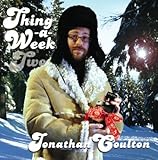
Coulton is something I’ve not encountered before: a humorous songwriter who actually has a great voice, and sings more than just humorous songs. For example, on the same album “Thing A Week Two” is the song “Flickr”. This is a beautiful tune that is a sort of stream of consciousness describing photos you’d see on Flickr – but perfectly rhyming and set to a tune that is as radio-friendly as any I’ve heard. On his web site, in the “wiki” section, he has a video for the song that has all the pictures in it that he sings about. This video should play on MTV… except, of course, that they don’t play music videos anymore.

Almost all of his songs have a catchy tune, a bouncy beat, and are fun to sing along with. On his album “Thing a Week Three”“, “Tom Cruise Crazy” and “Code Monkey” are two standouts that should also both become hits. “Code Monkey” will be instantly familiar to anyone who’s ever worked in a cubicle environment with computers, and “Tom Cruise Crazy” is just a damn good song all around.

You really have to listen to these songs to appreciate how incredibly good they are. Every one of them is impeccably written, with rhymes and hooks that are downright giddy. Coulton’s voice is a great folk-rock singing voice, evoking a 21st century combination of John Denver and Bruce Springsteen. I don’t know why he hasn’t had at least several Top 40 hits already. Or perhaps he has, and I am even more behind the times than I think I am.

There’s even a delightful cover of a Beatles song, “I Will”, to be found on “Thing A Week Two”. By the way, I was confused at first about why he has four volumes of “Thing A Week”. Well, as it turns out, when he got started as a full-time performer, he made himself write, record, and make available a new song every week for a year. Hence, “Thing A Week”. An admirable lesson to anyone who’s trying to start their own business, especially in a creative field.

RE: Your Brains” is still my favorite. This is a song from one co-worker to another – except that the guy singing the song is a zombie, and he’s trying to get his office mate to let him eat his brains (as zombies are wont to do):

Heya Tom, it’s Bob from the office down the hall
Good to see you buddy, how’ve you been?
Thing have been OK for me except that I’m a zombie now
I really wish you’d let us in

I think I speak for all of us when I say I understand
Why you folks might hesitate to submit to our demand
But here’s an FYI:
You’re all gonna die screaming

And then that fantastic refrain, in which an entire chorus of singing zombies joins along:

All we want to do is eat your brains
We’re not unreasonable, I mean, no one’s gonna eat your eyes
All we want to do is eat your brains
We’re at an impasse here, maybe we should compromise:
If you open up the doors
We’ll all come inside and eat your brains

I defy anyone not to sing along once you’ve heard this song. In less than 24 hours, this has become one of my favorite Car Songs. Play it loud, pound on the dashboard (traffic permitting), and shout along at the top of your lungs. It will put you in a great mood and really set the rest of your day in perspective, trust me.

So don’t wait for the undead to take control – head on over to Coulton’s web site (we Jonathans have to stick together, right?) and buy a few songs. Buy an entire album or two, they’re worth it. And all of his music is available as non-DRM’d MP3 tracks in high quality, which I heartily support and greatly admire. I already know I’ll be buying the rest of his music over the next few days, I just can’t resist. You can get his stuff on iTunes and Amazon as well, but why not buy them directly from the man who makes them?

Now come on, everybody! Gather ’round and sing along! All we want to do is eat your brains…